ZSP ETF guide. Cost, yield and top holdings in one place.
ZSP tracks the S&P 500, an index of large U.S. companies. See what it costs to hold each year, what it pays, what sits inside and how it has returned.
In Canadian dollars.
What ZSP is, in plain words.
ZSP tracks the S&P 500, an index of large U.S. companies. The fund is managed by BMO, trades on the Toronto Stock Exchange in Canadian dollars and launched on Nov 14, 2012. On Oct 30, 2026 it held C$24.91B in net assets and its MER was 0.09%. U.S. large-company exposure from BMO at a low MER.
Investors search for ZSP ETF because they want a clear answer to four practical questions. What does it cost to hold each year, what does it pay, what is actually inside, and how does it fit in a TFSA, an RRSP or a taxable account. This guide answers each one with dated figures from the issuer, and marks anything the issuer page does not publish as Not captured.
Key takeaways
- What it is. ZSP tracks the S&P 500, an index of large U.S. companies.
- Cost. MER 0.09%, about $9 a year on $10,000.
- Income. Trailing yield 0.82%, paid quarterly.
- Risk. Stock funds can fall sharply in a weak year.
It suits you if
- You want U.S. large company exposure in Canadian dollars.
- You already hold Canadian stocks and want to add the U.S. market.
- You are comfortable with technology having the largest weight.
Look elsewhere if
- You want Canada, Europe and emerging markets in the same fund.
- You want to avoid technology concentration.
- You want a hedge against currency moves.
What ZSP holds.
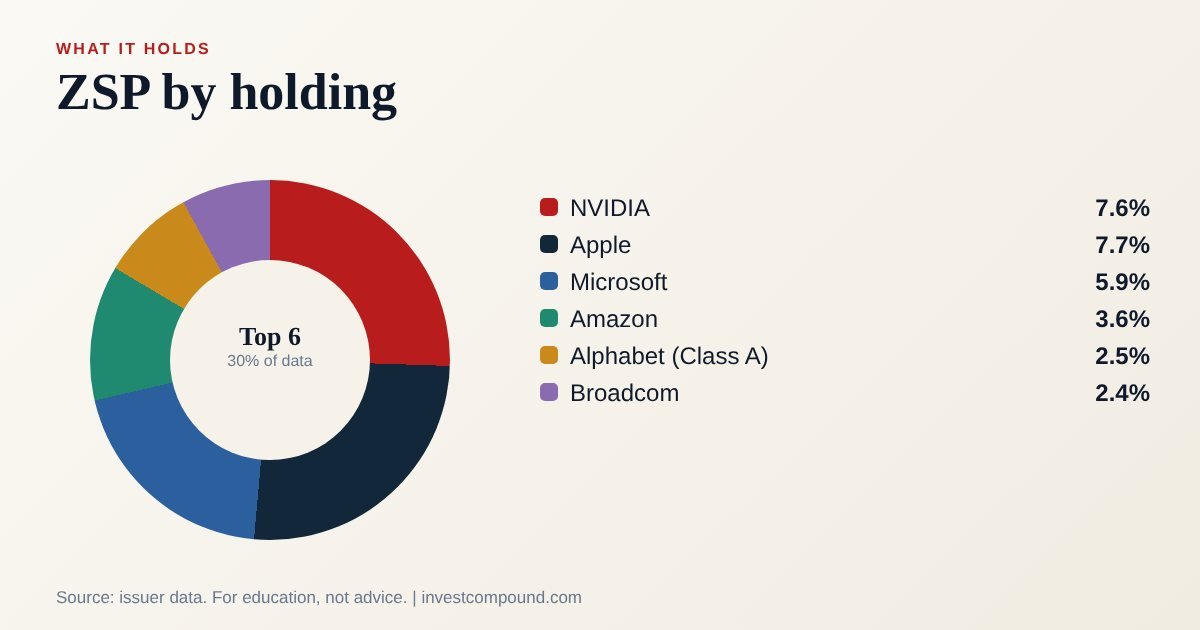
The 10 largest stock positions inside ZSP, as of Oct 30, 2026. Pick a number to see how much of the fund they make up.
The ten largest holdings and the sector split are shown below from the issuer page. The weights are concentrated in a small number of very large companies, so a handful of names can move the whole fund on a single day.
ZSP yield and distributions.
ZSP pays distributions as a quarterly payer according to the issuer. The yield shown on the issuer page was 0.82% dated Oct 30, 2026. The distribution log with exact dates and amounts was Not captured for this fund, so use the issuer page for payment dates.
A yield is a snapshot, not a promise. The payment moves with the dividends and interest the fund receives, and some years include capital gains or return of capital that do not repeat.
Every payment, and the year by year record.
The payment log and annual tax breakdown were Not captured for this fund, because the issuer data we use publishes them only as a downloadable file. The issuer page lists every payment date and amount.
What ZSP costs to hold each year.
The MER of 0.09% means the fund keeps about $9 a year for every $10,000 you hold. That cost is taken out of the fund price in small daily amounts, so you never see a bill, but it lowers your return every year. Over ten years on a flat $10,000 the MER adds up to roughly $90, before any growth.
Two other costs sit outside the MER. Trading commissions depend on your brokerage, and many Canadian brokerages now charge nothing to buy ETFs. Foreign withholding tax is paid inside the fund on dividends from outside Canada and shows up as a lower distribution rather than a fee.

MER cost at common amounts
| Amount held | Per month | Per year | Over 10 years, flat | Hypothetical 2.00% fund, per year |
|---|---|---|---|---|
| $1,000 | $0.07 | $0.90 | $9 | $20 |
| $5,000 | $0.38 | $4.50 | $45 | $100 |
| $10,000 | $0.75 | $9.00 | $90 | $200 |
| $25,000 | $1.88 | $22.50 | $225 | $500 |
| $50,000 | $3.75 | $45.00 | $450 | $1,000 |
| $100,000 | $7.50 | $90.00 | $900 | $2,000 |
| $250,000 | $18.75 | $225.00 | $2,250 | $5,000 |
Flat estimates at the current MER with no growth and no change in fee. Trading commissions depend on your brokerage and are not included. The 2.00% fund is a hypothetical used for scale.
Where the cost shows up
- Not as a bill. The unit price and returns are already lower by the MER.
- Foreign tax appears on your T3 or in a registered account as a lower distribution.
- In a taxable account, part of the foreign tax can be claimed as a credit.
MER cost calculator
Flat estimate at a MER of 0.09% with no growth and no change in fee. It shows scale only, not a forecast.
How ZSP has returned.
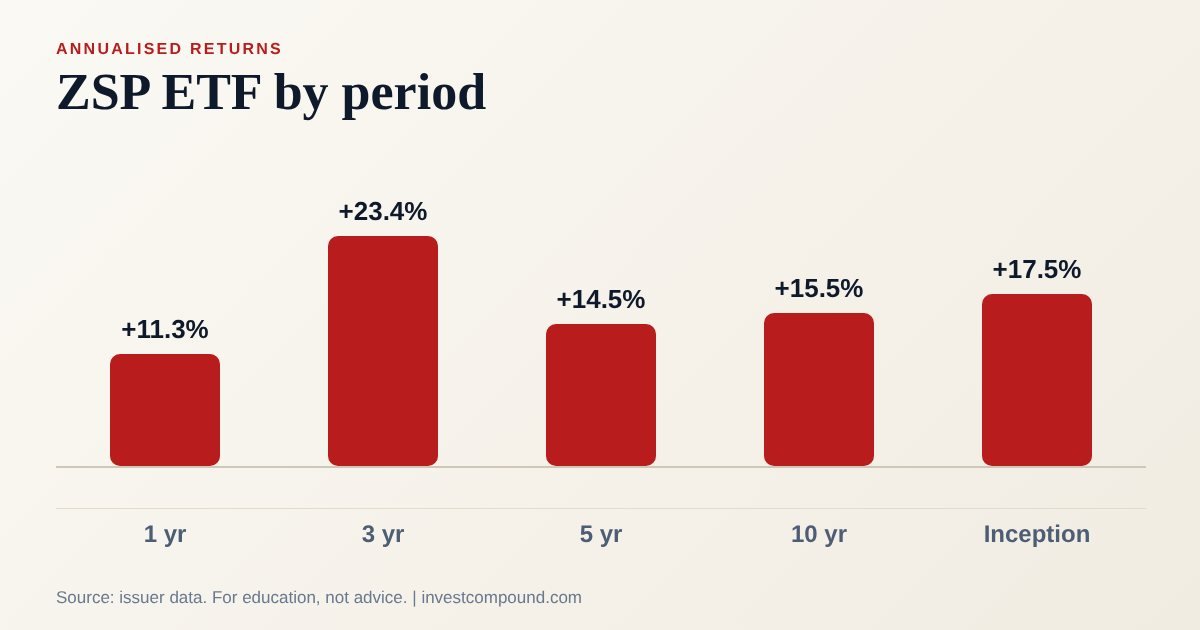
Calendar year returns were Not captured from the issuer page for this fund, so this guide shows the period returns the issuer publishes. Returns include fees. Past performance does not guarantee future results, and a single period tells you little about the next one.
Annualised NAV returns from the issuer, as of Oct 31, 2026. They include fees.
Past performance does not guarantee future results. Gaps are shown as Not captured because the issuer page did not publish that period.
ZSP fund facts in one place.
Every figure comes from the issuer for the date shown. A line reads Not captured when it is not published on the pages we use.
Where the companies are.
The country and sector tables were Not captured for this fund. See the issuer page for current exposure.
What the ride can look like.
ZSP can lose value, and the calendar year record shows the range so far.
- Market risk. The fund falls when U.S. stocks fall.
- Currency risk. The U.S. dollar exposure moves the Canadian dollar value of the fund.
- Concentration. A few very large technology companies carry a high share of the weight.
- Single country. Nothing outside the United States cushions a U.S. decline.
- Distribution risk. Payments change each period and are not guaranteed.
How investors use ZSP.
ZSP is most often used as the U.S. leg of a portfolio, next to a Canadian stock fund and sometimes an international fund. A buyer who adds a U.S. fund to a Canadian core is choosing to increase the share of the portfolio that depends on U.S. companies and the U.S. dollar. Because the largest holdings are very large technology firms, the fund can behave differently from the broad economy.
The fund trades in Canadian dollars, so you avoid the conversion fee that comes with buying a U.S. listed fund. Some investors still prefer a U.S. dollar version held in a registered account for tax reasons, which is a topic to check against your own situation.
Before buying ZSP, check four things on the issuer page. First, confirm the MER matches the figure on this page, since fees can change when an issuer cuts costs. Second, confirm the fund is eligible for the account you plan to use. Third, read the latest tax breakdown if you hold it in a taxable account. Fourth, look at the bid and ask spread on the day you trade, since a wide spread is a cost that the MER does not show.
Several comparable funds exist, with MERs of VFV at 0.08%, XUS at 0.09%, VUN at 0.16%, so the cost gap between them is small, and the choice often comes down to holdings, yield and the account you use.
No single fund is right for everyone, and this guide describes the product rather than recommending it. The figures come from the issuer and are dated. Distribution amounts, yields and holdings change, and past returns do not predict future returns. For a decision with large amounts of money, read the prospectus and the Fund Facts document, and consider speaking with a licensed adviser about your own situation.
ZSP against similar funds.
The same fund type from other issuers. Open a comparison for holdings overlap and returns.
| Fund | Issuer | MER | Net assets | Trailing yield |
|---|---|---|---|---|
| ZSP (this fund) | BMO | 0.09% | C$24.91B | 0.82% |
| VFV | Vanguard | 0.08% | C$35.91B | 0.86% |
| XUS | iShares | 0.09% | C$13.58B | 1.12% |
| VUN | Vanguard | 0.16% | C$20.07B | 0.79% |
ZSP is one of 20 funds in the Canadian ETFs category on this site, grouped here with VFV, XUS, VUN. Each comparison page lines up two funds on cost, holdings overlap, yield and returns, so you can see what separates them.
Where ZSP fits.
Distributions and gains inside a TFSA are not taxed, so the MER is the main drag you carry. ZSP units are eligible for registered plans according to the issuer. Foreign withholding tax paid inside the fund cannot be claimed back in a TFSA.
Tax is deferred until you withdraw, and the whole balance is taxed as income at that point. Foreign withholding tax that the fund pays on its holdings can reduce the payout in a registered account, so check the issuer tax documents.
Most of the distribution is foreign income from U.S. dividends, which is taxed at your full rate in a taxable account. The issuer publishes a breakdown after year end, and the amounts on your T3 slip are what count for your return. Part of the foreign tax can be claimed as a credit.
General education, not tax advice. Rules change, so confirm with the issuer tax documents or an adviser.
Buying ZSP in five steps.
- Pick the account. TFSA, RRSP or taxable. Registered plans can hold this fund.
- Search the ticker. Type ZSP in your brokerage and choose the TSX listing in Canadian dollars.
- Use a limit order. It sets the most you will pay and avoids surprises at the open.
- Check the cost. Many Canadian brokerages charge no commission on ETFs, and some charge a small fee per trade.
- Set a routine. Add money on a schedule and decide whether to reinvest distributions.
Terms used on this page.
Where to go next from ZSP.
Every ZSP link in one place. Start with the category, then the head to head comparisons, then the guides for other funds and the tools.
CategoryCanadian ETFsAll 20 Canadian funds, grouped by type, with a comparison page for every pair.Open the category →ZSP comparison pages 2
Guides for similar funds
More Canadian fund guides
Calculators for ZSP investors
Other ETF categories
Guides and research
Common questions about ZSP.
What is ZSP?
ZSP tracks the S&P 500, an index of large U.S. companies. It is managed by BMO, trades on the TSX in Canadian dollars and launched on Nov 14, 2012.
What is the MER of ZSP?
The MER of ZSP on the issuer page is 0.09%, or about $9 a year per $10,000 invested.
What is the ZSP dividend yield?
The issuer page showed a distribution yield of 0.82% on Oct 30, 2026 for ZSP. Yields change, so check the issuer page for the current figure.
How often does ZSP pay a dividend?
ZSP pays distributions as a quarterly payer. The payment log was Not captured for this fund.
What does ZSP hold?
ZSP holds 505. Its largest positions are NVIDIA, Apple, Microsoft.
Can I hold ZSP in a TFSA or RRSP?
Yes. The issuer lists ZSP as eligible for registered plans. Distributions inside a TFSA are not taxed, and an RRSP defers tax until withdrawal. Foreign withholding tax paid inside the fund can still reduce the payout, so keep the fund tax documents.
How has ZSP performed?
The issuer period returns are shown in the returns section. Returns include fees, and past performance does not guarantee future results.
ZSP or VFV, what is the difference?
The two funds do a similar job and differ in cost, issuer and holdings. ZSP has a MER of 0.09% and VFV has a MER of 0.08%. Open the VFV vs ZSP comparison for holdings overlap, yield and returns side by side.
Is ZSP hedged to the Canadian dollar?
Check the issuer page for the currency policy. The fund is priced in Canadian dollars, and unless the issuer states a hedge, the U.S. dollar exposure moves the Canadian dollar value of the units.
Source, BMO fund page. All figures are dated as shown. This guide is for education and is not personal advice or an offer to sell.