INVEST COMPOUND · ACADEMY
Asset Allocation Explained With Portfolio Examples
Asset allocation is the way you divide a portfolio among stocks, bonds, cash, and other investments. The right mix depends on your financial goals, time horizon, ability to withstand losses, and the amount of volatility you can realistically tolerate.
Asset allocation is the mix of stocks, bonds, cash, and other investments used to fund a financial goal. That mix is one of the main drivers of how much volatility and downside risk a portfolio can experience.
A portfolio intended for a home purchase next year should usually look very different from one intended to support retirement decades from now, even if both portfolios belong to the same investor.
Understanding asset allocation means deciding how much investment risk your money can reasonably take before selecting individual securities or funds.
What Is Asset Allocation?
Asset allocation is the process of dividing a portfolio among different categories of investments.
The major categories commonly include:
- Stocks: ownership interests in companies. Stocks can offer substantial long-term growth potential, but they can also experience large short-term declines.
- Bonds: debt securities with contractual payment terms. High-quality bonds may provide income and reduce some portfolio risks, but bond prices fluctuate and defaults are possible.
- Cash and cash equivalents: generally emphasize liquidity and lower price volatility. Bank deposits, Treasury bills, and money market funds are not legally identical and can have different protection and access characteristics.
- Other assets: some portfolios may also include real estate, REITs, commodities, or other investments.
The central purpose of asset allocation is not to predict which asset class will perform best next year. It is to build a mix whose potential return, liquidity, and risk characteristics fit the investor’s actual objectives.

Risk Tolerance Versus Risk Capacity
These concepts sound similar but measure different things.
Risk tolerance describes your emotional willingness to experience losses and volatility.
If your portfolio fell 30%, would you remain invested according to your plan, or would the decline cause you to abandon the strategy?
Risk capacity describes your financial ability to absorb a loss.
A young investor may have decades before retirement, but an upcoming home purchase, unstable income, debt obligations, or limited emergency savings can still reduce the amount of portfolio risk that is financially reasonable.
A sound asset allocation therefore needs to fit both your finances and your behaviour. A theoretically attractive portfolio is not useful if you cannot hold it through a difficult market.
Time Horizon: One of the Biggest Drivers
Time horizon is one of the most important inputs in portfolio design.
Money needed soon generally deserves greater stability and liquidity. Money that will not be needed for decades can often tolerate more short-term volatility.
Near-term money: consider whether accessible cash, insured deposits, Treasury bills, or other high-quality short-term instruments are more appropriate for an obligation with little timing flexibility.
A short-term bond fund is still an investment and can lose value. The word “short” does not mean principal is guaranteed.
Medium-term goals: investors may consider a mix that balances growth with greater stability.
Long, flexible horizons: portfolios often contain a larger equity allocation, while accepting that recovery from a severe decline can take years and is never guaranteed for an individual investment.
Asset Allocation Portfolio Examples
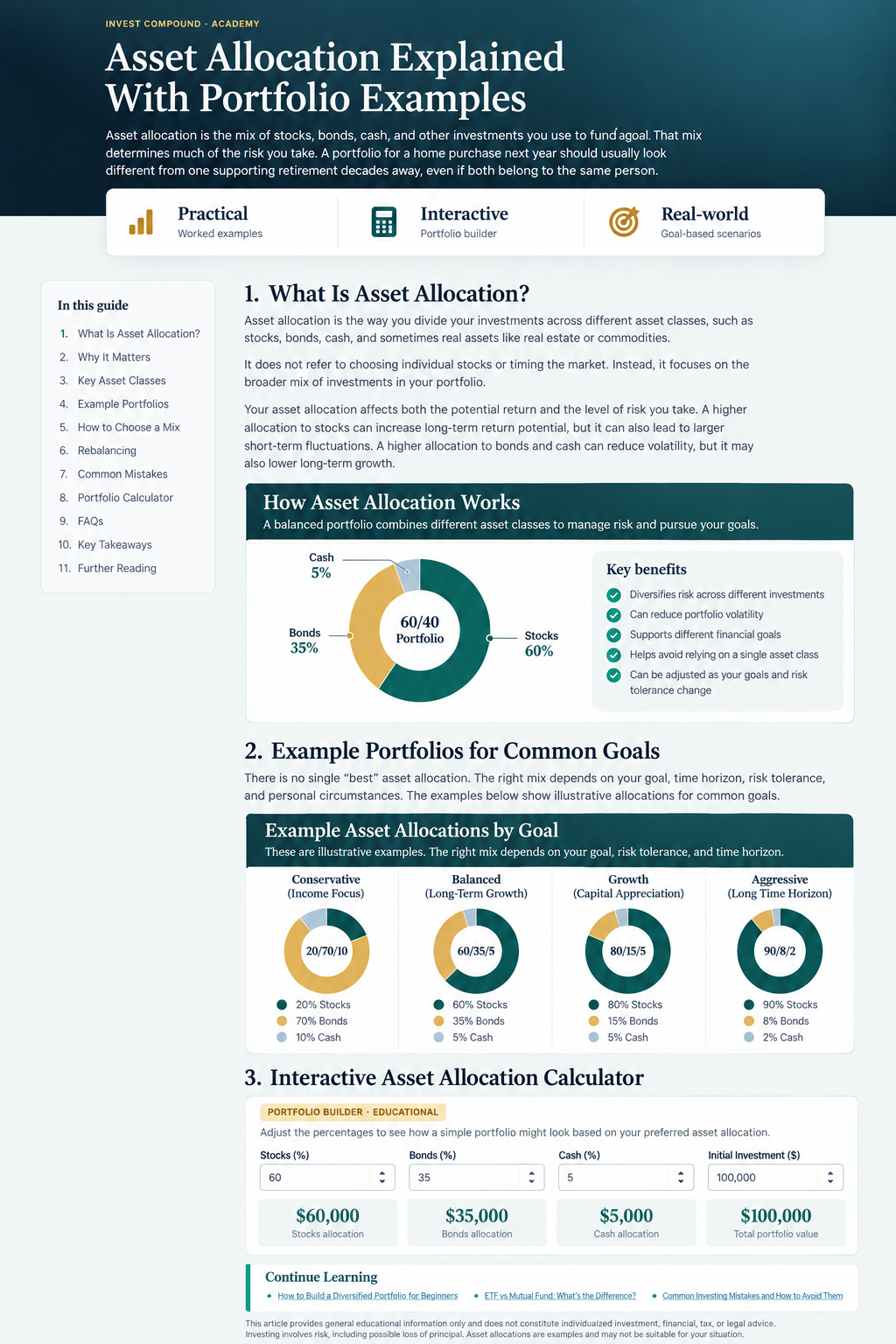
There is no universal portfolio that is appropriate for everyone. These examples illustrate how different mixes can change portfolio behaviour. They are not recommendations.
| Style | Stocks | Bonds | Cash | General Character |
|---|---|---|---|---|
| Conservative | 30% | 55% | 15% | Lower equity exposure and generally smaller market swings, with less long-term growth potential. |
| Balanced | 60% | 35% | 5% | A middle-ground allocation combining growth assets with bonds and a small cash position. |
| Growth | 80% | 15% | 5% | Greater equity exposure, higher expected volatility, and more long-term growth potential. |
| Aggressive | 90% | 8% | 2% | Very high equity exposure with potentially large gains and large losses. |
A traditional 60/40 stock-and-bond portfolio is often used as an example of balanced portfolio asset allocation, but stocks and bonds can still decline at the same time.
Diversification can reduce some risks. It does not eliminate investment losses.
Age-Based Asset Allocation Rules of Thumb
Investors sometimes use age-based shortcuts when thinking about asset allocation.
One traditional formula is:
100 minus your age = percentage held in stocks.
Under that rule, a 40-year-old would hold 60% in stocks.
More aggressive versions use 110 or 120 minus age.
These are only rough starting points. They ignore many important factors.
Someone with a stable pension, substantial emergency savings, and a flexible retirement date might reasonably accept more investment risk. Another person of the same age with unstable employment and major near-term obligations might need considerably more liquidity.
Age alone is not enough to determine an appropriate allocation.
A Worked Asset Allocation Example
Suppose an investor has $50,000 and chooses a hypothetical 70/30 asset allocation:
- $35,000 in stocks.
- $15,000 in bonds.
Assume stocks decline by 20% while bonds rise by 2%.
The stock portion falls from $35,000 to $28,000.
The bond portion rises from $15,000 to $15,300.
The portfolio ends at:
$43,300
That represents a hypothetical portfolio loss of approximately 13.4%.
An all-stock portfolio experiencing the same 20% equity decline would have fallen from $50,000 to $40,000.
The bonds did not prevent a loss. They reduced the size of the loss in this simplified example.
Loss size also affects the recovery required to return to the starting value. A 20% decline requires a 25% gain to recover. A 13.4% decline requires a smaller percentage gain.
Diversification Within Each Asset Class
Asset allocation is not simply a decision between stocks and bonds.
Within the stock portion, diversification may include exposure to:
- U.S. companies.
- Canadian companies.
- International developed markets.
- Emerging markets.
- Large companies.
- Smaller companies.
- Different economic sectors.
Within bonds, investors may hold different:
- Issuers.
- Credit qualities.
- Maturities.
- Durations.
- Currencies.
Broad, low-cost funds can sometimes provide significant diversification within one investment vehicle.
If you are building a portfolio with ETFs, see How to Build an ETF Portfolio .
When Should You Change Your Asset Allocation?
Good reasons to reconsider your allocation generally involve changes in your circumstances rather than changes in market headlines.
Examples include:
- Your retirement date is approaching.
- A home purchase or other major expense has moved closer.
- Your income has become less stable.
- You have taken on significant new debt.
- Your family obligations have changed.
- You discovered that your actual tolerance for losses is lower than expected.
A frightening headline, fashionable sector, or friend’s investment tip is usually not a sufficient reason to redesign a long-term portfolio.
Changing your target asset allocation and rebalancing back toward an existing target are two different decisions.
Match Asset Allocation to Expenses You Actually Expect
Asset allocation becomes more useful when each pool of money has a clearly defined job.
Suppose you need $30,000 for a down payment in 18 months and separately have $40,000 intended for retirement in 25 years.
Treating all $70,000 as one long-term growth portfolio can hide the fixed near-term obligation.
The down-payment portion may require much greater stability and liquidity. The retirement allocation can be evaluated using its much longer horizon and the investor’s capacity for loss.
A similar household might have:
- $90,000 for retirement.
- $18,000 for home repairs in 18 months.
- $12,000 for emergency reserves.
Treating the entire $120,000 as one aggressive portfolio would ignore the fact that $30,000 has a different purpose.
The ability to delay an expense also matters. A discretionary purchase may be postponed. An essential medical expense or closing payment may not be.
Translate Asset Allocation Into a Loss Scenario
Percentage allocations become easier to understand when translated into dollars.
Consider a hypothetical $100,000 portfolio with:
- 60% stocks.
- 30% bonds.
- 10% cash.
Assume stocks decline 35%, bonds decline 8%, and cash remains unchanged before interest.
Stocks fall from $60,000 to $39,000.
Bonds fall from $30,000 to $27,600.
Cash remains $10,000.
The portfolio becomes:
$76,600
That represents a hypothetical decline of 23.4%.
This is not a forecast and is not a worst-case limit. It is simply a way to turn an asset allocation into a more tangible risk scenario.
Also avoid assuming that bonds must rise whenever stocks fall. There can be periods when several asset classes decline together.
Consider Risks Outside the Brokerage Account
Portfolio risk does not exist in isolation.
Employment income, business ownership, real estate, pensions, debt, emergency savings, and other household exposures can affect the amount of investment risk that is reasonable.
Consider someone employed by an energy company who also owns company shares and holds a portfolio concentrated in energy funds.
A severe industry downturn could affect employment income and investments at the same time.
Similarly, a household whose home value, employment, and investment portfolio depend heavily on the same local economy may be less diversified than the brokerage statement suggests.
This does not mean every outside asset must be inserted into a precise percentage calculation.
A home is partly a place to live. A pension may have restrictions that make it very different from a tradable bond.
The useful question is how those exposures might behave under stress and whether they provide accessible cash when it is needed.
Debt matters too. A variable-rate loan can raise required household spending when interest rates rise.
An asset allocation that looks reasonable inside an investment account may need adjustment once household income, debt, and outside assets are considered.
Decide What Bonds and Cash Are Supposed to Do
Calling an investment a bond does not fully describe its risk.
Short government debt, long-duration government bonds, investment-grade corporate debt, lower-quality corporate debt, and foreign-currency bonds can behave very differently.
A high-yield bond fund can sometimes behave more like equities during periods of economic stress because credit risk becomes more important.
A long-duration bond fund can experience substantial price changes when market yields move.
If the bond allocation exists to fund a known expense, examine:
- Maturity.
- Credit quality.
- Currency.
- Liquidity.
- Duration.
If the bond allocation exists primarily to diversify long-term equity risk, examine whether the actual bond holdings are capable of serving that purpose.
Cash also needs a definition. A bank deposit, Treasury bill, and money market fund are not legally or economically identical.
If you want a deeper explanation, read How Bonds Work .
Write an Asset Allocation Policy
A short written policy can make an allocation easier to maintain.
It can include:
- Your target allocation.
- Acceptable percentage ranges.
- The purpose of each major holding.
- Your normal review frequency.
- Your rebalancing method.
- Life changes that would justify reconsidering the target allocation.
For example, an investor might review the portfolio twice each year and direct new contributions toward whichever asset class is below its target range.
A meaningful life event—such as reduced income, a new dependent, or a revised retirement date—might justify a broader review.
Separate a change in circumstances from a change in feelings caused by market headlines.
If an important goal has moved closer, reducing risk may make sense. If markets simply fell while your goals and finances remain unchanged, an immediate redesign may represent an emotional response rather than a planning improvement.
The purpose of asset allocation is to create a mix you can understand, finance, and maintain—not to predict the winning asset class every year.
Common Asset Allocation Mistakes
- Choosing an allocation primarily because one asset class performed well recently.
- Holding too much stock in your own employer.
- Ignoring near-term cash needs and being forced to sell investments during a market decline.
- Treating multiple overlapping ETFs as true diversification.
- Assuming bonds cannot lose money.
- Using an age formula without considering income, debt, pension benefits, or upcoming expenses.
- Changing the portfolio every time financial news becomes alarming.
- Never revisiting the allocation after major life changes.
Frequently Asked Questions About Asset Allocation
What is the best asset allocation?
There is no single best allocation for everyone. A reasonable allocation depends on your goals, time horizon, liquidity needs, financial capacity for loss, and ability to stay invested through volatility.
What is a 60/40 portfolio?
A traditional 60/40 portfolio generally refers to approximately 60% stocks and 40% bonds. It is often used as an educational example of a balanced portfolio, not as a universal recommendation.
Should bonds be in my portfolio when interest rates are high?
The answer depends on why the bonds are being held. Bonds can serve different purposes, including income, capital preservation, liability matching, and diversification.
Do young investors need cash?
Young investors can still need accessible cash for emergencies and near-term expenses. A long investment horizon does not eliminate short-term financial obligations.
How often should asset allocation be reviewed?
Many investors use a scheduled review—such as annually or semi-annually—rather than reacting to daily price movements. Major life changes can justify an earlier review.
Is asset allocation the same as diversification?
They are related but not identical. Asset allocation refers to how the portfolio is divided among broad asset categories. Diversification also considers how widely investments are spread within those categories.
Key Takeaways
- Asset allocation helps determine the overall risk profile of a portfolio.
- A suitable mix depends on both risk tolerance and financial risk capacity.
- Time horizon and the flexibility of future expenses matter.
- Stocks, bonds, and cash can all lose purchasing power or market value under different conditions.
- Diversification reduces dependence on a single exposure but does not eliminate investment risk.
- Household income, debt, property, pensions, and employment can affect how much portfolio risk is reasonable.
- An allocation policy can help prevent impulsive decisions during difficult markets.
- The goal of asset allocation is not to predict the next winning asset class. It is to build a portfolio you can use and maintain through changing conditions.
LEARNING LAB · HYPOTHETICAL
Asset Allocation Stress Test
Adjust the portfolio mix and hypothetical market returns to see how different asset allocations can affect the ending portfolio value.
Educational illustration only. Cash return is assumed to be 0% in this simplified calculation. Results exclude fees, taxes, inflation, currency effects, and other factors. Hypothetical scenarios are not forecasts.
Continue Learning in the Invest & Compound Academy
Explore related Academy guides to portfolio construction, market risk and investment fundamentals.
Portfolio construction and maintenance
Asset allocation | Build an ETF portfolio | ETF rebalancing | One-fund portfolios | Three-fund portfolio | Total market vs S and P 500 | Best ETFs for beginners
Sources and Further Reading
Asset allocation and diversification involve risk, and there is no allocation that guarantees a particular investment outcome.
- SEC Investor.gov – Asset Allocation and Diversification
- FINRA – Asset Allocation and Diversification