How Compound Interest Works
Follow the balance. Separate deposits from growth. Understand the assumptions.
How compound interest works is one of the essential concepts in saving and investing. Compounding occurs when interest or investment gains remain in an account and become part of the amount on which future returns are calculated.
The process can be powerful over long periods, but the result depends on the starting balance, contributions, rates of return, costs and time. A projection is not a promise of what investments will earn.
1. How Compound Interest Works: Start With the Balance
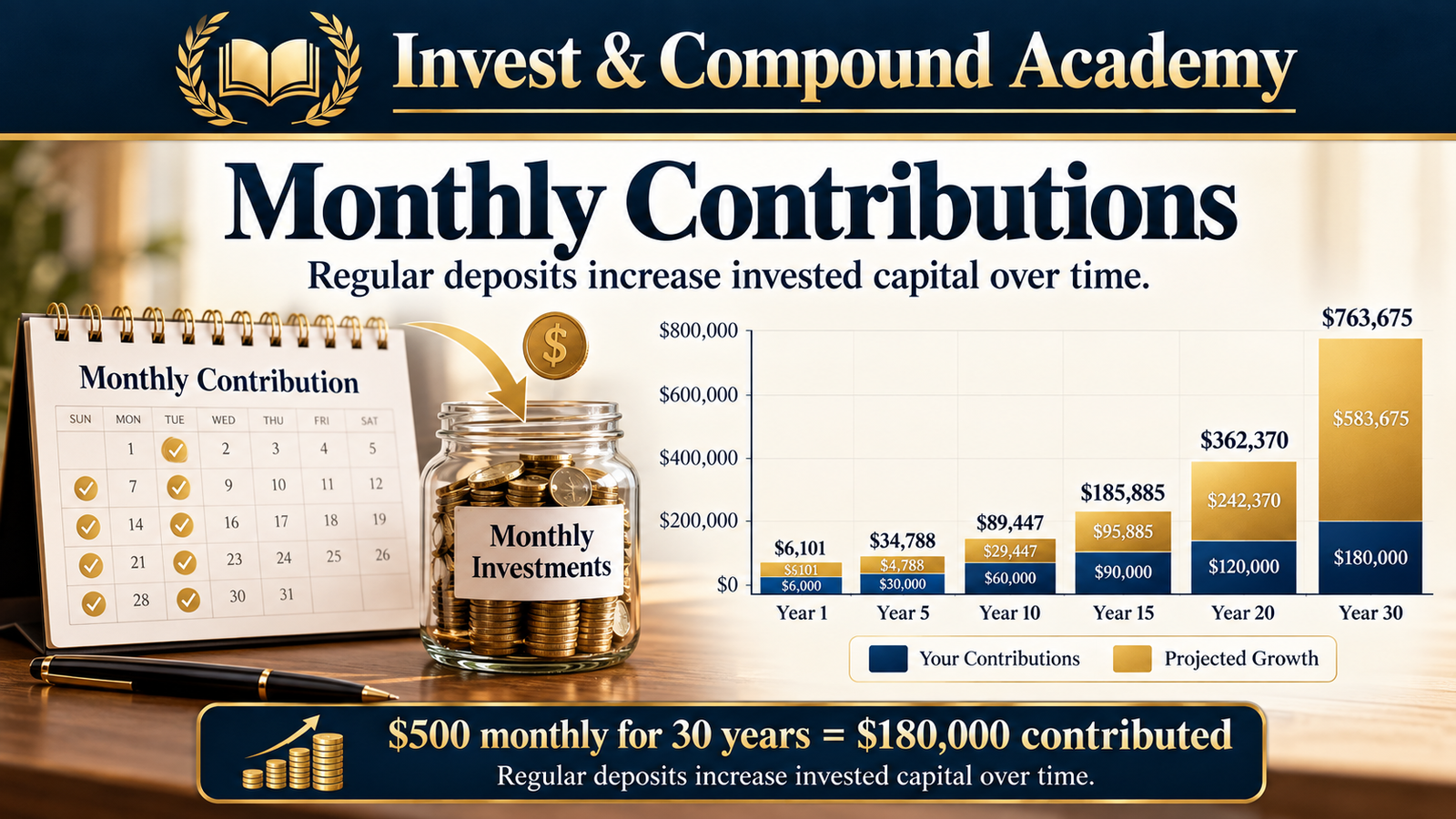
Imagine depositing $10,000 into an account earning a hypothetical 5% annually, with interest credited once a year. After the first year, the balance becomes $10,500.
In the second year, 5% applies to $10,500 rather than the original $10,000. Interest is now calculated on the principal and the $500 previously earned.
| Year | Starting balance | Interest at 5% | Ending balance |
|---|---|---|---|
| 1 | $10,000.00 | $500.00 | $10,500.00 |
| 2 | $10,500.00 | $525.00 | $11,025.00 |
| 3 | $11,025.00 | $551.25 | $11,576.25 |
Compound Interest vs Simple Interest
Simple interest is calculated on the original principal. If $10,000 earned 5% simple interest every year, the annual interest would remain $500.
Compound interest allows previously earned interest to increase the interest-bearing balance. Over three years, the compounded amount is $11,576.25, compared with $11,500 under the simplified simple-interest assumption.
The difference becomes more substantial with longer periods and higher positive rates. The same mathematics also explains why interest on unpaid debt can become increasingly expensive.
2. Use the Compound Interest Formula
For a fixed nominal annual interest rate compounded a specified number of times per year, the standard formula is:
A = P × (1 + r/n)nt
In this formula, A represents the ending balance, P is the starting principal, r is the nominal annual interest rate expressed as a decimal, n is the number of compounding periods per year, and t is time in years.
For example, a $10,000 balance earning a nominal 6% annual rate compounded monthly for ten years would use P = 10,000, r = 0.06, n = 12 and t = 10.
Deposit timing, withdrawals and changes in interest rates require additional calculations. The simple formula assumes a fixed rate and no additional cash flows.
Nominal Rates and Effective Annual Rates
A nominal annual interest rate does not fully describe the effect of compounding frequency. When an interest rate is quoted nominally, more frequent compounding increases the effective annual rate if all else is held constant.
For an annual nominal rate r compounded n times per year, the effective annual rate is:
EAR = (1 + r/n)n − 1
By contrast, investment return assumptions are often stated as effective annual returns. These should not automatically be treated as nominal rates compounded monthly. The growth calculator below converts an assumed effective annual return into a mathematically consistent monthly rate.
3. Give Compounding Time to Accumulate
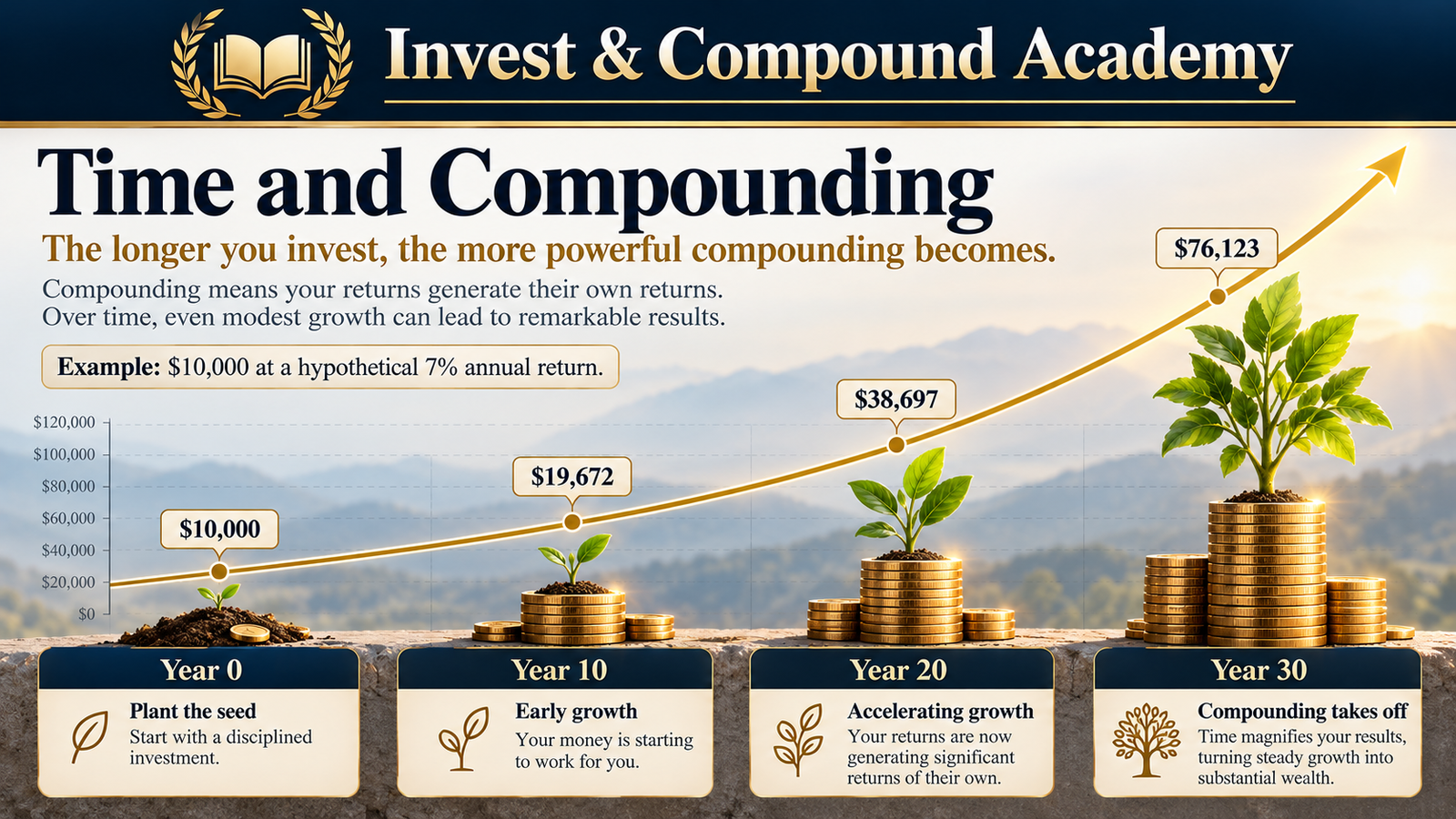
Compounding does not create the same amount of growth each year when the rate is positive. The underlying balance increases, so applying the same percentage produces larger dollar gains over time.
For example, a hypothetical $10,000 investment earning a constant 7% effective annual return would approximately double over ten years. Over 30 years, its balance would be more than seven times its starting amount.
These examples assume uninterrupted positive growth. Actual market investments experience losses as well as gains, so a constant annual growth rate is a modelling assumption rather than a realistic description of year-to-year returns.
An Early Start Can Change the Mathematics
Money contributed earlier generally has more time to compound, assuming positive returns. Two investors who contribute the same amount at different dates may finish with different balances because their money remains invested for different periods.
However, a longer investment horizon does not eliminate market risk. The final result also depends on the sequence of returns, fees, taxes, contribution timing and withdrawals.
4. Add Regular Contributions
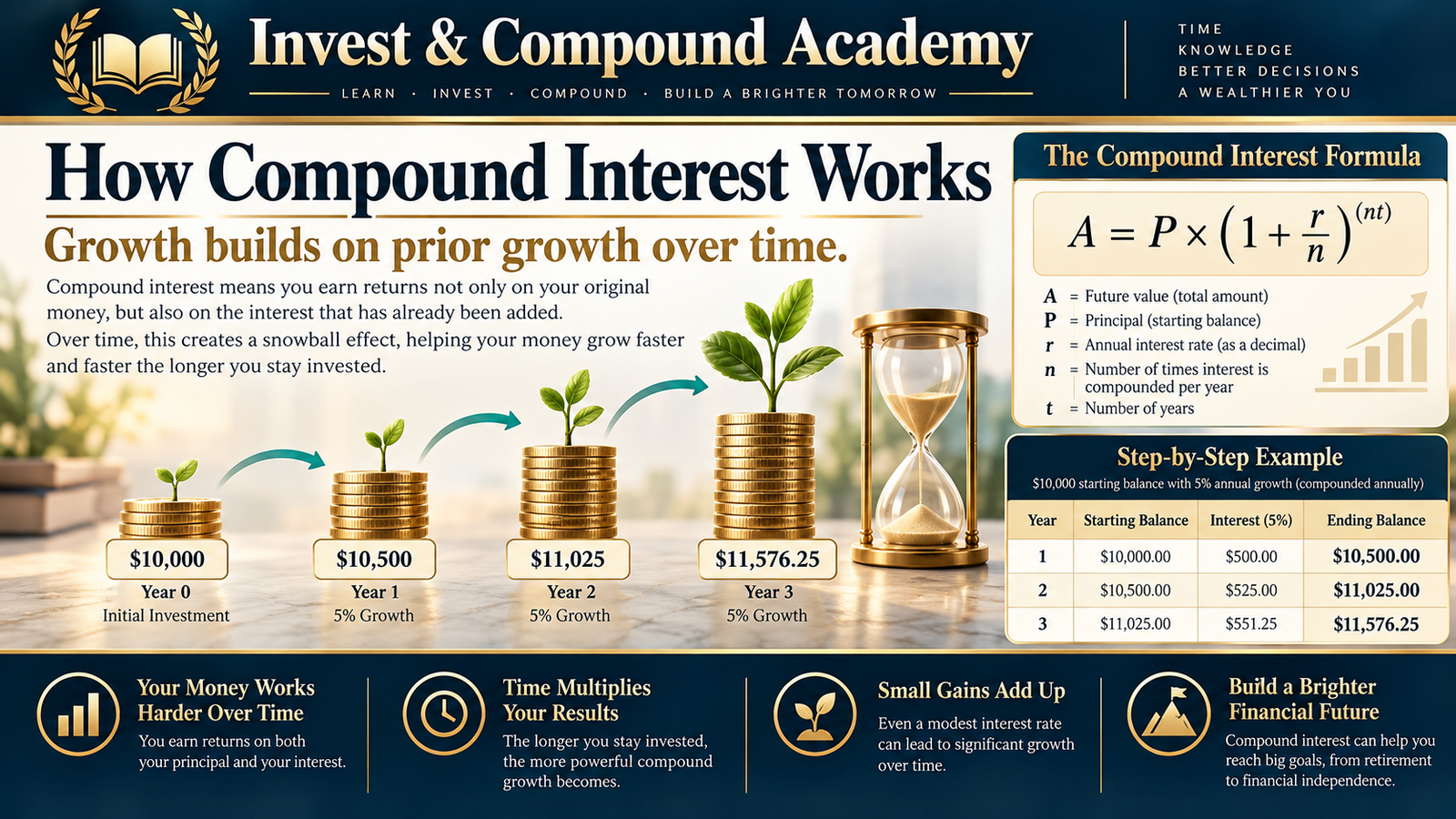
Regular contributions add new capital to a growing account. This is different from growth generated by the account’s existing balance.
If you contribute $500 monthly for 30 years, your contributions alone total $180,000. Any amount above your total deposits represents modelled investment growth, before adjustments for taxes, inflation and other excluded effects.
Separating deposits from returns is particularly important. A larger account balance can result from additional savings even when investment performance has been disappointing.
Compound Interest Calculator
Explore how the starting balance, monthly deposits, years and annual return affect a hypothetical investment outcome.
| Year | Total contributed | Modelled balance | Gain or loss |
|---|
Monthly deposits are assumed to occur at the end of each month. The entered annual return is treated as an effective annual rate and converted into an equivalent monthly rate. The model applies that same rate consistently, excluding taxes, fees and inflation.
5. Understand Reinvestment and Total Return
Compounding in a savings account usually means credited interest remains in the balance. For market investments, compounding is often used to describe the accumulation of investment returns over time, particularly when distributions are reinvested.
Stock and ETF returns are not guaranteed interest payments. Their market values fluctuate, and distributions may vary. Reinvested dividends can buy additional shares, which subsequently rise or fall in value.
When assessing an investment, examine total return rather than treating cash distributions as a separate guaranteed source of profit. A distribution can be accompanied by a decline in the investment’s market price.
Automatic Reinvestment Is Not Available Everywhere
Some accounts support dividend reinvestment plans or fractional purchases, while others require distributions to accumulate as cash until enough is available for a purchase.
Check the actual brokerage, account type and eligible securities. The presence of a distribution does not mean it will automatically compound.
Our Dividend Yield vs Total Return guide explains this relationship further.
6. Allow for Uneven Investment Returns
A smooth annual return is useful for illustrating mathematics, but actual investment returns vary. Markets can rise rapidly, fall sharply or remain weak for extended periods.
The arithmetic average of annual returns does not necessarily equal the compounded return experienced by an investor.
For example, a $10,000 portfolio gaining 20% rises to $12,000. A subsequent 20% decline reduces the balance to $9,600.
The arithmetic average of +20% and −20% is zero, but the cumulative compounded result is a 4% loss. The returns do not cancel because they apply to different balances.
Steady Growth
A constant positive return produces a smooth compounding illustration. It is useful for understanding the formula but does not represent typical market behaviour.
Uneven Returns
Alternating gains and losses can produce a different result from their arithmetic average.
Negative Returns
Compounding also works in reverse. Successive negative returns reduce the balance on which future changes occur.
Use Several Scenarios
Instead of making a financial plan depend on a single assumed return, consider lower, middle and higher hypothetical return paths. Identify which assumptions would cause the plan to fall short.
Scenario modelling helps clarify sensitivity. It does not assign probabilities or guarantee a particular outcome.
The Rule of 72 Is an Estimate
The Rule of 72 offers an approximate way to estimate the time needed for a balance to double at a positive annual return. Divide 72 by the return percentage.
At an assumed 6% annual return, the approximation gives 12 years. The actual result depends on the precise return and compounding convention.
Two Annual Returns: Average vs Compounded Result
Arithmetic Average vs Compounded Return
See why two annual percentages do not simply add together when measuring an investment’s ending value.
Formula: Ending value = starting value × (1 + year-one return) × (1 + year-two return), with percentages expressed as decimals. The compounded two-year return is based on the beginning and ending values and differs from the arithmetic average.
7. Account for Fees, Inflation and Taxes
Fees Reduce Future Growth
Investment expenses reduce the amount available to compound. Over a long horizon, even a relatively small annual expense difference can have a substantial effect on the ending value, assuming comparable investments and positive growth.
The relevant comparison includes ongoing fund costs, transaction charges and any account or advisory fees. Expenses should not be deducted twice if the return assumption already reflects them.
Inflation Changes Purchasing Power
A growing nominal account balance does not necessarily mean purchasing power grows at the same rate. Inflation reduces what a given amount of money can buy.
Real returns reflect growth after accounting for inflation. A simplified relationship between nominal and real returns is:
Real return = (1 + nominal return) ÷ (1 + inflation rate) − 1.
This relationship is more accurate than simply subtracting the inflation percentage, especially when rates are large.
Taxes Depend on the Account
Interest, dividends, gains and fund distributions can have different tax treatment depending on the investment, jurisdiction and account.
Registered and tax-advantaged accounts can change when taxes apply, although they may have contribution limits, withdrawal restrictions or other rules.
A useful projection should identify whether the assumed return is before or after fees and taxes, and whether its balances are expressed in nominal or inflation-adjusted dollars.
Common Questions About Compound Interest
Can compound interest make a small investment grow?
Yes, a small balance can accumulate growth over time when returns remain invested. The eventual result depends on the rate, period, contributions and costs. Market investments can also experience losses.
Does compound interest work without monthly deposits?
Yes. A starting balance can compound without additional contributions. Deposits increase invested capital but are not required for the mathematics of compounding.
Does compounding always mean positive returns?
No. Repeated negative investment returns also compound. A portfolio can lose money even over a long period.
What is the difference between simple and compound interest?
Simple interest is calculated on the original principal. Compound interest is calculated on a balance that includes previously credited interest.
Why do calculators use different compounding results?
Calculators can use different assumptions about nominal and effective rates, contribution timing, compounding frequency, taxes and costs. Compare those assumptions before comparing results.
References & Official Data Sources
The following investor-education resources provide additional information about compound growth, expenses and investment returns. Numerical scenarios in this article are hypothetical.


