INVEST COMPOUND · ACADEMY
How Interest Rates Affect Stocks and Valuations
To understand how interest rates affect stocks, follow the effects through corporate financing costs, consumer demand, investor alternatives, expected earnings, and the valuation of future cash flows.
Understanding how interest rates affect stocks requires more than remembering that higher rates are “bad” and lower rates are “good.” Interest rates influence corporate borrowing costs, household spending, investment alternatives, earnings expectations, and the return investors require for owning risky assets.
Those forces can move in different directions at the same time. A central-bank rate cut can support valuations while also signaling that economic growth is weakening. A rate increase can pressure highly indebted companies while having a much smaller immediate effect on cash-rich businesses with long-term fixed-rate debt.
That is why the relationship between interest rates and the stock market is powerful but never mechanical.
How Interest Rates Affect Stocks: The Essentials
Central banks such as the U.S. Federal Reserve and the Bank of Canada influence short-term interest rates through monetary policy.
Those policy rates help shape broader financial conditions, including business borrowing rates, consumer credit, deposit yields, bond yields, and the discount rates investors use when valuing future cash flows.
When rates rise, borrowing generally becomes more expensive. Savers may earn more on deposits and high-quality fixed-income investments, while companies and households carrying variable-rate or newly refinanced debt may face higher payments.
When rates fall, financing can become cheaper. But the economic reason for the rate cut matters. If rates are falling because a recession is developing, weaker earnings can offset some of the valuation benefit.
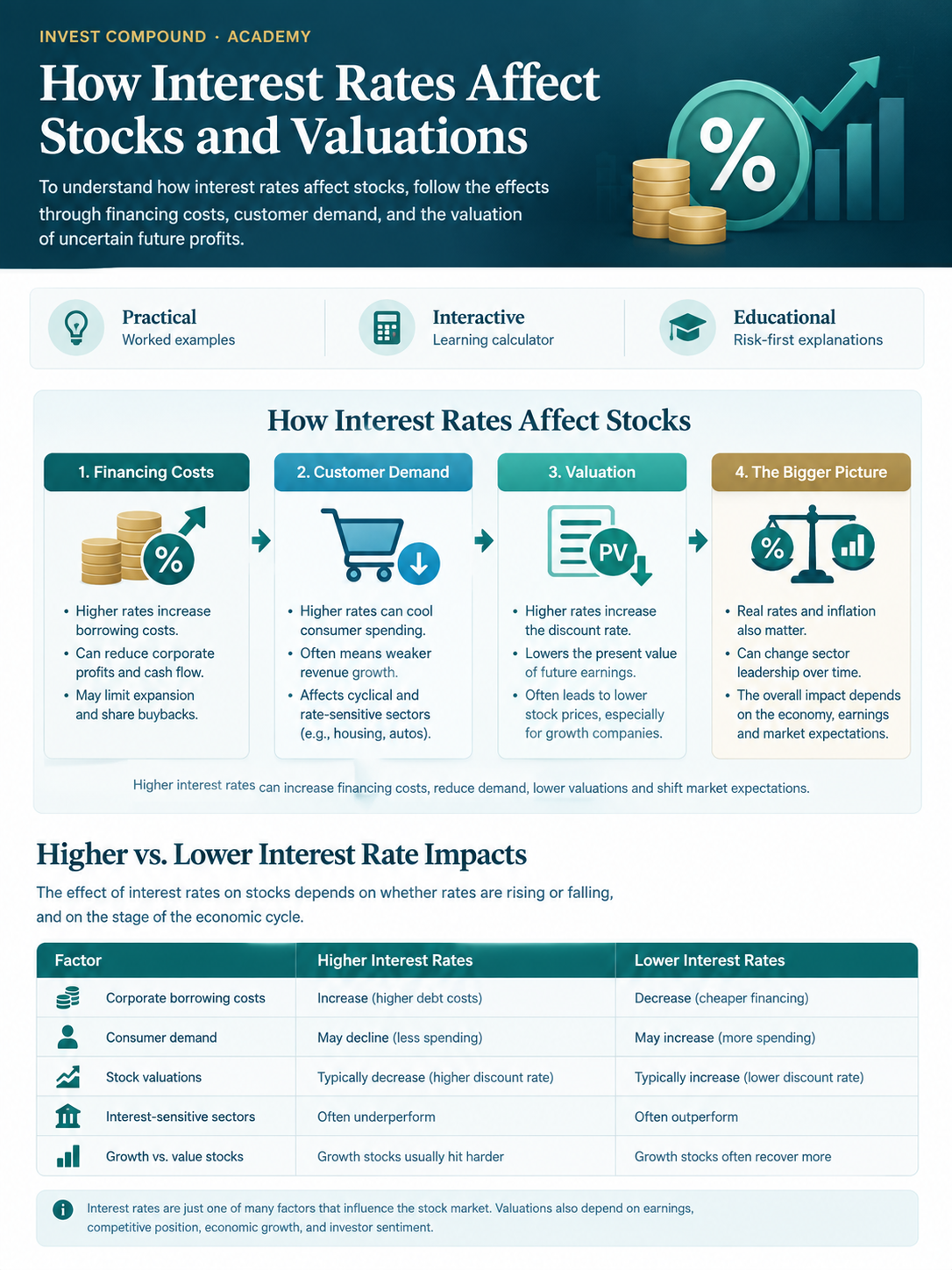
Four Main Ways Interest Rates Affect Stocks
The clearest way to understand how interest rates affect stocks is to separate the process into several channels.
How Interest Rates Affect Stock Valuations
Valuation connects expected future cash flows with the return an investor requires today.
A dollar expected ten years from now is worth less today than a dollar available immediately because today’s dollar can be invested and because future payments involve uncertainty.
The rate used to translate future cash flows into today’s value is commonly called a discount rate.
As the discount rate rises, the present value of a future payment falls, all else equal.
Imagine a hypothetical $100 payment received ten years from now.
- Discounted at 5%, its present value is approximately $61.39.
- Discounted at 8%, its present value falls to approximately $46.32.
The future $100 payment did not change. The required return changed. That alone produced a substantial difference in today’s estimated value.
Stocks are more complicated than a single fixed payment. Future earnings are uncertain, businesses can grow or shrink, companies can issue or repurchase shares, and investor risk premiums change over time.
The equity discount rate is also not simply the Federal Reserve’s or Bank of Canada’s policy rate.
Investors generally require additional compensation for business risk, economic uncertainty, financial leverage, and other risks.
Nevertheless, the present-value mechanism explains why higher interest rates can reduce stock valuations even when near-term earnings have not yet changed.
Which Stocks Are Most Sensitive to Interest Rates?
Rate sensitivity varies substantially across companies.
Growth Stocks
High-growth companies can be particularly sensitive when much of their expected profit lies years in the future.
Because distant cash flows are more sensitive to changes in the discount rate, an increase in required returns can cause a large change in the valuation investors are willing to assign today.
Highly Leveraged Companies
Businesses with significant debt can face higher financing costs when debt matures or floating-rate borrowing resets.
The effect depends on the company’s maturity schedule, contractual interest rates, cash balance, and ability to generate operating cash flow.
Real Estate and REITs
Real estate businesses frequently rely on debt financing. Higher borrowing costs can affect acquisitions, development economics, property valuations, and refinancing.
Utilities
Utilities often operate capital-intensive businesses and may use significant debt. Their dividend characteristics can also cause some investors to compare them with fixed-income alternatives when bond yields change.
Banks and Financial Companies
Banks have a more complicated relationship with interest rates.
Higher rates may improve certain lending spreads, but rapid rate changes can also increase deposit costs, reduce loan demand, create credit losses, or affect the market value of fixed-income assets.
A simple rule that “higher rates help banks” can therefore be misleading.
Why Expectations Matter More Than the Headline
Financial markets are forward-looking.
By the time a central bank formally announces an interest-rate decision, investors may already have incorporated much of the expected move into stock and bond prices.
What can move markets sharply is the difference between what investors expected and what actually happened.
For example:
- A larger rate increase than investors expected.
- A rate cut when no cut had been expected.
- Updated economic projections.
- A change in central-bank guidance.
- A shift in inflation or growth expectations.
This is why an unchanged policy rate can sometimes trigger a large market move while an actual rate cut generates only a modest reaction.
The decision itself is only one piece of information.
Interest Rates Are a Symptom as Well as a Cause
Interest rates do not change in an economic vacuum.
Central banks commonly raise rates when inflation is too high or when demand is stronger than policymakers consider sustainable. They may cut rates when inflation pressure declines, growth weakens, financial conditions tighten, or economic risks increase.
That means a rate cut can represent very different environments.
A Supportive or “Soft-Landing” Cut
Inflation may be cooling while economic activity remains reasonably resilient. Lower rates may then reduce financial pressure while corporate earnings remain relatively healthy.
A Recessionary Cut
Central banks may also cut because unemployment is rising, credit conditions are deteriorating, or economic activity is contracting.
In that environment, declining earnings can outweigh the benefit of a lower discount rate.
Examine When Higher Rates Actually Reach a Business
A policy-rate increase does not affect every corporate borrower at the same time.
A company with fixed-rate debt maturing eight years from now may feel little immediate increase in contractual interest expense.
Another company with floating-rate borrowing or large debt maturities next quarter can feel the change much sooner.
Imagine two fictional manufacturers with the same sales, operating profit, and $50 million of debt.
Company A borrowed at a fixed 3% rate for several more years.
Company B has financing that resets with short-term market rates.
If Company B’s borrowing rate increases from 3% to 6%, annual interest expense on $50 million would rise from approximately $1.5 million to $3 million, before considering repayments or other contractual terms.
Company A may not experience the same immediate increase.
However, both share prices can still react to higher market rates.
Even if Company A’s interest expense remains fixed today, investors may require a higher return on its shares, reducing the valuation multiple they are willing to pay.
Customer behaviour matters too.
If both companies sell products normally financed with loans, higher customer borrowing costs can reduce demand before either company’s own debt needs to be refinanced.
To understand how interest rates affect a particular stock, examine the entire business model rather than simply looking at the sector name.
Separate the Earnings Channel From the Valuation Channel
A company can report stronger earnings while its stock price declines.
This can happen when investors become unwilling to pay the same valuation multiple for those earnings.
Suppose a company earns $4 per share and trades at 25 times earnings.
Implied share price: $4 × 25 = $100
Now suppose earnings increase 10% to $4.40 per share, but the market valuation falls to 20 times earnings.
New implied price: $4.40 × 20 = $88
Earnings improved, but the hypothetical stock price declined by 12% because the valuation multiple contracted.
The reverse is also possible.
Lower required returns can support higher valuation multiples, but deteriorating earnings may offset or overwhelm that benefit.
This is why statements such as “rate cuts are bullish for stocks” are incomplete.
A better analysis separates:
- Changes in operating earnings.
- Changes in interest expense.
- Changes in expected future growth.
- Changes in the valuation multiple or discount rate.
A High-Dividend Stock Is Still an Equity Investment
Rising interest rates can cause investors to compare dividend-paying stocks with bonds, Treasury securities, and bank deposits.
But the risks are not equivalent.
A corporate dividend is generally not a guaranteed payment. A company can reduce or eliminate its dividend, and the stock price can decline substantially.
Imagine a fictional stock paying $3 per year and trading at $60.
Dividend yield: 5%
If the stock falls to $50 while the dividend remains $3, its quoted dividend yield becomes: 6%
The higher yield does not mean the existing shareholder suddenly earned more income. The cash distribution remained $3 while the market value of the investment declined.
Comparing dividend stocks with fixed-income alternatives therefore requires consideration of total return, capital risk, cash-flow reliability, taxes, liquidity, and inflation—not yield alone.
Make Your Household Interest-Rate Exposure Visible
Interest rates affect investors outside their brokerage accounts too.
Consider:
- Mortgage or loan renewal dates.
- Variable-rate debt.
- Credit-card balances.
- Accessible savings.
- Emergency reserves.
- Employment exposure to rate-sensitive industries.
- Portfolio concentration.
A homeowner whose mortgage renews soon can experience higher household payments at the same time that rate-sensitive investments decline.
Someone with no debt and significant cash savings may instead benefit from higher deposit yields.
The same central-bank decision can therefore have very different consequences for two households.
If an additional $300 monthly payment would eliminate your ability to save or meet other obligations, household cash-flow resilience deserves attention before making additional speculative investments.
Asset allocation can help place these risks in a broader portfolio context. See Asset Allocation Explained With Portfolio Examples .
What Can a Long-Term Investor Do?
Understanding how interest rates affect stocks is more useful as an analytical framework than as a short-term trading signal.
Practical steps include:
- Diversify. Avoid making your financial outcome dependent on one sector, company, or rate scenario.
- Review corporate debt. Look at maturity schedules, fixed versus floating borrowing, interest coverage, and refinancing requirements.
- Separate earnings from valuation. A good business can still be a poor investment at an excessive price.
- Maintain adequate liquidity. Emergency money should not depend on selling stocks at a favourable market price.
- Use higher safe yields intelligently. Higher rates may improve the return available on cash and fixed-income assets appropriate for shorter-term needs.
- Avoid trading solely around central-bank meetings. Markets react to expectations, guidance, economic data, and many variables that cannot be reliably predicted.
If you want to understand the bond side of this relationship, see Why Bond Prices Fall When Interest Rates Rise and How Bonds Work .
Common Interest-Rate Investing Mistakes
- Selling an entire portfolio because a Federal Reserve or Bank of Canada meeting is approaching.
- Assuming every rate cut must cause stocks to rise.
- Assuming every rate increase must cause stocks to fall.
- Ignoring what the market had already expected.
- Looking at a company’s sector but ignoring its debt maturity schedule.
- Treating a high dividend yield as equivalent to a guaranteed deposit or bond yield.
- Ignoring how changing rates affect your own mortgage, loans, savings, and employment.
- Attributing every stock-price movement to interest rates while overlooking earnings, competition, regulation, or company-specific developments.
Frequently Asked Questions About Interest Rates and Stocks
How do interest rates affect stocks?
Interest rates can affect stocks through corporate financing costs, consumer demand, competition from safer investments, earnings expectations, and the discount rate investors apply to future cash flows.
Why can higher interest rates hurt stock valuations?
Higher required returns reduce the present value of otherwise unchanged future cash flows. Higher rates can also increase corporate borrowing costs and slow economic demand.
Why are growth stocks sensitive to interest rates?
A large portion of a growth company’s estimated value may depend on profits expected far in the future. Distant cash flows are more sensitive to changes in the discount rate used to value them today.
Do falling interest rates always help stocks?
No. Lower rates can support valuations and reduce financing costs, but rate cuts can also occur because economic growth is weakening. Deteriorating earnings may offset the benefit of lower rates.
Why can stocks fall after good economic news?
Strong economic data can sometimes increase expectations that interest rates will remain higher for longer. If investors had expected earlier rate cuts, stock valuations may adjust even though the economic report itself appears positive.
Is the Federal Reserve rate the same as a mortgage rate?
No. Central banks directly influence short-term policy rates. Mortgage rates are influenced by longer-term bond-market conditions, inflation expectations, credit risk, lender margins, and other factors, so they do not necessarily move point-for-point with the policy rate.
Should investors change their portfolio every time rates change?
Not necessarily. A rate decision should be considered in the context of the investor’s goals, time horizon, asset allocation, company-specific exposures, and liquidity needs rather than automatically triggering a trade.
Key Takeaways
- Interest rates affect stocks through financing costs, household spending, investment alternatives, earnings, and valuation.
- Higher discount rates can reduce the present value of future cash flows even when the cash-flow forecast itself has not changed.
- Growth companies and businesses with substantial financing needs can be particularly rate-sensitive.
- Fixed-rate and floating-rate borrowers can experience the same interest-rate environment very differently.
- Market reactions depend heavily on expectations. A policy decision matters relative to what investors had already priced in.
- Rate cuts do not automatically mean rising stocks because they may accompany deteriorating economic conditions.
- Dividend stocks remain equity investments and should not be treated as substitutes for guaranteed deposits.
- Household debt and income exposure should be considered alongside portfolio risk.
- Understanding how interest rates affect stocks can improve investment analysis, but it does not create a reliable short-term market-timing system.
LEARNING LAB · HYPOTHETICAL
Interest Rate and Present Value Calculator
See how changing the discount rate affects the present value of a hypothetical future cash flow.
Educational illustration only. This calculator discounts one hypothetical future payment and is not a stock-valuation model. Actual stock valuation involves uncertain future cash flows, changing growth assumptions, risk premiums, taxes, capital structure, and many other factors.
Continue Learning in the Invest & Compound Academy
Explore related guides on market mechanics, bond yields, portfolio construction, and stock valuation.
Bonds, rates and fixed income
How bonds work | Bond prices and rates | Bond yield | Government vs corporate | Bond ETFs vs bonds | Bond ladders | Best bond ETFs
Sources and Further Reading
- Federal Reserve – Monetary Policy
- Bank of Canada – Monetary Policy
- SEC Investor.gov – Investor Education