Robo-Advisor vs DIY Investing and Financial Advice
Compare the work, support and total costs—with practical fee examples and two calculators.
A robo-advisor vs DIY investing comparison starts with a practical question: which jobs do you want to do yourself, and which are you paying someone else to handle?
Choosing funds, maintaining an allocation and building a retirement income plan are different tasks. An automated portfolio can handle routine implementation without providing comprehensive financial planning. A human adviser may provide that planning—or offer a narrower service. The written agreement matters more than the label.
This guide compares responsibilities, costs and support. The examples use hypothetical fees, not current provider quotes, and do not assume that every service delivers the same value.
Robo-Advisor vs DIY Investing: What Changes?
| Route | Typical responsibility | What to confirm |
|---|---|---|
| DIY investing | You choose and maintain the portfolio, sometimes using an all-in-one fund. | Your ability to manage decisions, records and risk consistently. |
| Robo-advisor | The provider implements an investment approach using the information you supply. | Investment options, rebalancing, human access and services included. |
| Human advice | A professional provides the advice or management specified in the engagement. | Planning scope, qualifications, compensation, conflicts and legal duties. |
These routes can overlap. Some automated providers offer access to advisers, and some investors hire a planner while keeping a self-directed account. Compare the actual arrangement rather than assuming three distinct price or service tiers.
DIY Investing: Control Comes With Work
With a self-directed brokerage account, you decide what to buy, when to contribute and how to maintain the portfolio. You also need to understand the account rules, keep appropriate records and avoid changing the plan simply because markets become uncomfortable.
DIY can reduce explicit management charges. It is not automatically the cheapest outcome: expensive products, frequent trading, currency conversion and poor decisions can outweigh the absence of an advisory bill. A hypothetical 0.20% annual fund expense on a $100,000 average balance represents roughly $200. Trading spreads and other account charges are separate.
An all-in-one fund can simplify implementation. Target-date funds generally adjust their mix along a stated glide path; many Canadian asset-allocation ETFs maintain a specified allocation. Check the actual product documents. Internal rebalancing does not turn a fund into a personal financial plan.
- Useful strengths: control over implementation, potentially low costs and flexibility.
- Work retained: choosing an appropriate mix, monitoring changes, managing account records and deciding when specialist help is needed.
Our guide to building an ETF portfolio covers construction. Here, the question is who remains responsible for maintaining and reviewing it.
Robo-Advisors: Understand What Is Automated
A robo-advisor generally uses information about your goals, finances, time horizon and risk tolerance to recommend and manage investments. Rebalancing, cash investment and other features depend on the provider. Some services also offer tax-loss harvesting or access to a professional; neither should be assumed.
Check whether human support means technical help with the app or investment guidance from a qualified person. Ask how that access works, whether it requires a particular account balance and which planning questions are covered. The SEC’s robo-adviser bulletin explains why service scope and the information collected deserve scrutiny.
Automation follows its inputs. A questionnaire cannot consider an upcoming property purchase, unstable income or outside account if the relevant information is missing. Update your details when circumstances change, and ask how the provider handles unusual situations.
Where tax-loss harvesting is available, its usefulness depends on tax circumstances and activity outside the platform. Transactions in other accounts can affect the result. Confirm the applicable local rules rather than treating the feature as guaranteed savings.
Human Financial Advice: Define the Engagement
A human professional may help with retirement withdrawals, pensions, insurance, estate coordination, business ownership or cross-border issues. Those services are not automatically included in portfolio management. Tax coordination also does not necessarily include preparing a tax return, and discussing an estate plan does not replace legal drafting.
Compensation can include asset-based charges, hourly fees, project fees, commissions or a combination. Ask for both the dollar cost and the work included. “Fee-only” describes a compensation arrangement; it does not establish every service, qualification or legal duty.
Verify the person and firm through the relevant official databases. U.S. investment advisers and broker-dealers operate under different frameworks; a firm may offer both kinds of relationships. In Canada, check registration and permitted activities through the appropriate regulator. A title or polished website is not a substitute for these checks.
The Financial Consumer Agency of Canada’s guide offers questions about qualifications, services and payment. Ask who will actually do the work and which issues require a separate accountant, lawyer or other specialist.
Annual Costs: A $250,000 Worked Example
Convert percentage fees into dollars before comparing providers. Suppose a US$250,000 balance remains unchanged for a year. The following examples separate service charges from estimated fund expenses.
| Example | Service fee | Fund expenses | Combined estimate |
|---|---|---|---|
| DIY portfolio | 0% = $0 | 0.20% = $500 | $500 |
| Automated service | 0.40% = $1,000 | 0.15% = $375 | $1,375 |
| Human-advice arrangement | 1.00% = $2,500 | 0.20% = $500 | $3,000 |
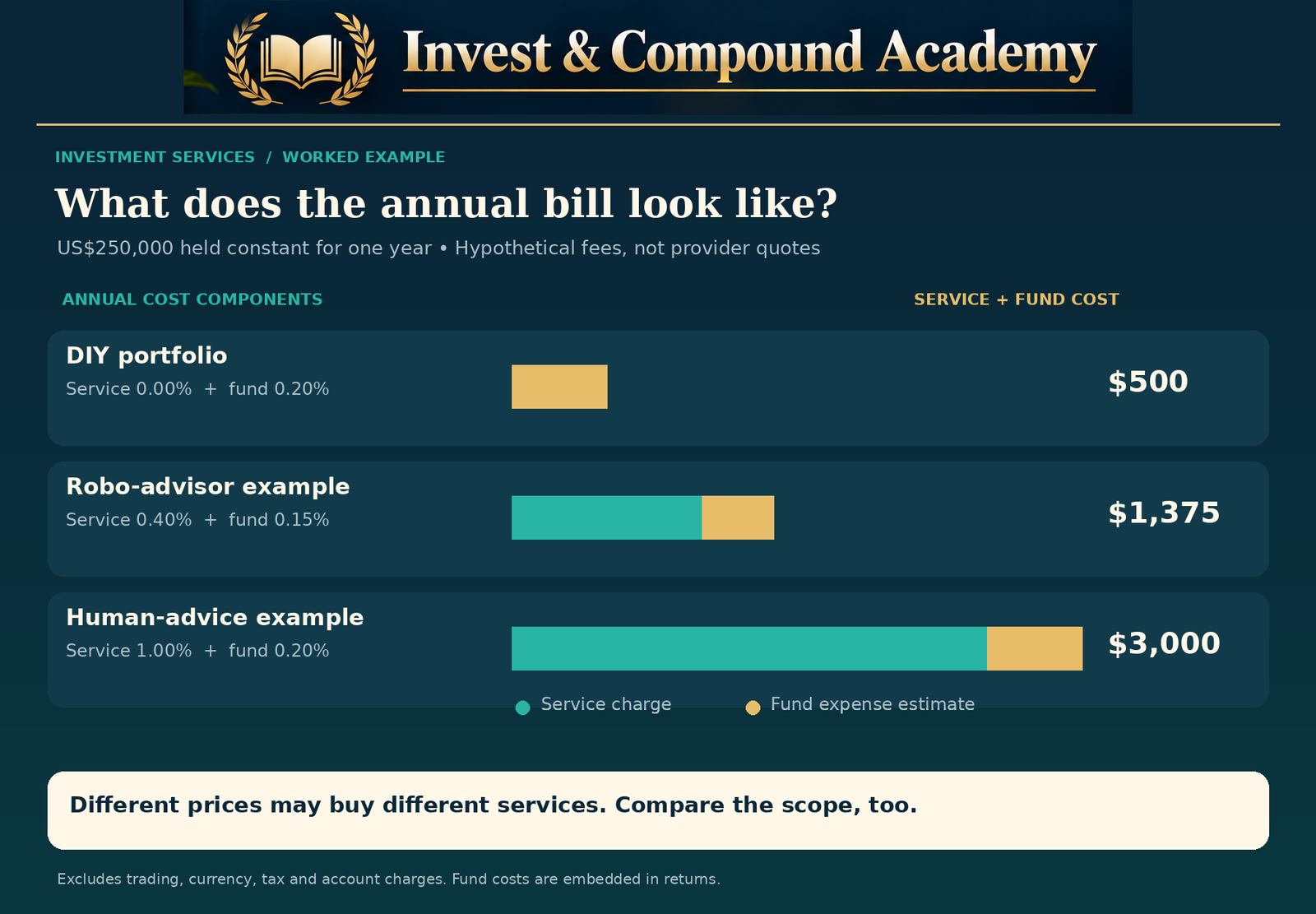
The difference between $500 and $3,000 is $2,500 a year in this example. What does that additional cost buy: recurring planning, implementation, access to a professional, or mainly portfolio administration? A useful comparison makes the service as visible as the fee.
Fund expenses are generally reflected in investment returns rather than a separate annual invoice. Include commissions, spreads, currency costs, custody charges and applicable taxes on fees where relevant. Avoid counting a cost twice when a quote already includes it. Cash requirements and revenue arrangements also deserve review.
Annual Investment Cost Calculator
Use one currency throughout. This estimates a year at an unchanged balance, not a provider’s actual invoice.
Estimated annual cost = balance × (service rate + fund expense rate) + additional annual charges. Enter only additional charges not already included in the rates.
How Fees Affect Growth Over 25 Years
To isolate ongoing costs, assume a $100,000 lump sum earns a constant 6% gross annual return for 25 years. There are no contributions, withdrawals or taxes. For this simplified illustration, the annual cost rate is subtracted from the gross return.
| Annual cost | Simplified net return | Value after 25 years |
|---|---|---|
| 0.20% | 5.80% | $409,394 |
| 0.75% | 5.25% | $359,379 |
| 1.00% | 5.00% | $338,635 |
| 2.00% | 4.00% | $266,584 |
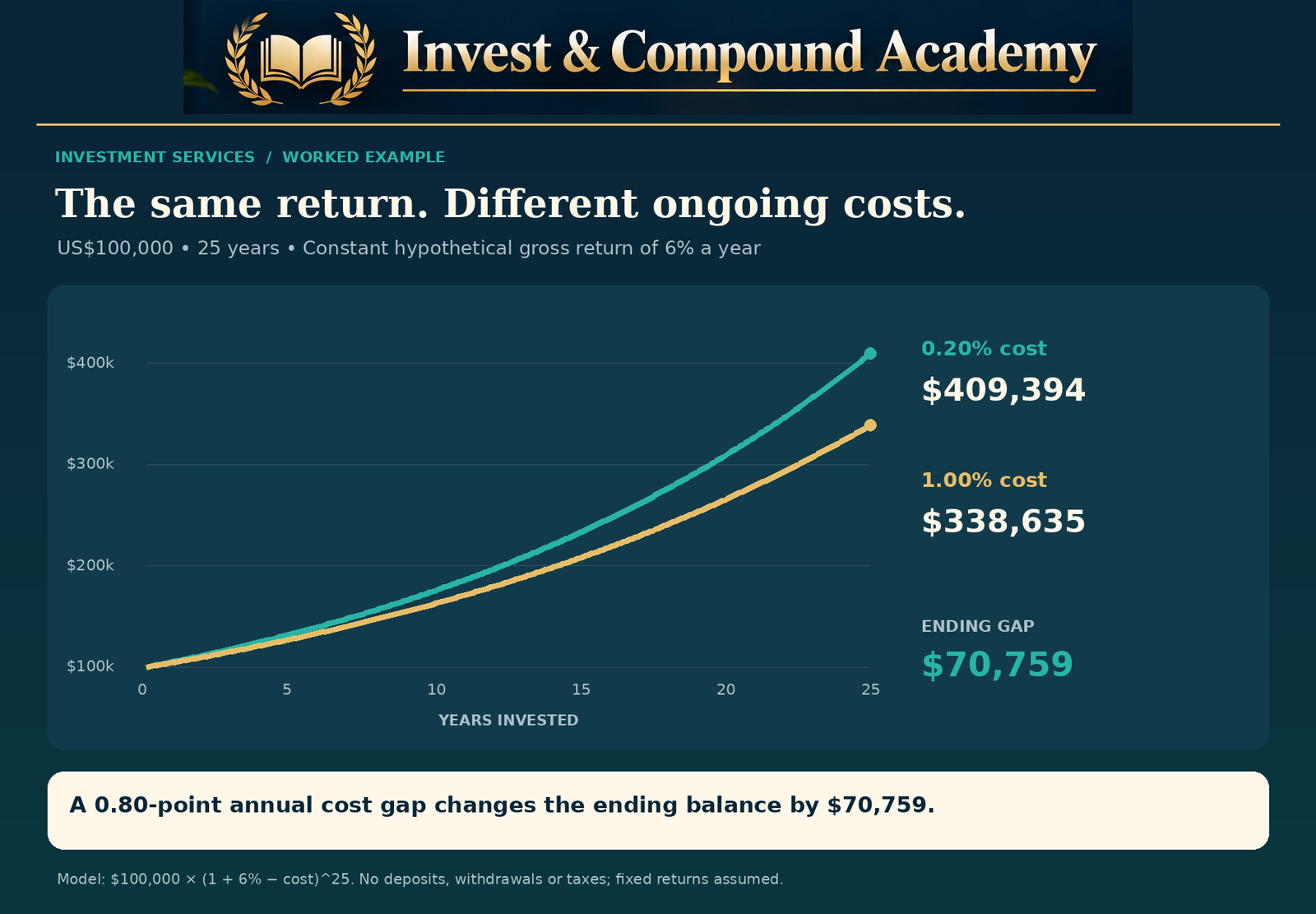
The gap includes both the modeled charges and the growth no longer earned on money absorbed by costs. It is not a tally of invoices. Actual fees may be deducted monthly or quarterly and calculated differently, so this is a comparison model rather than an exact billing simulation.
This example does not predict provider performance or measure the value of planning and behavior. Different portfolios can have different risk and gross returns. A service that helps an investor follow a suitable plan may provide value the model cannot quantify; that value should still be assessed against a clear scope and cost.
Compare Two Ongoing Cost Rates
A lump-sum scenario using the same gross return for both routes. Rates are assumptions, not forecasts.
Value = starting amount × (1 + gross annual return − annual cost rate)years. Excludes deposits, withdrawals, taxes and fixed charges. A positive gap means Route A ends higher; a negative gap means Route B ends higher.
Compare Fees as the Balance Changes
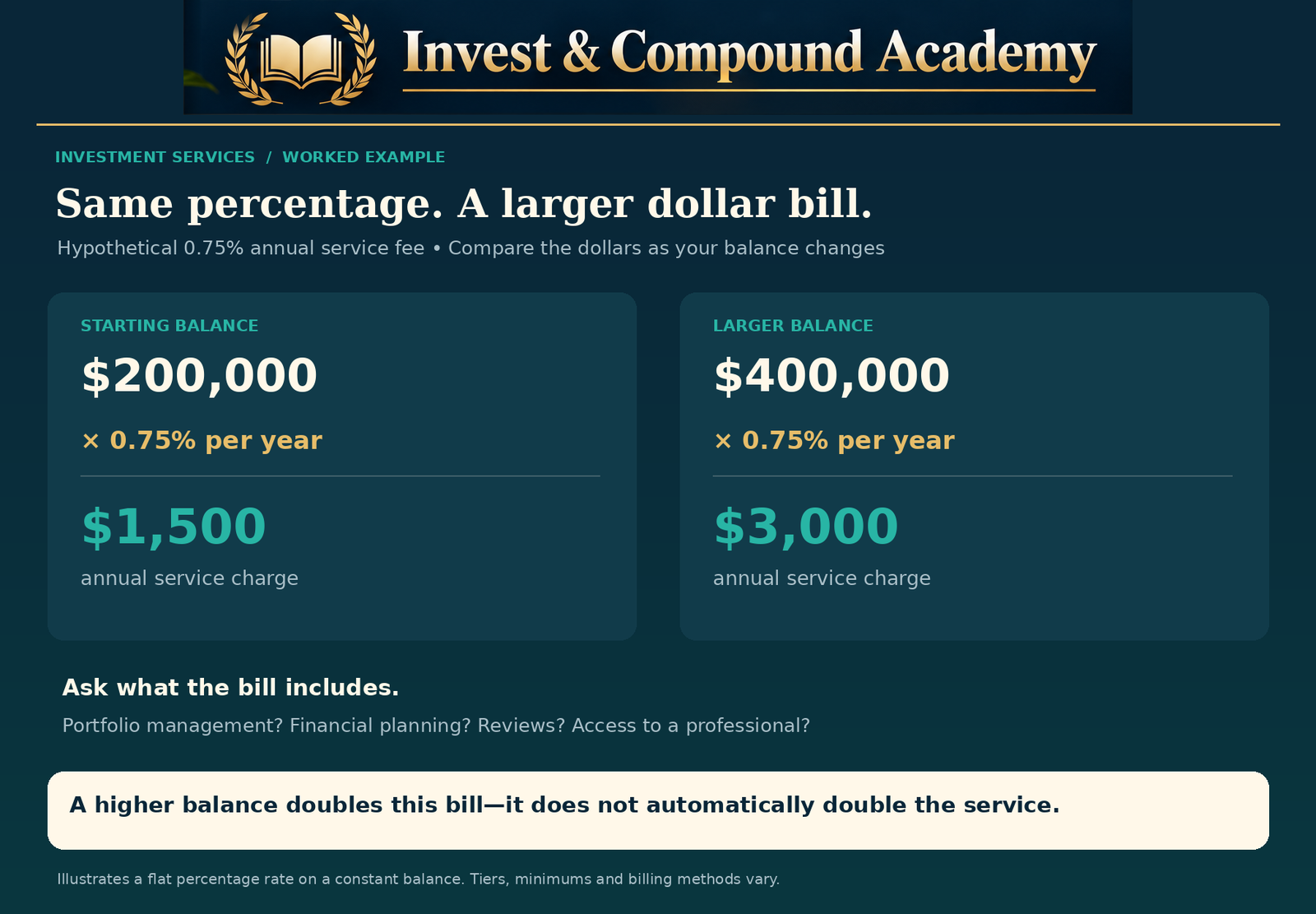
At a hypothetical 0.75% annual service rate, a $200,000 balance implies $1,500 a year. At $400,000, it implies $3,000. The rate is unchanged; the dollar bill doubles. Actual agreements may have tiered rates or periodic valuation methods.
A $2,000 one-time planning project is not directly comparable with a $2,000 annual management fee. Match the time period, deliverables, implementation and follow-up first. Ask for dollar illustrations at today’s balance and at a larger balance, plus the treatment of deposits and withdrawals.
A Hybrid Approach Needs Clear Responsibilities
You might hire a planner to establish a retirement framework, then implement the portfolio yourself or through an automated service. That can separate specialist advice from routine administration, but someone must own every important task.
| Task | Possible owner | Review trigger |
|---|---|---|
| Establish goals and allocation | You and the planner | Initial plan and agreed updates |
| Implement and rebalance | You or the managed service | The written investment policy |
| Report life changes and outside assets | You | Material changes in circumstances |
| Monitor contribution room and tax records | You, with appropriate professional help | Contributions, withdrawals and reporting deadlines |
| Prepare tax filings | You or an engaged tax professional | The relevant tax cycle |
Do not assume that a planner, accountant and investment provider coordinate automatically. Specify who notices a change, who decides what it means and who is authorized to act. A one-time plan can become outdated after retirement, an inheritance, marriage or a business sale.
Questions That Make the Service Assessable
- What exactly will I receive? Request the written scope, deliverables, review schedule and exclusions.
- What will I pay? Ask about service charges, underlying products, implementation, cash arrangements and other compensation.
- Which duties apply? Confirm the legal relationship, trading discretion, conflicts and complaint process.
- Who provides support? Identify the responsible person and distinguish technical assistance from financial advice.
- Where are assets held? Confirm the custodian, account ownership, authorizations and applicable protection arrangements.
Use concrete scenarios. For retirement, ask who compares withdrawals from taxable and sheltered accounts and coordinates the tax estimates. During a market decline, ask how the service reviews spending, cash and allocation. A process you can examine is more useful than a promise to avoid losses.
Where permitted, request a sample or anonymized deliverable. Review the assumptions, actions and responsibilities it contains. Registration and disciplinary checks are essential background work, but they do not by themselves prove that the service fits your needs.
Plan a Provider Transition Before Authorizing It
Ask the receiving firm which investments can transfer in kind and which require sales. Proprietary holdings, fractional shares and unsupported securities may complicate a move. Confirm exit charges, transfer charges and any time out of the market.
In a taxable account, understand potential consequences before liquidating. For registered or retirement accounts, confirm the permitted transfer process before withdrawing money. Keep statements and check units, cash, cost-basis records where relevant, beneficiaries and authorizations at the receiving institution. An account disappearing from the old app does not prove that every record arrived correctly.
Keep control of credentials and understand any discretion granted to trade. Registration or investor-protection membership does not guarantee investment returns. Firm-failure protection, where applicable, has eligibility rules and does not protect against ordinary market losses.
Review Service Quality Against the Agreed Job
Record whether reviews occurred, fees matched the agreement, questions received clear answers and recommendations explained their trade-offs. Confirm that updates were implemented where the service was responsible for doing so.
A single year’s return is a weak service scorecard because it reflects asset exposure and market conditions. Compare results with an appropriate benchmark and the agreed risk, while evaluating planning and communication separately. Avoid changing providers merely because another portfolio performed better over a short period.
DIY deserves the same review discipline. A low expense ratio helps little if the portfolio becomes unnecessarily complicated or the investor abandons it during a decline. The arrangement needs to be understandable, affordable and practical to maintain.
Frequently Asked Questions
Is a robo-advisor better than DIY investing?
There is no universal winner. A robo-advisor can delegate routine implementation. DIY offers more control and can reduce explicit service fees, but you retain the work. Compare the actual portfolio, support, cost and responsibilities.
Is a financial adviser worth 1% a year?
The percentage alone cannot answer that. Translate it into dollars, identify the services included and assess whether you need and use them. Planning value and ongoing portfolio management are related but distinct.
Can I hire a planner and keep a DIY account?
Yes, where the planner offers that engagement. Confirm whether the work ends with recommendations or includes implementation and updates. Assign responsibilities for later changes.
Does an automated service prevent investment losses?
No. Its investments remain exposed to market risk. Automation can also produce a poor fit if the information supplied is incomplete or outdated.
Can I switch from a robo-advisor to DIY later?
Often, but confirm transfer eligibility, possible sales, charges, tax implications and record transfers before proceeding. Account and jurisdiction rules matter.
Should I compare only the advertised management fee?
No. Include underlying investment costs and other applicable charges, then compare the service scope. Check that quoted components do not overlap before adding them.
Key Takeaways
- Start with the work required, then compare providers.
- DIY retains responsibility; automation delegates specified tasks; human advice depends on the engagement.
- Compare annual costs in dollars and over time using explicit assumptions.
- A hybrid arrangement needs named owners for updates, implementation and records.
- Verify registration, compensation, custody and the written scope.
- Evaluate the service against its agreed job without relying on promises of outperformance.
Continue Learning in the Invest & Compound Academy
Explore the portfolio decisions behind the service you choose.
Investment services, portfolio construction and maintenance
References & Official Data Sources
Examples and calculations are original hypothetical illustrations. Reference review: October 17, 2026. Confirm current provider agreements and applicable jurisdiction rules.
- SEC: Investor Bulletin—Robo-Advisers
- SEC: How Fees and Expenses Affect Your Investment Portfolio
- FCAC: Choosing a Financial Advisor
- SEC: Form CRS Relationship Summaries
- SEC: Investment Adviser Public Disclosure
- FINRA: BrokerCheck
- CSA: Check Registration
- CIRO: Advisor Report Search
- SIPC: What SIPC Protects
This article provides general financial education, not personalized investment, tax or legal advice. It does not recommend a provider or security. Fees, services, registration requirements and investor-protection rules vary by jurisdiction and arrangement.
All figures and calculator results are hypothetical. Fixed-return examples simplify fee deductions and do not forecast actual results or the value of advice. Investing involves risk, including loss of principal.