Rule of 72 Calculator: Investment Doubling Time Explained
Estimate doubling time, compare the shortcut with exact compounding, and see how fees and inflation change the result.
The Rule of 72 calculator estimates investment doubling time by dividing 72 by a positive annual growth rate expressed as a percentage. At 8%, the estimate is nine years. The exact constant-rate calculation gives approximately 9.01 years. That is a useful shortcut, but it does not predict a market return. It also does not automatically account for inflation, fees, taxes or money added to the account. A balance that doubles in dollars may take much longer to double its purchasing power.
This guide focuses on doubling-time mathematics: when the Rule of 72 is accurate, how the exact formula works and which inputs can make a doubling estimate misleading. Use the calculators to compare assumptions; for broader growth mechanics, see how compound interest works.
Try the Rule of 72 Calculator
What Is the Rule of 72?
The Rule of 72 is a mathematical approximation used to estimate how long a balance would take to double at a positive annual growth rate. The standard formula is:
Suppose an investment grows at 8% annually. The Rule of 72 gives: 72 ÷ 8 = 9 years. The estimate suggests that the investment would take approximately nine years to double. If the annual growth assumption increases to 12%, the estimate becomes: 72 ÷ 12 = 6 years. A higher assumed growth rate produces a shorter estimated doubling period.
Why It Is Called a Rule
The word rule refers to a convenient calculation convention. It is not a financial regulation. It is not a guarantee about future investment performance. And it is not a strategy for generating a specified return. The rule simply summarizes a mathematical relationship between positive compound growth and the time required for a balance to approximately double.
When the Rule Is Most Useful
The calculation is useful for developing intuition. It can help investors compare growth assumptions, understand the long-term effects of fees, and recognize the economic significance of modest differences in annual returns. It can also provide a quick approximation of how long a price level might take to double under a constant inflation assumption. However, precise financial planning should generally use the exact formula rather than rely exclusively on the shortcut.
How to Calculate Doubling Time Using the Rule of 72
The calculation requires only one input: the assumed annual growth rate. For an 8% rate: 72 ÷ 8 = 9 years. For a 6% rate: 72 ÷ 6 = 12 years. For a 4% rate: 72 ÷ 4 = 18 years. The starting amount is not required. This is because the proportionate doubling time is identical for different starting balances under the same constant percentage growth assumption.
Starting With $1,000
At an assumed 8% annual growth rate, the Rule of 72 estimates approximately nine years for $1,000 to become $2,000.
Starting With $10,000
Under the same assumption, $10,000 would take approximately nine years to become $20,000.
Starting With $100,000
The estimate remains nine years for $100,000 to become $200,000. The dollar increase changes. The proportional growth rate does not. This is one of the most useful properties of exponential growth: when the growth rate remains constant, the time needed for each successive doubling is approximately the same.
Rule of 72 Doubling-Time Table
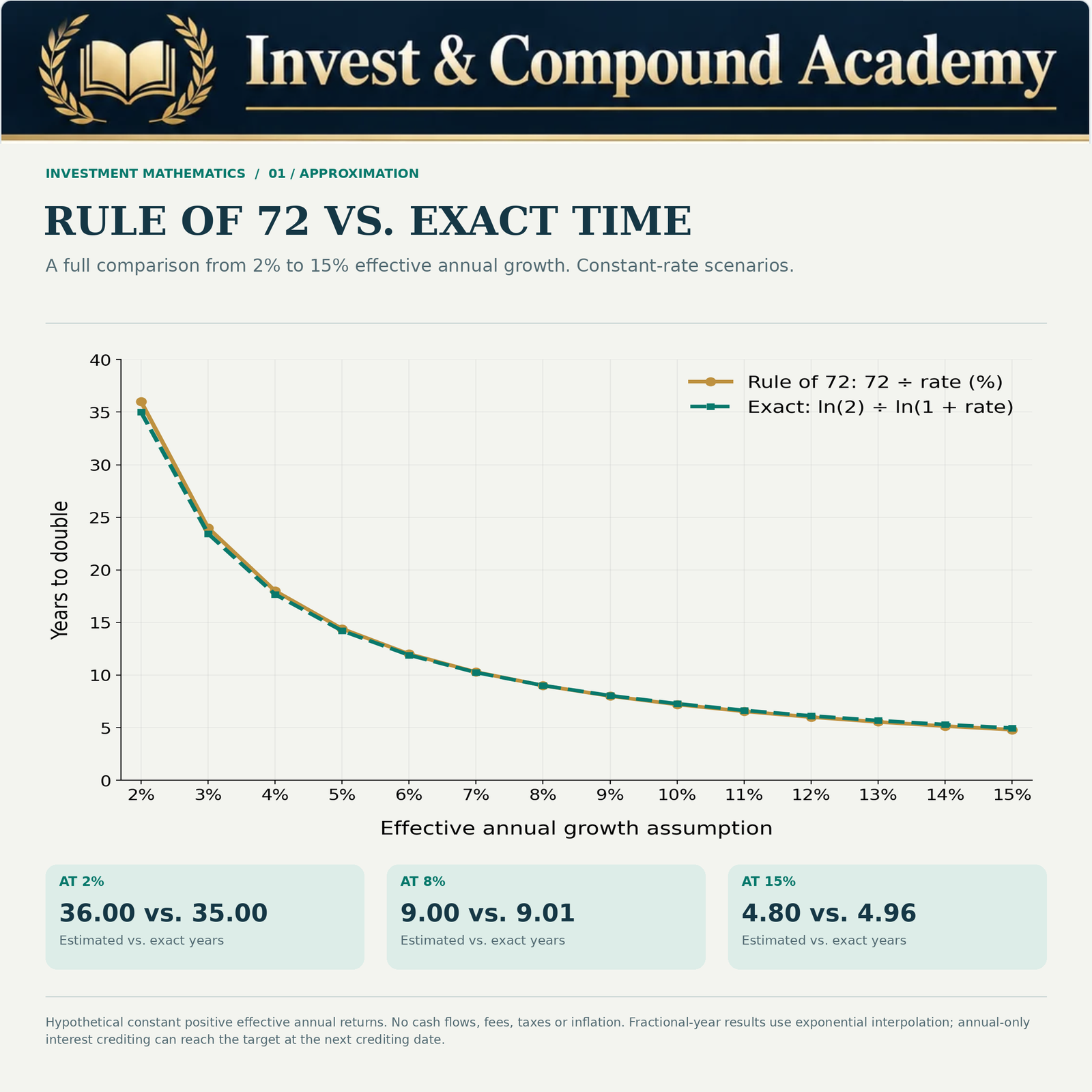
The following table compares the shortcut with the exact doubling-time formula, assuming a constant effective annual growth rate.
| Annual growth assumption | Rule of 72 estimate | Exact doubling time |
|---|---|---|
| 2% | 36.00 years | 35.00 years |
| 3% | 24.00 years | 23.45 years |
| 4% | 18.00 years | 17.67 years |
| 5% | 14.40 years | 14.21 years |
| 6% | 12.00 years | 11.90 years |
| 7% | 10.29 years | 10.24 years |
| 8% | 9.00 years | 9.01 years |
| 9% | 8.00 years | 8.04 years |
| 10% | 7.20 years | 7.27 years |
| 12% | 6.00 years | 6.12 years |
| 15% | 4.80 years | 4.96 years |
All examples assume constant positive returns without contributions, withdrawals, fees or taxes. The table shows that the shortcut is particularly close to the exact formula around a 7%–9% effective annual growth rate. It becomes less precise at very low or high rates. The approximation is still convenient when the goal is broad financial intuition, but it should not be mistaken for an exact result.
The Exact Formula for Investment Doubling Time
The Rule of 72 is based on the mathematics of compound growth. The standard future-value formula for a balance growing at a constant effective annual rate is:
Where:
- Present value is the initial balance.
- r is the effective annual growth rate expressed as a decimal.
- t is the number of years.
- Future value is the balance after t years.
To determine when an investment doubles, set future value equal to twice the starting balance.
Divide both sides by the starting balance.
Taking natural logarithms gives:
Therefore:
This formula gives the exact time in the exponential growth model. A fractional result interpolates between annual dates. If an account credits interest only on anniversaries and offers no accrual between them, the credited balance may first exceed the target at the next anniversary. For 8%, the interpolated result is 9.006 years; an annually credited balance first exceeds twice its starting value at year 10.
Example at 8%
For an 8% annual rate: r = 0.08. The calculation becomes: ln(2) ÷ ln(1.08). The result is approximately 9.006 years. The Rule of 72 gives nine years. The difference is very small.
Example at 3%
For a 3% annual rate: ln(2) ÷ ln(1.03) ≈ 23.45 years. The Rule of 72 gives 24 years. The approximation overstates the doubling time by approximately 0.55 years.
Example at 15%
For a 15% annual rate: ln(2) ÷ ln(1.15) ≈ 4.96 years. The Rule of 72 gives 4.8 years. The approximation understates the doubling time.
Why the Exact Formula Is Better for Calculators
A software calculator can perform logarithmic calculations instantly. There is little reason to substitute an approximation when precise output is required. A high-quality financial tool can display both values: the Rule of 72 for intuition and the exact formula for accuracy.
Why Does the Rule Use 72?
The number 72 provides a convenient approximation to the mathematical relationship between doubling time and compound growth. The natural logarithm of two is approximately 0.693147. For relatively small growth rates, the expression ln(1 + r) can be approximated by r. Therefore:
When the rate is expressed as a percentage rather than a decimal:
This is sometimes associated with the Rule of 69.3. However, 72 is convenient for mental arithmetic because it has many divisors. It can be divided evenly by 2, 3, 4, 6, 8, 9 and 12. It also produces particularly close estimates at several commonly illustrated annual growth rates.
Rule of 69.3 Versus Rule of 72
For a continuously compounded annual rate expressed in percent, 69.3147 divided by that rate gives the exact exponential-model doubling time. This is a different rate convention from an effective annual return. The Rule of 72 can provide more convenient approximations for certain annually compounded rates. The best shortcut depends on the compounding assumptions and the range of rates being considered. For precise work, the exact logarithmic formula is preferable.
A Shortcut Is Not an Investment Forecast
The rule does not estimate what the stock market will actually earn. It only translates an assumed growth rate into an approximate doubling period. The investor must separately assess whether that growth assumption is reasonable and appropriate for the investment and financial objective.
Understanding Compound Growth
Compound growth occurs when investment returns are earned not only on the original principal but also on previously accumulated growth that remains invested. The Consumer Financial Protection Bureau illustrates compound interest using principal and accumulated interest. The same mathematical principle helps explain long-term investment growth, although market returns are uncertain rather than fixed contractual payments.
A Simple Two-Year Example
Suppose an investor starts with $10,000. Assume the balance grows 5% during the first year. The ending value is: $10,000 × 1.05 = $10,500. During the second year, assume another 5% gain. The result is: $10,500 × 1.05 = $11,025. The second year’s growth is $525. That is greater than the first year’s $500 gain because it is calculated on a larger balance.
Why Time Matters
As the invested balance grows, the dollar amount associated with a fixed percentage return becomes larger. At a balance of $10,000, a 5% gain equals $500. At $100,000, the same percentage gain equals $5,000. The rate is unchanged. The dollar effect grows with the balance.
The Importance of Reinvestment
Compounding requires returns to remain economically invested or otherwise contribute to future growth. If an investor withdraws all investment earnings each year, the future balance may follow a different trajectory. For dividend-paying investments, total-return calculations generally account for distributions and the relevant reinvestment assumptions. A distribution paid into cash and spent cannot simultaneously remain invested in the portfolio.
How Long Does $10,000 Take to Double?
The Rule of 72 can estimate when $10,000 might become $20,000 under different constant growth assumptions. At 4%, the shortcut estimates eighteen years. At 6%, twelve years. At 8%, nine years. At 10%, 7.2 years. But those values are not promises.
An 8% Example
Suppose the account starts with $10,000. At an 8% effective annual growth rate, its value would be approximately $14,693 after five years, $21,589 after ten years and $46,610 after twenty years. The figures assume all growth remains invested and the effective annual rate is constant; they do not assume a separately quoted continuously compounded interest rate. Actual portfolio performance will vary.
Why Starting Amount Does Not Affect Doubling Time
The mathematical doubling period depends on the percentage rate, not the initial amount. However, the starting amount does affect the number of dollars gained. Doubling $10,000 adds $10,000. Doubling $250,000 adds $250,000. This distinction helps explain why the same percentage return has different financial consequences across portfolio sizes.
To separate deposits from gains, use our investment-growth measurement guide. The doubling calculator here deliberately excludes external cash flows.
What Happens When Money Doubles More Than Once?
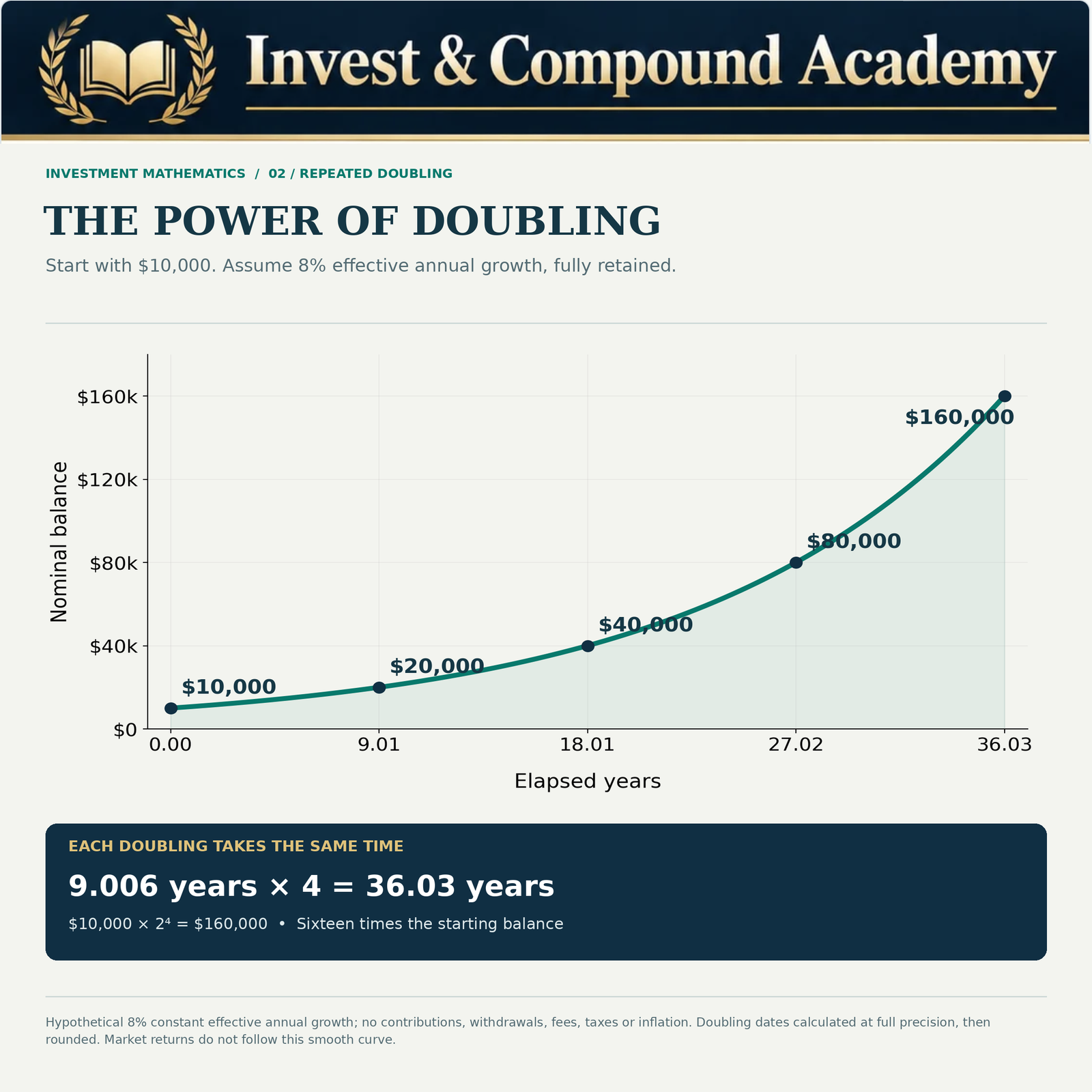
A balance can double repeatedly if positive compound growth continues long enough. Suppose a hypothetical portfolio grows at 8% annually. The exact doubling period is approximately nine years. Starting with $10,000, successive doublings produce $20,000, $40,000, $80,000 and $160,000. Using full-precision doubling times at 8%, the milestones occur at approximately 9.01, 18.01, 27.02 and 36.03 years. The equal spacing is a property of the constant-rate model, not a pattern promised by markets.
The Relationship Between Doubling and Multiples
Two doublings multiply the original balance by four. Three doublings multiply it by eight. Four doublings multiply it by sixteen. The relationship can be expressed as:
Why Long-Term Projections Require Caution
This arithmetic can produce very large projected values over extended horizons. However, constant growth rates are mathematical assumptions. Stock markets do not deliver identical returns every year. Taxes, fees, withdrawals, contribution decisions and economic conditions can materially affect actual wealth accumulation. The purpose of the model is to understand compounding, not to forecast an inevitable outcome.
Can the Rule of 72 Be Used for Stocks?
Yes, as an illustrative approximation based on an assumed compound growth rate. However, stocks do not have guaranteed annual returns. Their prices fluctuate according to business performance, interest rates, valuations and market conditions.
Historical Averages Versus Future Outcomes
Investors may encounter long-term historical return averages for diversified stock indexes. Such averages can be useful for understanding past market performance. But they do not guarantee that the same return will occur in a future period. An investor purchasing at a demanding valuation may experience a different outcome from someone investing when valuations are more favorable.
The Importance of Compound Annual Growth Rate
When estimating doubling time from historical investment performance, the compound annual growth rate, or CAGR, is generally more appropriate than a simple arithmetic average. CAGR summarizes the constant annualized growth rate that would connect a starting value to an ending value over a specified period. It does not mean that the investment actually earned that rate each year.
CAGR Formula
Suppose a portfolio increases from $10,000 to $20,000 over eight years without contributions or withdrawals. The CAGR is 2^(1/8) − 1, approximately 9.05%. The Rule of 72 gives an estimated doubling period of approximately 7.96 years. The actual observed doubling took eight years. The small difference reflects the approximation.
The S&P 500 guide explains index exposure. How to read a stock, P/E ratios and PEG ratios address business and valuation questions that a doubling-time formula cannot answer.
Why Arithmetic Average Returns Can Be Misleading
Arithmetic average returns add periodic returns and divide by the number of observations. They do not fully describe compounded investment growth. Consider a portfolio that rises 50% in one year and falls 30% in the next. Its arithmetic average annual return is (50% − 30%) ÷ 2 = 10%. But starting with $10,000, the balance becomes $15,000 after the gain and $10,500 after the decline. The total two-year return is only 5%. The CAGR is approximately 2.47%, not 10%.
Why This Matters for Doubling Estimates
Using the 10% arithmetic average in the Rule of 72 suggests doubling in 7.2 years. That calculation is not consistent with the actual two-year compound growth experience. Using the observed CAGR of approximately 2.47% gives a much longer illustrative doubling estimate.
The Broader Lesson
Investors should not insert a historical arithmetic average into a doubling-time formula without understanding the return measure. The compound return and the consistency of future returns matter. Even CAGR does not guarantee future results. It summarizes a historical period or specified projection.
How Market Volatility Affects Doubling Time
The Rule of 72 assumes a constant positive growth rate. Actual market returns fluctuate. Two investments with the same arithmetic average return can produce different compounded outcomes if their returns vary.
The Mathematics of Losses
Suppose an investment loses 25%. To recover to its previous value, it must gain approximately 33.33%. A 25% gain after a 25% decline does not restore the original balance. Starting with $100, a 25% loss reduces the value to $75. A subsequent 25% gain increases it to $93.75. The portfolio remains below its original level.
Volatility and Compound Growth
High volatility can reduce compounded growth relative to an arithmetic average. The size and ordering of returns influence the path and when a target may first be crossed. Without intervening cash flows, reordering the same set of returns does not change terminal wealth: their growth factors multiply to the same product. With contributions or withdrawals, ordering can also change the ending balance. This is why planning with one smooth annual percentage should be recognized as a simplification.
Why the Exact Doubling Formula Still Has Limits
The exact formula is mathematically precise for a specified constant growth rate. It is not a precise prediction of a volatile financial market. More sophisticated simulations can examine variable returns, but they require assumptions about return distributions, correlations and market conditions. Those assumptions also introduce uncertainty.
Start with what a market correction means and corrections versus bear markets. Our bear-market guide, correction-duration research and bear-market recovery guide explain why a smooth doubling curve is not a realistic recovery timetable.
Can the Rule of 72 Be Applied to ETFs?
Yes, provided the calculation is based on an assumed compound total-return rate appropriate to the ETF. The fund’s investment strategy matters. A diversified equity ETF has different expected risks from a short-term Treasury ETF, high-yield bond ETF or covered-call fund.
Broad-Market Equity ETFs
A broad-market ETF provides exposure to the companies represented by its index or investment strategy. Its returns depend on changes in security values and distributions. Historical total-return figures may be useful for illustrating past doubling periods. They do not guarantee future growth.
Dividend ETFs
Dividend-focused ETFs may distribute cash regularly. However, the amount distributed is not necessarily the fund’s total return. Price declines can offset cash distributions.
Covered-Call ETFs
Covered-call funds may generate distributions through option-writing strategies. A quoted distribution rate should not be inserted into the Rule of 72 as though it were a guaranteed compound total return. For example, a fund distributing an annualized amount equal to 12% of a reference price has not thereby established a sustainable 12% growth rate. The fund’s NAV may decline, distributions may change and upside participation may be limited.
Bond ETFs
Bond funds experience changes in market values due to yields, credit conditions and duration. Yield-to-maturity and realized shareholder returns are not always identical. The Rule of 72 should not automatically equate a fund’s quoted yield with its eventual compounded return.
The ETF beginner’s guide, ETF research framework and creation and redemption guide explain what fund investors own and how NAV, costs and trading mechanics affect their experience. Our ETF versus mutual fund guide compares the wrappers.
Distribution Yield Is Not a Doubling Rate
One of the most important cautions for income-oriented ETF investors concerns the difference between distributions and investment growth. Consider a hypothetical ETF priced at $100. It distributes $12 per share over a year, an apparent annual distribution rate of 12% relative to the initial price. But suppose the share price falls to $88. Ignoring taxes and reinvestment effects, the investor received $12 in cash and holds a share worth $88. The combined economic value is $100. The total return is approximately zero.
It would be incorrect to use 12% in the Rule of 72 and conclude that the investment necessarily doubles in six years.
Total Return Is the Appropriate Concept
For investments making cash distributions, total return includes both the value of the securities and the cash paid, measured consistently. A doubling-time estimate should use an assumed compound total return if the goal is to estimate growth in total investment wealth.
Income Withdrawal Changes the Calculation
An investor spending every distribution rather than reinvesting it is following a different financial strategy. The remaining portfolio may not compound at the same rate as a total-return index with reinvested distributions. For retirement-income planning, the balance between withdrawals and investment returns requires a separate cash-flow model.
Read dividend yield versus total return before treating a payout percentage as a growth rate. Covered-call ETF financial reports shows how to examine portfolio operations and distributions. The strategy guides for JEPI, JEPQ, SPYI and QQQI provide product-specific context; none turns its distribution rate into a guaranteed doubling assumption.
How Investment Fees Affect Doubling Time
Investment fees reduce the returns investors retain. Over long periods, even modest differences in annual costs can influence compound growth. Suppose two hypothetical funds provide exposure to the same underlying investment strategy. One has annual operating expenses of 0.10%. The other has expenses of 0.80%. The difference is 0.70 percentage points annually. If the funds otherwise produce comparable gross returns, the lower-cost fund may retain a larger portion for investors.
A Consistent Fee Example
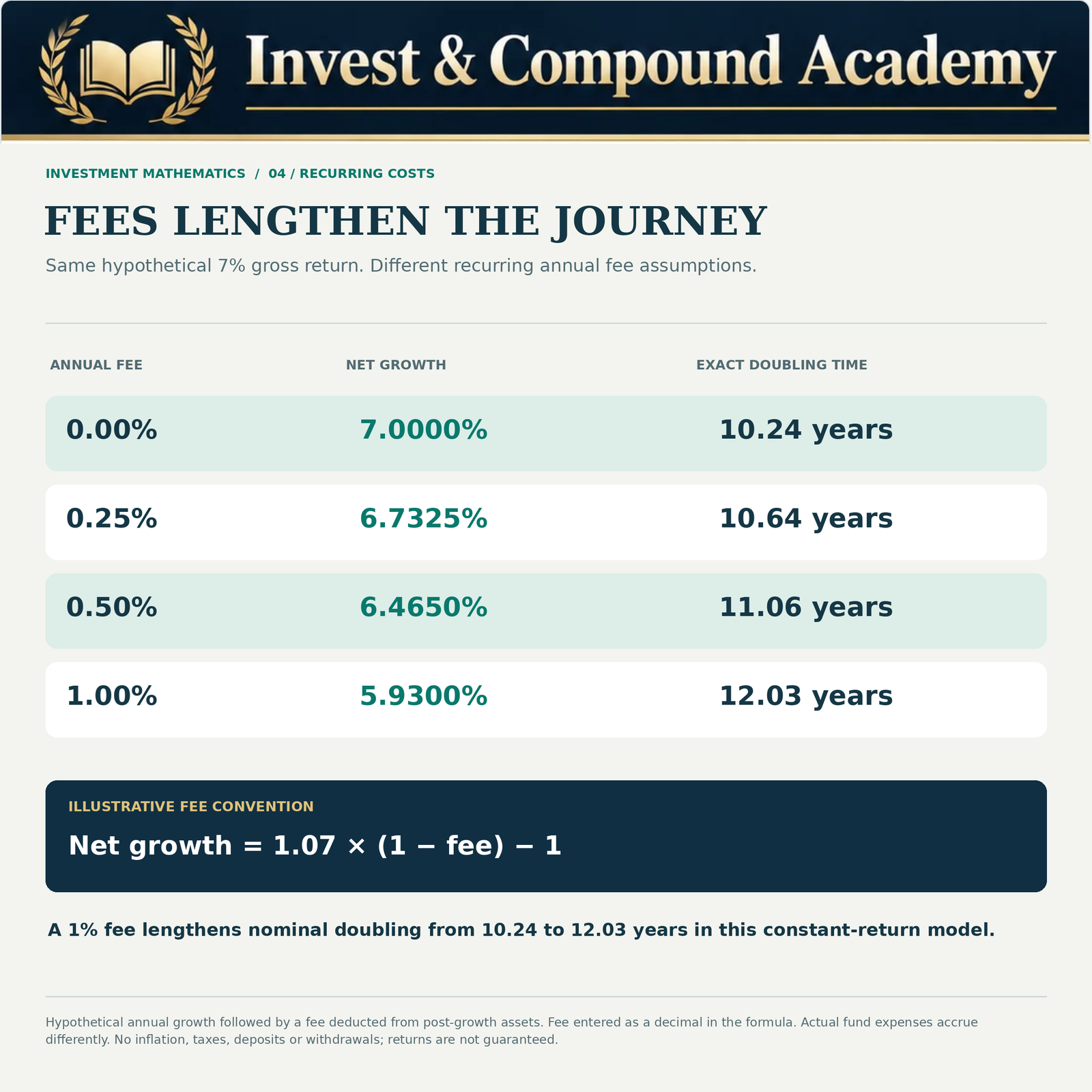
Assume a hypothetical 7% effective annual gross return. In this article’s illustrative model, growth occurs first and a recurring fee is then deducted from the post-growth assets.
With a 0.50% annual fee, the factor is 1.07 × 0.995 = 1.06465: net growth of 6.465%. Exact nominal doubling takes approximately 11.06 years, compared with 10.24 years before fees. The Rule of 72 estimates 11.14 years at the net rate.
Why the Convention Matters
Subtracting 0.50 percentage points directly from 7% gives 6.50%, a useful rough approximation but a different model. Do not mix the two calculations. Actual fund expenses usually accrue through assets over time rather than as a single year-end charge. Other costs and tracking differences also influence investor returns.
Avoid Subtracting Fees Twice
If a published fund return already includes operating expenses, subtracting the same expense ratio again would understate the return. Establish whether the input is gross or net before adding a fee assumption. Set the calculator’s fee input to zero when the selected return already accounts for that expense.
Total Costs Matter
ETF expense ratios are only one component. Investors may also incur trading spreads, brokerage commissions, currency conversion costs and taxes. A calculator should distinguish recurring percentage costs from one-time transaction expenses.
Our QQQ-to-QQQM switching analysis separates recurring costs from one-time execution expenses. Whole-share ETF rebalancing examines rounding, residual cash and funded trades.
How Inflation Changes Doubling Time
A nominal investment balance can double without doubling its purchasing power. Inflation increases the nominal cost of goods and services over time. Therefore, investors should distinguish between nominal doubling and real doubling.
Nominal Doubling
Nominal doubling means the account balance increases to twice its original dollar amount. For example, $50,000 becomes $100,000.
Real Doubling
Real doubling means the inflation-adjusted purchasing power of the investment doubles. This requires the investment to grow enough to offset inflation and still achieve an additional 100% real increase.
Exact Real Return
The real growth rate is:
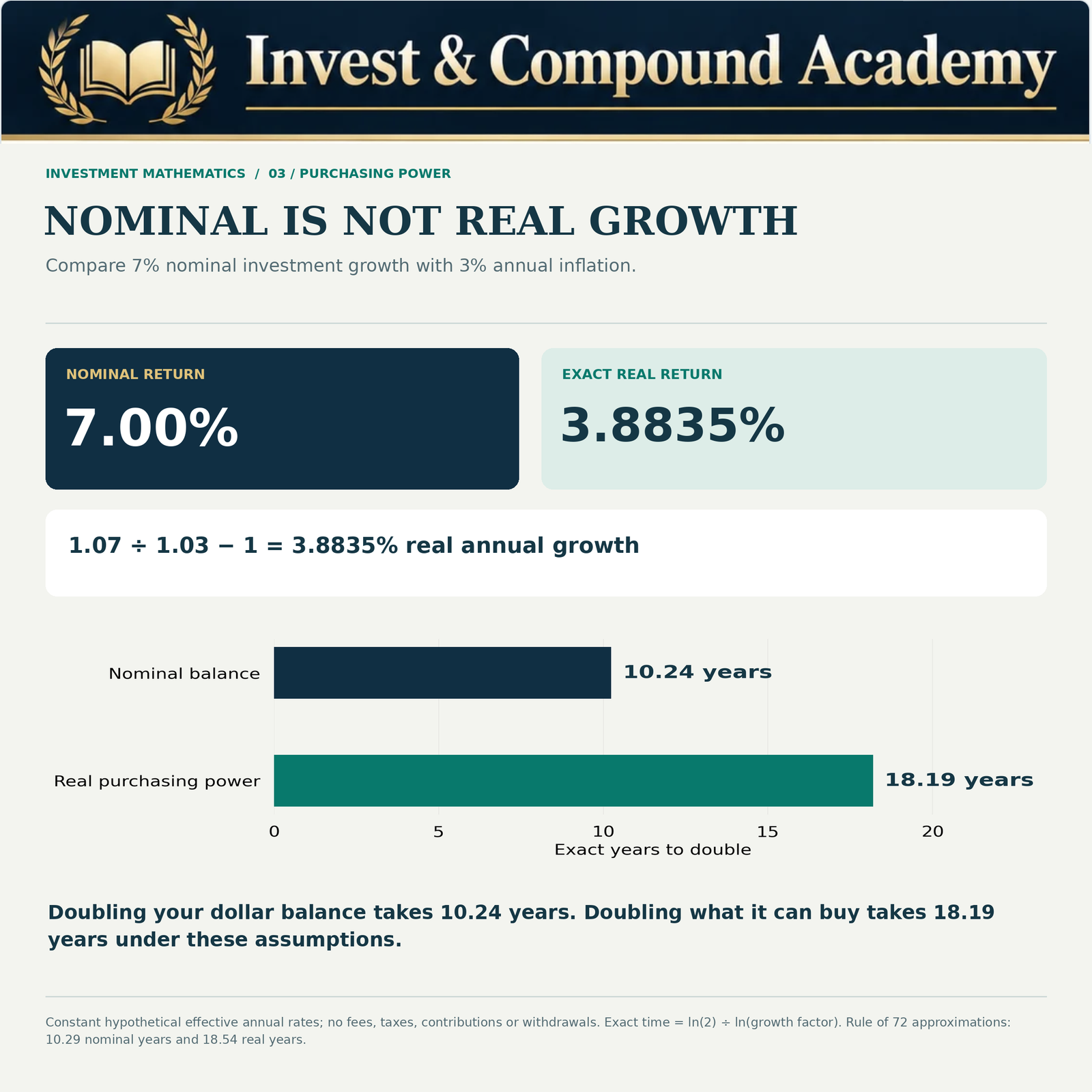
Suppose nominal growth is 7% and inflation is 3%. The exact real annual growth rate is 1.07 ÷ 1.03 − 1 ≈ 3.8835%. Using the Rule of 72 with the real growth rate gives an estimated purchasing-power doubling time of approximately 18.54 years. The exact logarithmic formula gives approximately 18.19 years. By comparison, the nominal Rule of 72 estimate at 7% is about 10.29 years.
Why the Difference Is Significant
The investment could approximately double in nominal value after about ten years under the assumed growth rate. But achieving twice the original purchasing power would take much longer. This matters for retirement planning, education savings and other financial objectives that depend on future spending power.
The inflation and investing pillar develops the purchasing-power question beyond this constant-rate calculation.
Inflation Can Cause Prices to Double
The same doubling calculation can estimate how long the general price level might take to double under a constant inflation assumption. At 2% inflation, 72 ÷ 2 = 36 years. At 3%, 72 ÷ 3 = 24 years. At 4%, 72 ÷ 4 = 18 years. At 6%, 72 ÷ 6 = 12 years. These are approximate values.
An Example at 3%
Suppose a basket of goods and services costs $50,000 today. At a constant 3% annual inflation rate, its nominal cost would approximately double over the period indicated by the Rule of 72. The exact doubling time is approximately 23.45 years.
Why This Matters for Financial Goals
An investor targeting $1 million in thirty years may assume that the future amount provides the same living standard associated with $1 million today. That would be incorrect if the price level rises substantially during the period. Long-term goals should distinguish future nominal dollars from today’s purchasing power.
Can the Rule of 72 Estimate When Fees Halve Wealth?
The rule can also illustrate the cumulative effect of a persistent negative growth rate or cost, but the mathematical interpretation needs care. The usual Rule of 72 is designed for positive growth and doubling time. A shrinking balance follows a different half-life relationship. A fee’s effect relative to an otherwise identical fee-free portfolio is also distinct from saying the actual portfolio balance halves; the portfolio can still grow while falling behind the comparison.
A Constant Annual Decline
Suppose a balance declines by 5% every year. Its future value is:
To determine when the balance falls to half its original value:
The result is approximately 13.51 years. Simply dividing 72 by 5 gives 14.4 years, which is not the precise half-life under this convention.
Why the Difference Matters
Growth and decline rates are not symmetrical. A 50% loss requires a 100% gain to recover. Financial calculations should use the correct formula rather than applying a familiar shortcut mechanically.
Compounding Frequency: Annual, Monthly and Daily
The Rule of 72 is commonly applied to annual rates. However, the compounding convention matters. A nominal annual interest rate compounded monthly is not identical to the same numerical rate expressed as an effective annual rate.
Nominal Annual Rate
Suppose a deposit earns a nominal annual rate of 6%, compounded monthly. The monthly periodic rate is 0.06 ÷ 12 = 0.005, or 0.5%. The effective annual rate is:
This is approximately 6.17%.
Effective Annual Rate
The effective annual rate incorporates the effect of compounding over the year. If a calculator uses a nominal annual rate with monthly compounding, its exact doubling-time formula must account for that convention.
Exact Formula for Periodic Compounding
For nominal annual rate j compounded m times per year:
The formula assumes a positive constant nominal rate and regular compounding.
Continuous Compounding
Under continuous compounding at a constant nominal annual rate r:
For 6% continuous compounding, 0.693147 ÷ 0.06 ≈ 11.55 years.
Why Labels Matter
A calculator should clearly distinguish an effective annual return from a nominal rate with a specified compounding frequency. Using one rate convention in the input and another in the formula produces misleading results.
The Rule of 72 and Regular Contributions
A common question is how long a portfolio will take to double when the investor continues making contributions. The Rule of 72 alone is not sufficient to answer this question. Regular deposits change the invested principal. The account may reach twice its original balance partly because of new money rather than investment returns.
A Simple Example
Suppose an investor starts with $10,000 and contributes $500 monthly. The balance may reach $20,000 relatively quickly even with no investment returns. After twenty months, contributions alone total $10,000. The account would reach $20,000, ignoring losses, interest and fees. That is not an investment doubling achieved through compound returns. It is the result of adding capital.
Contributions Versus Growth
A useful calculator should distinguish the initial investment, additional contributions, investment growth, withdrawals, fees and taxes. These components produce different financial effects.
Future Value With Contributions
For a constant periodic return, the future value of a starting amount and regular end-of-period contributions can be calculated using an annuity formula.
Where P is the starting balance, C is the contribution per period, r is the periodic return and n is the number of periods. If r is zero, contributions simply accumulate without growth. The formula is an illustrative model when applied to market investments. Actual returns vary from period to period.
Our dollar-cost averaging guide models regular purchases. Lump-sum investing versus DCA addresses the different decision of when to deploy cash already available.
How Contributions Can Change the Meaning of Doubling
Suppose an investor starts with $20,000. After several years, the account balance reaches $40,000. Is it accurate to say the investment doubled? In nominal account-value terms, yes. But that statement alone does not reveal investment performance. If the investor contributed another $18,000 during the period, only $2,000 of the increase may be attributable to net investment growth, under a simplified cash-flow accounting.
Why Performance Measurement Is Different
Investors making contributions and withdrawals need performance measures that account for external cash flows. Time-weighted returns and money-weighted returns serve different analytical purposes.
Time-Weighted Return
Time-weighted measurement attempts to isolate portfolio investment performance from the effects of external cash-flow timing. It is commonly used to evaluate managers or strategies.
Money-Weighted Return
Money-weighted return, often represented by an internal rate of return, reflects the amounts and timing of investor cash flows. It can be particularly relevant when evaluating an individual’s actual investment experience.
Why This Matters for the Rule of 72
The shortcut should be applied to a defined growth rate. It should not be used to claim that contributions represent investment returns. A portfolio reaching a target balance and an investment doubling through its own performance are different concepts.
Reverse Rule of 72: What Rate Is Needed to Double by a Deadline?
The Rule of 72 can be rearranged. If an investor wants to estimate the growth rate required to double a balance over a specified number of years:
For a target of twelve years, 72 ÷ 12 = 6%. For eight years, 72 ÷ 8 = 9%. For six years, 72 ÷ 6 = 12%.
Exact Required Growth Rate
A more precise calculation is:
For a target doubling period of ten years, 2^(1/10) − 1 ≈ 7.177%. The Rule of 72 suggests 7.2%. The results are close.
Why Required Does Not Mean Achievable
The formula calculates the mathematical return required. It does not assess whether that return is realistic for a particular investment. An investor should not increase portfolio risk automatically because a target date implies a high required return. Financial goals may need to be adjusted through additional saving, longer timelines or different spending assumptions.
Risk and the Temptation to Assume Very High Returns
The Rule of 72 can make high return assumptions look exceptionally attractive. At a hypothetical 18% annual return, 72 ÷ 18 = four years. At 24%, 72 ÷ 24 = three years. But sustained returns at those levels are not guaranteed and may require exposure to substantial investment uncertainty.
Why High Return Assumptions Deserve Scrutiny
An unusually high promised return with little or no risk is a classic investment red flag. The U.S. Securities and Exchange Commission advises investors to be cautious of promises of high returns with minimal risk.
Volatility Can Change Realized Compounding
An investment may gain 40% one year and lose 30% the next. The arithmetic average annual return is 5%. But the two-year cumulative result is 1.40 × 0.70 − 1 = −2%. The investment lost money despite the positive arithmetic average.
Leverage Does Not Eliminate Risk
Borrowing can magnify investment gains. It also magnifies losses and may create forced-liquidation risk. A high projected rate of return should not be separated from the possibility of significant financial impairment.
Buying during a correction and what to do during a correction examine decision rules. Market warning signs discusses vulnerability without promising an entry or exit signal.
Rule of 72 Examples for Retirement Planning
Retirement projections often involve long time horizons. The Rule of 72 can provide a quick sense of the influence of a growth assumption. Suppose someone has $100,000 invested and expects to retire in twenty years. At a hypothetical 6% constant annual return, the Rule of 72 suggests that the balance could double approximately every twelve years. At 8%, it suggests approximately every nine years.
Why Two Percentage Points Matter
A difference between 6% and 8% may appear modest in one year. Over twenty years, compound growth produces substantially different outcomes. At 6%, $100,000 × 1.06^20 ≈ $320,714. At 8%, $100,000 × 1.08^20 ≈ $466,096. The hypothetical difference is approximately $145,382.
Why Retirement Planning Needs More Than the Rule
Retirement planning also depends on contributions, taxes, inflation, asset allocation, withdrawals and the sequence of returns. The Rule of 72 cannot model all those variables. It is useful for understanding growth sensitivity, not producing a complete retirement projection.
Real Spending Power
Even if a nominal portfolio balance increases significantly, its real purchasing power depends on inflation. A financial plan should consider the future cost of living rather than treating a future nominal balance as economically equivalent to the same amount today.
Begin with ETF portfolio construction and the portfolio-maintenance workbook. The compounding-with-withdrawals guide explains why taking money out changes the analysis.
Rule of 72 for Savings Accounts and Fixed-Rate Deposits
The Rule of 72 can be relatively straightforward for savings products with specified positive rates, provided the rate convention and any changes are understood. Suppose a hypothetical account has a constant 4% effective annual yield. The Rule of 72 suggests approximately eighteen years to double. The exact doubling time is approximately 17.67 years.
Why Account Terms Still Matter
A savings rate can change. Fees may apply. Some products have minimum balance requirements or penalties. Interest may be taxed. Therefore, even a simple savings account may not deliver a constant after-tax rate indefinitely.
Fixed-Term Products
A fixed-term deposit may specify its rate over the term. However, if the term ends before the projected doubling period, future reinvestment rates become relevant. The investor cannot assume that the original rate will remain available at each maturity.
After-Tax Growth
If interest is taxable annually, the effective retained return may be lower than the quoted rate. The exact effect depends on account type and applicable tax rules. The Rule of 72 estimate should therefore match the economic return the investor intends to evaluate.
How Taxes Affect Investment Doubling
Taxes can reduce the amount of investment growth retained. However, the effect depends on when and how returns are taxed.
Taxable Interest
Interest income may be taxed annually in certain accounts or jurisdictions. This can reduce the amount remaining to compound.
Dividends
Dividend taxation varies by jurisdiction, account and distribution type. A stated yield is not necessarily the investor’s after-tax growth rate.
Realized Capital Gains
Capital gains taxes can arise when securities are sold at a gain in taxable accounts. The timing of realization may affect after-tax compounding.
Tax-Advantaged Accounts
Registered and tax-advantaged investment accounts may defer or exempt certain taxes under applicable rules. The treatment differs between countries and account types.
Why One Universal Tax Adjustment Is Misleading
Subtracting a flat tax percentage from every projected investment return may not accurately represent the applicable law. A rigorous calculator should either use a clearly defined tax model or explicitly state that taxes are excluded.
Using the Rule of 72 to Evaluate Inflation and Fees Together
Combine the same hypothetical 7% effective annual gross return with a 0.50% annual fee and 3% inflation. Apply the fee convention used above before adjusting for purchasing power.
The Rule of 72 estimates 72 ÷ 3.3641 ≈ 21.40 years to double purchasing power. The exact formula gives approximately 20.95 years. Before either adjustment, the exact nominal doubling time at 7% is 10.24 years.
Why the Difference Matters
These calculations answer different questions: how quickly gross dollars grow, how quickly dollars grow after the modeled fee, and how quickly their purchasing power grows. State which measurement a doubling claim uses.
Why the Calculation Is Illustrative
Returns, inflation and actual expense accrual vary. Taxes, cash flows and transaction costs are excluded. A precise mathematical result under constant assumptions remains a scenario, not a promised investment date.
Why the Rule of 72 Is Less Reliable at Extreme Rates
The accuracy of the shortcut varies with the assumed growth rate. At low rates, the number 72 may overstate exact doubling time. At higher rates, it may understate the result. The relationship can be understood through the logarithmic formula.
Low-Rate Example
At 2% growth, the Rule of 72 gives 36 years. The exact time is approximately 35 years.
Moderate-Rate Example
At 8%, the shortcut gives nine years. The exact time is approximately 9.01 years.
High-Rate Example
At 20%, the shortcut gives 3.6 years. The exact time is approximately 3.80 years. The approximation remains easy to use, but the error becomes more noticeable.
When Precision Is Necessary
For a quick discussion or mental calculation, a small approximation error may be acceptable. For financial models comparing close alternatives, exact logarithmic calculations are preferable. A calculator should generally compute the precise value and display the shortcut as supplementary educational information.
Use historical corrections, correction frequency and S&P 500 correction statistics as historical context. The economic recession pillar connects financial-market risk with the wider economy. Historical samples do not supply a guaranteed compound return.
How to Use This Rule of 72 Calculator
The main Rule of 72 calculator compares the shortcut with exact gross doubling time, then calculates fee-adjusted nominal and real doubling under a stated convention. Its growth input is an effective annual gross rate. The starting balance changes the dollar target, but not the doubling time.
Read the Outputs Separately
The shortcut and exact gross results use the entered growth rate before the modeled fee. After-fee doubling uses (1 + growth) × (1 − fee). Real doubling also divides that factor by (1 + inflation). All rates must remain constant for the displayed dates to describe the model.
When Doubling Is Not Reached
If net nominal growth is zero or negative, the modeled balance never doubles without added money. If real growth is zero or negative, purchasing power never doubles under those assumptions, even if nominal dollars increase. The calculator displays “Not reached” rather than inventing a positive time.
What the Tool Excludes
Contributions, withdrawals, taxes, spreads and variable market paths are excluded. A positive return input is a hypothetical scenario, not an investment promise. Use the separate reverse calculator for a target amount and deadline. Reset restores the stated examples.
A Reverse Doubling-Time Calculator
A complementary calculator can solve for the annual return required to reach a target. Suppose an investor wants $25,000 to become $50,000 over fifteen years, without contributions. The exact required annual rate is 2^(1/15) − 1 ≈ 4.73%. The Rule of 72 approximation gives 72 ÷ 15 = 4.8%. The difference is small.
General Target-Growth Formula
Not every goal involves exactly doubling. If the starting balance is P and the desired future balance is F:
Where t is the number of years.
Example: Tripling an Investment
Suppose an investor wants $20,000 to become $60,000 over twenty years. The required effective annual growth rate is 3^(1/20) − 1, approximately 5.65%. This calculation is more general than the Rule of 72. It can evaluate any positive target multiple.
The Limits of Reverse Calculations
A calculator can identify a required rate. It cannot guarantee that a suitable investment offering that rate exists. A high required return may indicate that the goal should be reconsidered rather than that the portfolio should take excessive risk.
Common Rule of 72 Mistakes
Treating an Approximation as Exact
The Rule of 72 is a shortcut. Precise doubling time comes from the compound-growth equation.
Using a Guaranteed-Return Interpretation for Stocks
Equity returns fluctuate. The assumed rate is not a contractual promise.
Using Arithmetic Average Returns
Arithmetic averages can overstate compounded growth relative to actual investment experience.
Ignoring Inflation
Nominal doubling does not necessarily mean doubling purchasing power.
Ignoring Fees
Recurring investment costs can materially change long-term growth.
Using Distribution Yield as Total Return
High cash distributions do not guarantee corresponding growth in total wealth.
Ignoring Withdrawals
Money taken out of the investment cannot continue compounding within that portfolio.
Mistaking Contributions for Investment Returns
A balance that doubles because the investor deposits more money has not necessarily doubled through investment growth.
Mixing Nominal and Effective Interest Rates
Compounding frequency affects the calculation.
Applying the Rule to Negative Returns Without Adjustment
Half-life calculations require the appropriate logarithmic relationship.
Assuming Historical Returns Will Repeat
Past performance provides information but does not guarantee future results.
Increasing Risk to Meet an Arbitrary Deadline
A mathematical required return does not establish an appropriate portfolio strategy.
Frequently Asked Questions
What Is the Rule of 72?
The Rule of 72 is a shortcut for estimating how long a positive constant growth rate would take to double an investment or other balance.
What Is the Formula?
Divide 72 by the annual growth rate expressed as a percentage.
How Long Does Money Take to Double at 6%?
The Rule of 72 estimates twelve years. The exact doubling time at a constant 6% effective annual rate is approximately 11.90 years.
How Long Does Money Take to Double at 7%?
The Rule estimates approximately 10.29 years. The exact time is approximately 10.24 years.
How Long Does Money Take to Double at 8%?
The Rule estimates nine years. The exact time is approximately 9.01 years.
How Long Does Money Take to Double at 10%?
The Rule estimates 7.2 years. The exact time is approximately 7.27 years.
Is the Rule of 72 Accurate?
It is a useful approximation, particularly around certain moderate growth rates. Its accuracy varies with the rate and compounding convention.
What Is the Exact Doubling-Time Formula?
For a constant effective annual growth rate r, exact doubling time equals ln(2) divided by ln(1 + r).
Why Is 72 Used Instead of 70?
The number 72 is convenient for mental division and closely approximates exact doubling time over commonly illustrated annual rates.
Does the Rule Work for ETFs?
It can illustrate doubling time using an assumed compound total return, but ETF returns are not guaranteed.
Can I Use a Dividend Yield in the Formula?
Not as a substitute for expected compound total return. Cash distributions and wealth growth are different concepts.
Does Dollar-Cost Averaging Change Doubling Time?
Additional contributions change the account balance and require a model that includes those cash flows. The basic Rule of 72 alone is insufficient.
Do Fees Affect Doubling Time?
Yes. Fees reduce retained returns and can lengthen the time required to achieve a given financial target.
How Does Inflation Affect the Calculation?
Inflation reduces purchasing-power growth. Real doubling time should use the inflation-adjusted growth rate.
Can My Portfolio Double in Nominal Terms but Lose Purchasing Power?
Yes, depending on the inflation experienced during the period.
Does a Higher Return Always Mean a Better Investment?
No. Higher expected returns may be associated with greater risk, uncertainty or potential losses.
Can the Rule Estimate How Long Prices Take to Double?
Yes, under an assumed constant positive inflation rate, it can approximate price-level doubling time.
Can It Calculate How Long Money Takes to Halve?
A related logarithmic formula can calculate half-life under a constant negative growth rate. The ordinary Rule of 72 is not exact for that purpose.
Can I Calculate the Return Needed to Double in Ten Years?
Yes. The Rule of 72 suggests approximately 7.2%. The exact effective annual rate is approximately 7.18%.
Should I Use the Rule for Retirement Planning?
It is useful for initial intuition, but a complete retirement projection should include contributions, spending, taxes, inflation, fees and variable investment returns.
What Is the Biggest Limitation?
The calculation assumes a specified consistent growth rate, while real investment outcomes—especially in financial markets—are uncertain.
Use the Shortcut as a Check, Not a Forecast
Want to test your own rate, starting balance and doubling timeline? Use the Rule of 72 Calculator to explore the estimate interactively.
The Rule of 72 is useful because it translates an assumed growth rate into a time horizon that is easy to understand. At 8%, nine years is a close estimate of the exact constant-rate doubling period. That convenience should not obscure the assumptions. Before using a doubling claim, identify the rate convention, distinguish total return from cash yield, establish whether fees are already included and decide whether the target is nominal dollars or purchasing power. Separate new contributions from investment growth.
A reverse calculation can reveal what a goal requires mathematically. It cannot establish that an investment can safely deliver the required rate. Use the calculators to examine assumptions and their consequences, then evaluate suitability, liquidity and risk through the broader financial plan.
Explore the Earlier Academy Pillars
Connect this mathematical guide with the sixteen earlier pillars on market behavior, economics, ETFs and investing methods.
Continue Learning in the Invest & Compound Academy
Develop the growth, contribution, cost and purchasing-power questions behind a doubling target.
Investment mathematics, compound growth and purchasing power
Market Correction Pillar | Indexes and Markets | Portfolio Construction
Sources and Further Reading
Reference review: October 19, 2026. Official resources support the explanations of compounding and investment risk. The doubling tables, fee convention and calculations are mathematical illustrations prepared for this guide; they are not official forecasts or endorsements. Calculations use full precision before display rounding.
- SEC Investor.gov: Compound Interest Calculator — initial balances, contributions, assumed returns, time horizons and compounding frequency.
- Consumer Financial Protection Bureau: How Does Compound Interest Work? Reviewed October 19, 2023. Principal, interest and annual compounding.
- SEC Investor.gov: Compound Interest — investor-education definition.
- SEC Investor.gov: Asset Allocation — risk tolerance, investment objectives and time horizon.
- SEC Investor.gov: Mutual Fund and ETF Fees and Expenses — understanding operating and transaction expenses.
This article provides general financial education, not personalized investment, financial, tax or legal advice or a recommendation to buy, sell or hold a security.
All growth rates, fee assumptions and inflation scenarios are hypothetical. The Rule of 72 is an approximation; exact calculations remain conditional on the stated constant-rate model. Market returns vary, can be negative and may involve permanent loss of principal.
Taxes, transaction costs, distributions, cash-flow timing, account terms and actual expense accrual can change outcomes. A distribution yield is not a guaranteed compound return. A required growth rate is a mathematical condition, not a promise that a suitable investment can achieve it.

