How Bonds Work: Yields, Maturity, and Credit Risk Explained
A bond is a loan with specific payment terms. Learn how interest, maturity, purchase price and issuer risk work together through practical examples.
By Greg Roman · Educational guide · Original hypothetical examples in USD
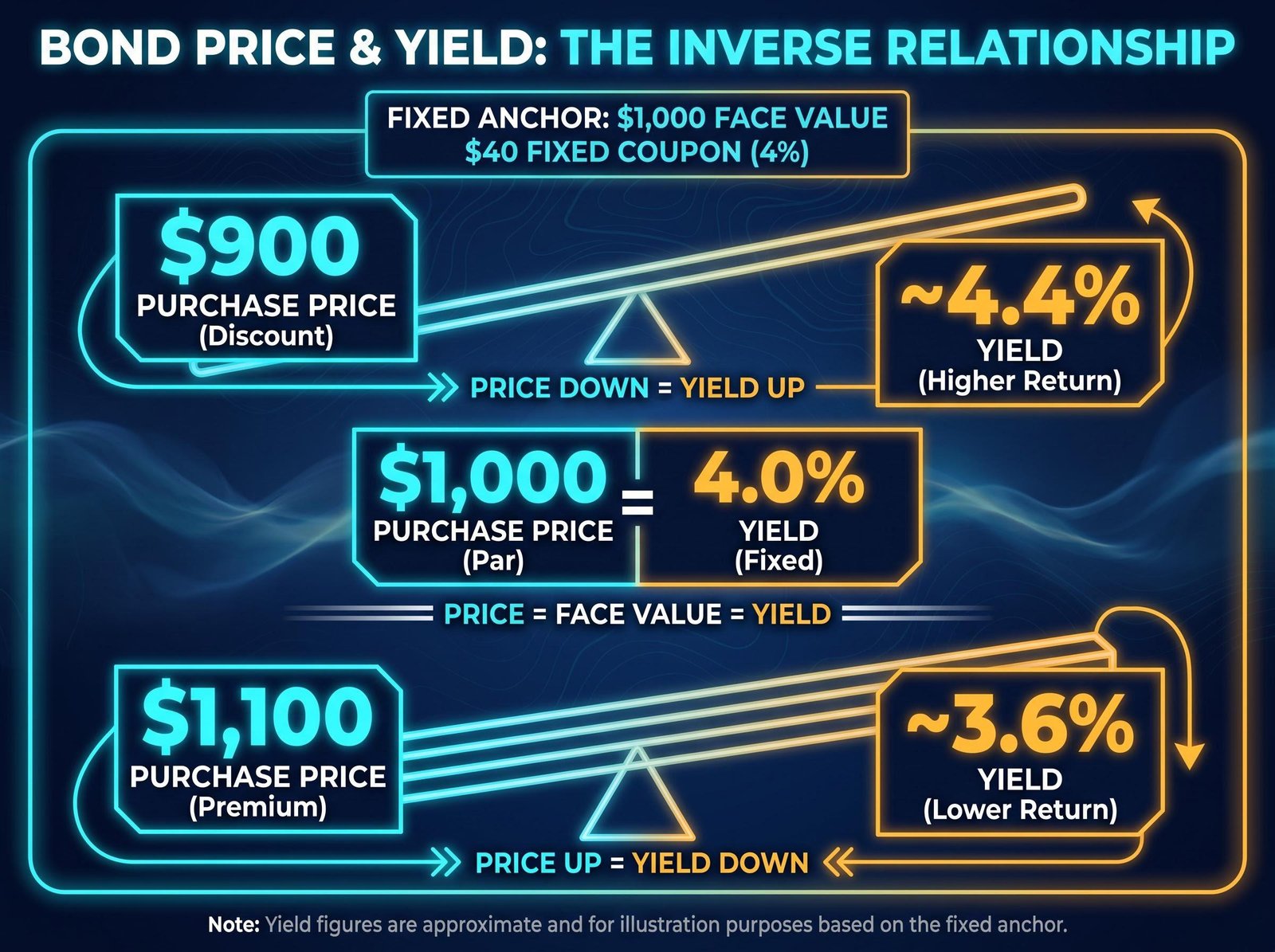
How bonds work depends on five details: the borrower, face value, coupon, maturity and the price paid. Connect those details before turning a payment schedule into a portfolio plan.
A bond looks reassuring on paper. There is an interest rate, a payment schedule and a date when the borrower is supposed to repay the debt. Compared with a stock whose future value depends on an uncertain business story, that structure can feel refreshingly concrete.
But a payment schedule is only the beginning. A bond can fall in market value while its issuer continues paying interest. An investment with a generous coupon can offer a less attractive return than a lower-coupon alternative. A maturity date can help organize a spending plan without eliminating the possibility of default.
Understanding how bonds work means connecting the promise with the price you pay and the risks you accept. This guide starts with a simple loan, follows its cash flows and explains the questions that deserve attention before a purchase. You do not need to predict the next central-bank decision to understand the basic mechanics.
What is a bond?
A bond is a debt security. When an issuer sells a bond, it borrows money under stated terms. The bondholder has a claim on the promised payments, which may include periodic interest and repayment of a specified principal amount.
The issuer might be a national government, a local authority or a company. Those borrowers use financing for different purposes, but the investor’s starting question is the same: what payments am I entitled to receive, and what could prevent them?
Buying a corporate bond makes you a creditor rather than a shareholder. Owning a company’s shares gives you an ownership interest; owning its debt gives you contractual rights defined by the security. A successful business can increase shareholder wealth substantially without increasing the fixed coupon on an existing bond.
That distinction helps explain the trade-off. A conventional bond sets out a payment arrangement rather than offering unlimited participation in business growth. In exchange, bondholders generally rank ahead of shareholders in a corporate insolvency, although priority among creditors varies and recovery may be incomplete. The precise terms matter more than a broad label such as conservative investment.
The five details that make a bond understandable
Begin with the issuer, face value, coupon, maturity and purchase price. Each answers a different question. Keeping them separate prevents many beginner mistakes.
| Detail | What it tells you | Hypothetical example |
|---|---|---|
| Issuer | Who owes the payments | A fictional company |
| Face value | Stated principal amount payable under the terms | $1,000 |
| Coupon | Contractual interest calculation | 4% fixed annually |
| Maturity | Scheduled date for principal repayment | Five years after purchase |
| Purchase price | What you actually pay for the security | $1,000 before costs |
Face value is also called par value. It is not necessarily the amount you paid. A bond with $1,000 face value can trade for more or less than $1,000 after issuance.
For a conventional fixed-rate bond, the coupon rate applies to face value. A 4% coupon on $1,000 means $40 of interest per year, assuming payments are made as promised. If the bond pays semiannually, that annual amount is normally divided into two $20 payments.
The payment frequency needs checking. Annual, semiannual and other schedules affect when cash reaches the account. Someone planning monthly spending should not assume that a bond described as income-producing sends money every month.
Follow a $1,000 bond from purchase to maturity
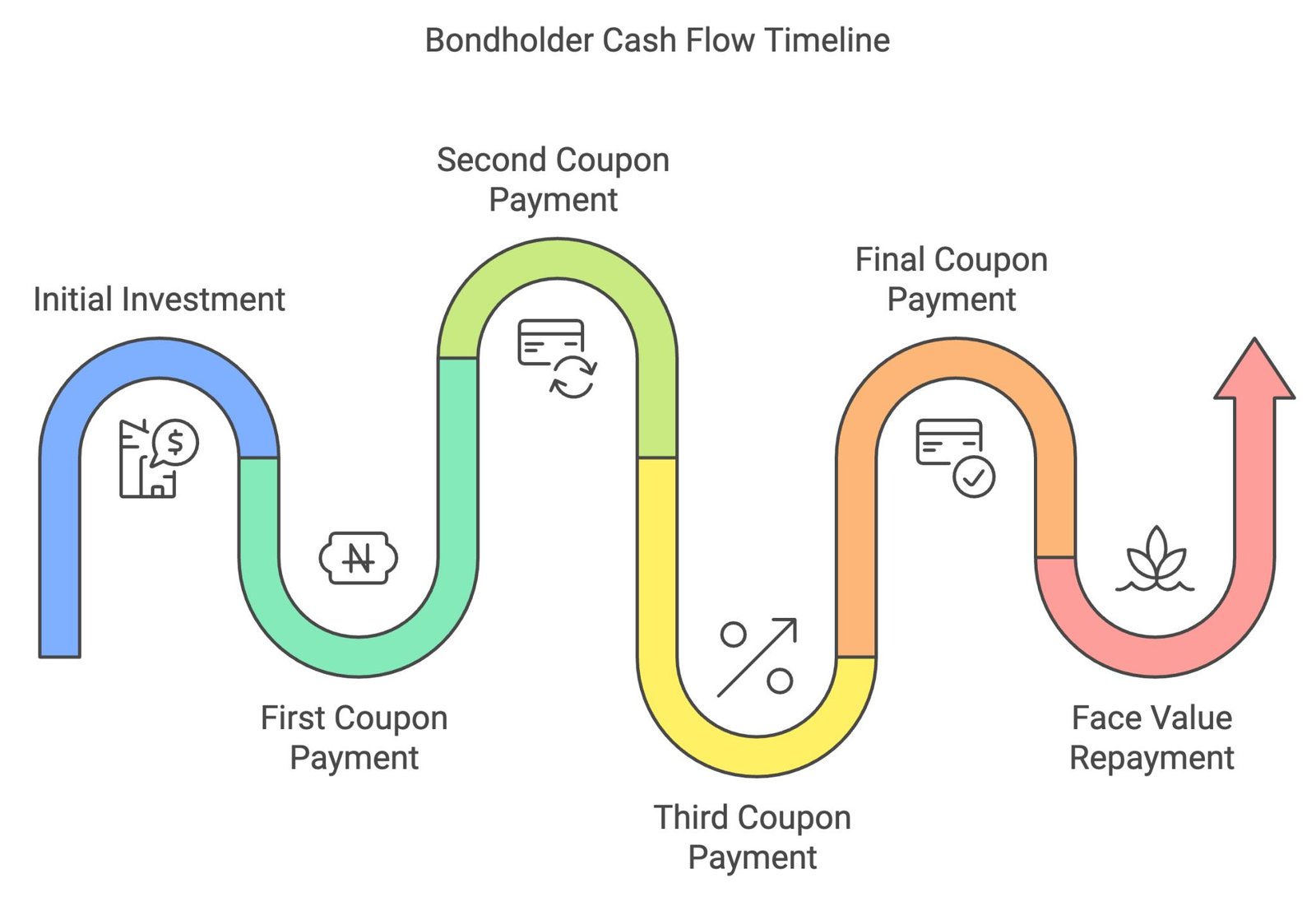
Consider a fictional, non-callable bond purchased at issuance for $1,000. It has a five-year maturity and pays a fixed 4% coupon in two installments each year. Assume every payment arrives on time, there is no default and the investor holds it to maturity.
| Year | Interest received during year | Principal repayment | Total cash received |
|---|---|---|---|
| 1 | $40 | $0 | $40 |
| 2 | $40 | $0 | $40 |
| 3 | $40 | $0 | $40 |
| 4 | $40 | $0 | $40 |
| 5 | $40 | $1,000 | $1,040 |
| Total | $200 | $1,000 | $1,200 |
The investor receives $200 of interest across five years and $1,000 of principal at maturity. The $1,000 repayment is returned capital, not an additional $1,000 profit. That is an important distinction when describing income or calculating return.
This example excludes brokerage costs, taxes, accrued interest and reinvestment earnings. It also assumes purchase at par. Those assumptions make the cash flow easy to inspect; they should not be mistaken for a complete estimate of every investor’s outcome.
The ten coupon payments can be spent, kept as cash or reinvested. The bond does not automatically compound its interest inside the security. If coupons are reinvested, the rate available on those later investments affects the eventual amount accumulated.
Why purchase price changes the investment result
Now keep the same $40 annual coupon and $1,000 maturity payment, but imagine buying the bond immediately after a coupon payment with five full years remaining. Ignore transaction costs and assume the same timely payments.
One buyer pays $950. Another pays $1,050. They receive the same contractual cash flows, yet they have made different investments because their starting costs differ.
The $950 buyer receives $200 of coupons plus $1,000 at maturity: $1,200 against a $950 purchase price. The difference is $250 before costs and taxes. The $1,050 buyer receives the same $1,200, leaving a $150 difference. These are total dollar gains across the period, not annualized yields.
A purchase below face value is a discount; a purchase above it is a premium. Paying a premium does not necessarily mean making a poor investment. A bond with attractive contractual payments can reasonably command a higher price. The useful task is comparing all payments with the actual purchase cost and relevant alternatives.
Coupon and yield answer different questions
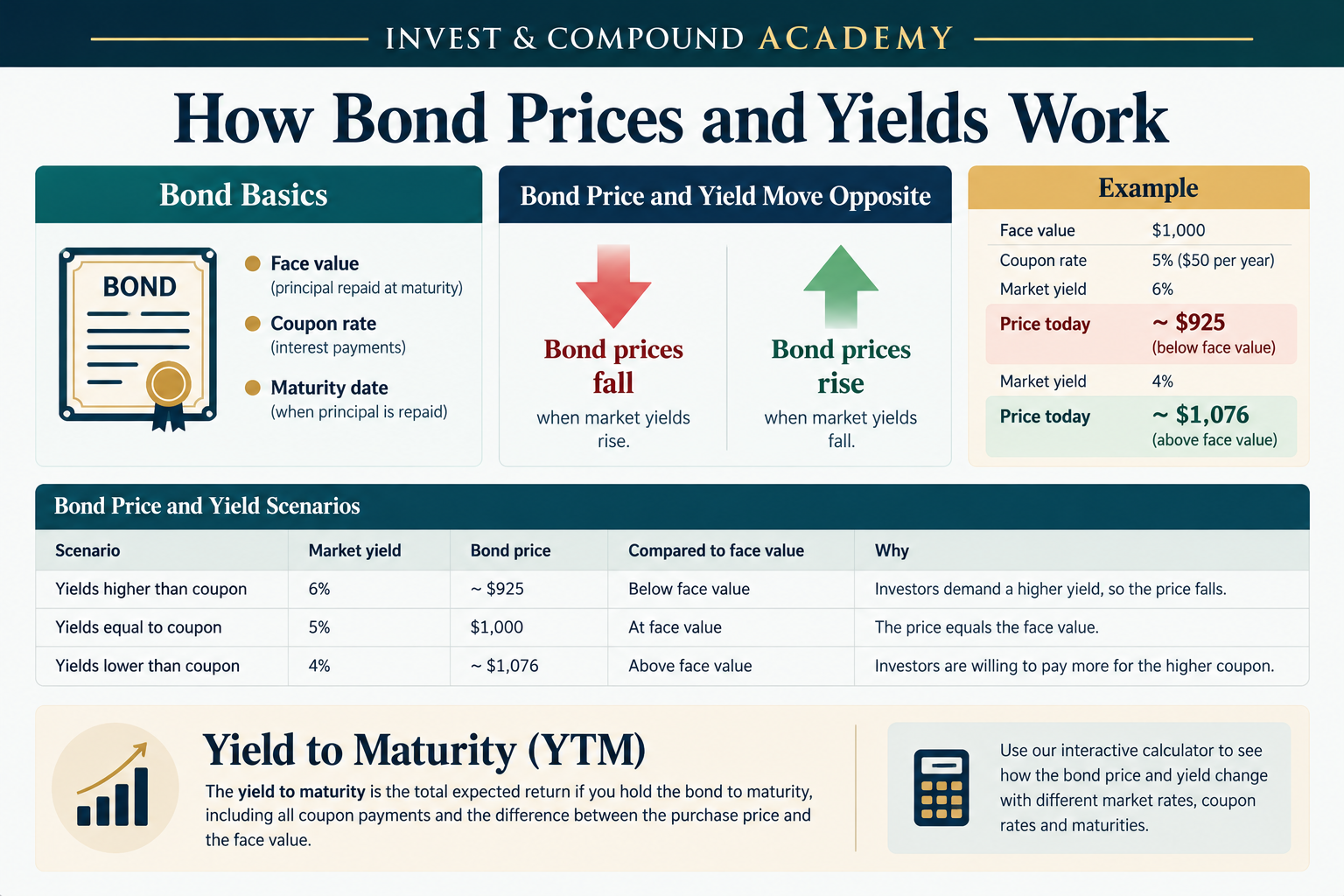
Understanding how bonds work requires separating the coupon promised under the bond’s terms from the yield implied by its price. They coincide in some simple situations, but should not be treated as interchangeable.
Current yield divides annual coupon dollars by the bond’s price. In our illustration, $40 divided by $950 is approximately 4.21%. At a $1,050 price, it is approximately 3.81%. The contractual coupon is still 4% in both cases.
Current yield leaves out the difference between purchase price and maturity repayment. It therefore cannot fully describe a discount or premium bond held to maturity. Yield to maturity uses the scheduled coupon and principal cash flows together with their timing to calculate a discount rate consistent with the purchase price.
It is a calculation under assumptions, not a promise of the investor’s eventual wealth. Default, an early sale, costs, taxes and the rate earned on reinvested coupons can change the realized result. We will examine those distinctions in the separate article on bond yields; for now, remember to ask which yield a quote is showing.
Why bond prices move even when payments do not
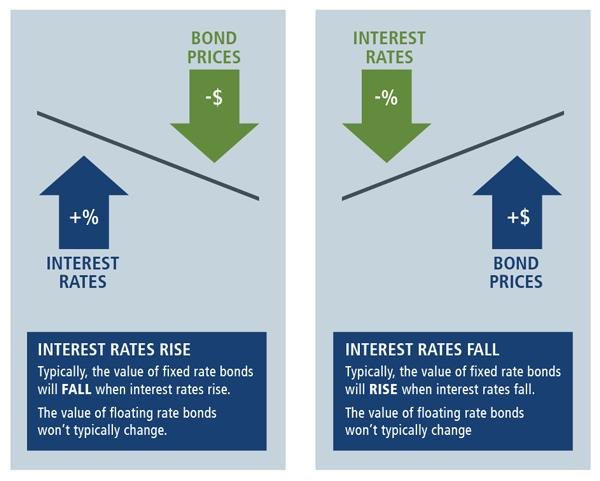
A fixed-rate bond can keep paying exactly what its contract specifies while its market price changes. This is central to how bonds work: buyers compare those fixed payments with returns available elsewhere for similar risks and payment dates.
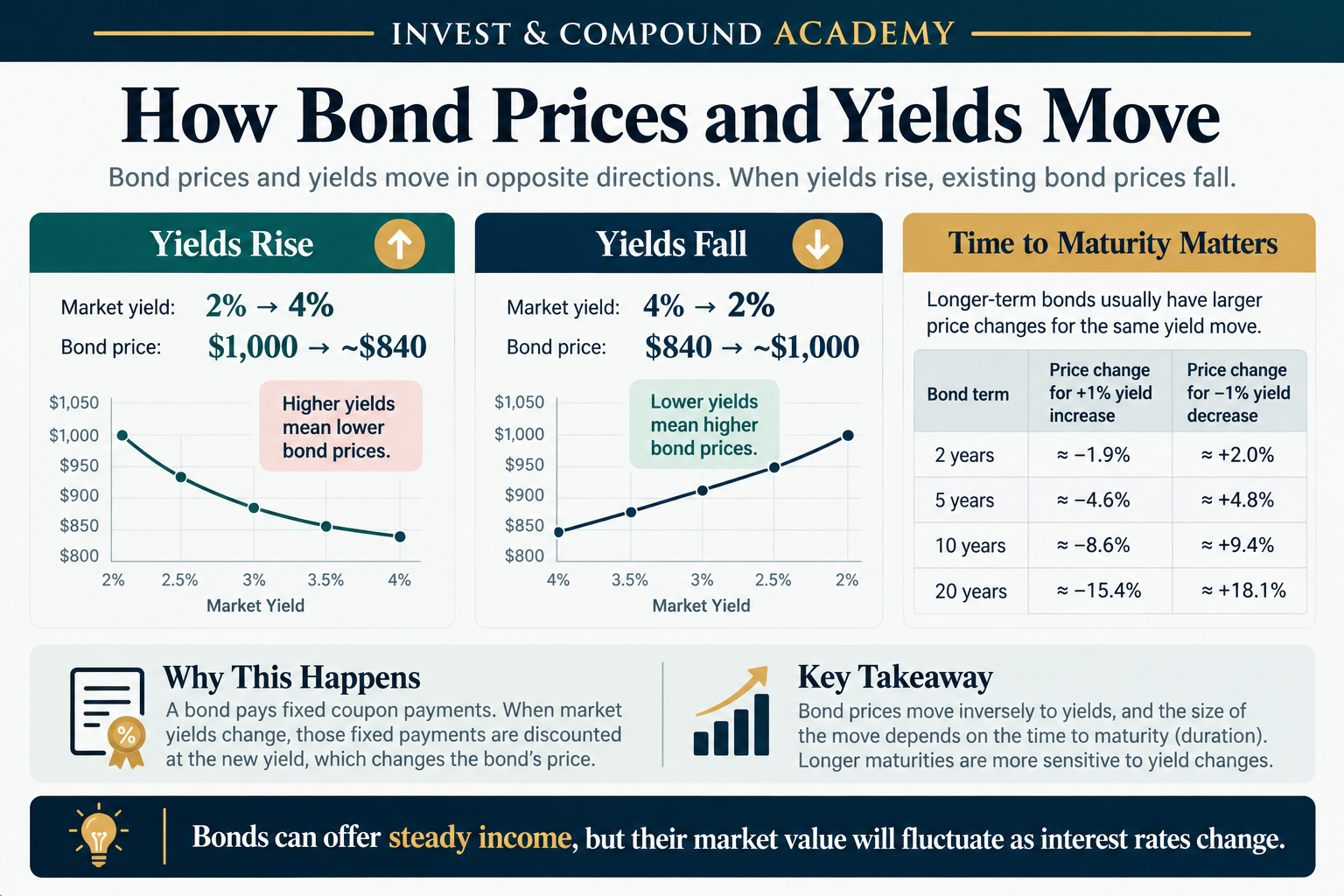
Suppose our existing bond pays $40 per year. New bonds of comparable quality and maturity begin offering more interest. A buyer would generally require a lower price for the older bond to make its smaller coupon competitive. If comparable market yields decline, the older bond’s payments become relatively more attractive and its price can rise.
This relationship is the foundation of interest-rate risk. It does not mean every bond moves identically or that interest rates alone determine prices. Credit conditions, liquidity and contractual features can also influence value.
An account statement showing a lower bond value does not, by itself, establish that the issuer missed a payment. It may show the price at which the security is currently valued. If you need to sell, however, that change matters: contractual repayment in the future does not give you the same cash today.
What maturity does—and what it does not do
Maturity identifies the scheduled principal repayment date. For a conventional bond, that gives an investor a specific date to compare with an intended spending need. A payment due in five years may fit a five-year obligation more naturally than a payment due in twenty years.
But matching dates is only part of the analysis. The investor still needs to consider payment reliability, currency and whether access to the money might be needed sooner. A long-term goal can unexpectedly become a short-term obligation after an employment or family change.
Holding a bond to maturity can avoid having to accept an unfavorable interim market price, provided the investor can actually wait and the issuer pays as promised. It does not remove default risk or restore purchasing power lost to inflation. It also does not mean a premium buyer receives their entire purchase price back: a $1,050 purchase can still have only $1,000 face value repayable.
Some bonds can be redeemed before their stated maturity under call provisions. Others have principal repayment structures that differ from the simple example above. Always read the actual security’s terms rather than applying the five-year illustration to every product carrying the word bond.
Credit risk: will the borrower meet the promise?
Credit risk concerns the issuer’s ability and willingness to meet its obligations. A delayed interest payment, missed principal payment or restructuring can change what the investor receives and when.
Credit ratings provide an outside assessment of credit quality. They can help organize a comparison, but they are opinions that may change. They do not insure the bond or eliminate the need to understand the issuer and the particular debt issue.
For a company, useful questions include how much debt comes due soon, what liquidity is available and whether the business generates enough cash to service obligations. The same issuer can have different bonds with different maturities, security and repayment priority. A familiar company name does not make all its debt interchangeable.
Higher yields often reflect greater perceived risk, although maturity, liquidity and other features also matter. Before treating a large yield difference as an opportunity, investigate what the market may be asking you to accept. The extra payment may be compensation for an exposure you would prefer to avoid.
Other risks that deserve a place in the review
Inflation risk is the possibility that fixed payments buy less over time. Receiving the promised number of dollars is different from preserving what those dollars can purchase. A fixed coupon does not automatically adjust when household costs increase.
Liquidity risk concerns selling when needed at an acceptable price. Some individual bonds trade infrequently, and the price available to a particular investor may differ from an indicative account valuation. Transaction size and dealer compensation can affect the practical cost of entering or leaving a position.
Reinvestment risk arises when coupons or principal must be invested again at uncertain rates. If a bond matures after market yields decline, replacing its income may require accepting lower payments or changing the risk exposure. A callable bond can bring this decision forward if the issuer redeems it early.
Currency risk matters when a bond pays in a currency different from the investor’s spending currency. A USD payment can remain unchanged while its CAD value moves. That makes the currency of the obligation just as important as the currency printed on the security.
Government and corporate bonds need different questions
Government bonds and corporate bonds are broad categories rather than complete risk descriptions. The country’s finances, currency, legal arrangements and particular security all matter when assessing a government issuer. Corporate analysis adds business risks and the structure of the company’s obligations.
For a beginner, the important habit is comparing like with like. A short-maturity government security and a long-maturity corporate bond differ in more than issuer type. A higher quoted yield may reflect several additional exposures at once.
We will compare these categories in a dedicated article. At this stage, avoid assuming that government means no risk or that corporate automatically means unsuitable. Identify the actual instrument and ask what role its risks and payments could serve.
How owning a bond ETF changes the arrangement
Buying a bond ETF means buying fund shares rather than becoming the direct owner of one specific bond through that purchase. The fund holds a portfolio of securities according to its strategy, and its share value reflects that portfolio along with fund-level trading conditions.
A conventional bond ETF generally does not give its shareholders a single date on which their purchase price will be repaid. Its underlying bonds mature, but the portfolio typically continues through reinvestment and trading. Target-maturity bond ETFs are a distinct structure and require their own review; their target date is not a guarantee of a particular payout.
An ETF can make diversified exposure more convenient, but diversification does not eliminate interest-rate or credit risk. Expenses, portfolio quality, maturity exposure and trading spreads also deserve attention. Readers comparing fund structures can continue with our ETF-versus-mutual-fund guide and ETF research workbook.
A practical review before buying
Write a short investment note before focusing on the order ticket. State the goal, the spending date and why this bond or fund seems relevant. Then record the terms that would make the decision reviewable later.
Ask who owes the payments; how much face value you are buying; what the coupon schedule is; what you will pay including applicable costs and accrued interest; when principal is scheduled to return; and whether early redemption is possible. For a fund, replace the single maturity question with a review of the portfolio strategy and structure.
Next, write down what could force an early sale. If the answer is an ordinary household bill, the investment may be serving a different role from the one you intended. The bear-market planning guide uses a spending-gap worksheet to help separate accessible reserves from long-term holdings.
Finally, explain the risk in your own words. If the entire justification is that the security pays an attractive percentage, the review is unfinished. A useful decision note connects that percentage with payment timing, issuer quality, price and the obligation the money is meant to support.
Frequently asked questions
Are bonds guaranteed?
No blanket guarantee applies to bonds as a category. Payment protections depend on the issuer, security and applicable terms. A contractual promise is not the same as insurance against loss.
Can I lose money if I hold a bond to maturity?
Yes. Default can reduce repayment, a premium purchase can exceed the principal returned, and costs or taxes affect the outcome. Even with timely contractual payments, inflation can reduce purchasing power. The full result includes coupons as well as repayment.
Does a higher coupon mean a better investment?
No. Compare purchase price, payment timing, credit quality and call features. A high coupon can come with a premium price or exposures that change its appeal.
Do all bonds pay regular interest?
No. Zero-coupon bonds do not make periodic coupon payments; floating-rate and other structures have different arrangements. Check the instrument rather than assuming the fixed-coupon example applies.
Can bond prices fall while interest continues arriving?
Yes. Contractual payments and market valuation are separate. Changing required yields can move the price even when the issuer remains current on payments.
A better starting question
The useful question is not simply whether bonds are safe. Understanding how bonds work means connecting their payments, price and uncertainties with the specific purpose your investment is meant to serve.
A maturity date can make planning clearer. A coupon can make income more visible. Neither replaces the need to examine the borrower or preserve flexibility for unexpected expenses. Start with the obligation you want to fund, then investigate the security that may help fund it.
Educational information, not personalized investment advice. Investments can lose value. Examples exclude taxes and trading costs unless stated otherwise.
How bonds work: Coupon and maturity cash-flow worksheet
Assumes a fixed coupon, annual periods, no default or call, no reinvestment, and no costs or taxes. Purchase price may differ from face value.
Continue Learning in the Invest & Compound Academy
Explore related lessons on bond pricing, yields, investment risk, and portfolio construction.
Bond-series articles may not be available until their scheduled publication dates.
Sources and example notes
Primary educational references support the concepts. Numerical scenarios and worksheets are original hypothetical examples, not current quotes or forecasts.
Educational content, not personalized investment or tax advice. Investments can lose value. The calculator is a simplified cost worksheet and does not recommend a transaction.