What Is a Bond Ladder? Planning Income Around Maturity Dates
Build a clearer maturity calendar with a five-rung example, and distinguish interest income, returned capital and reinvestment decisions.
By Greg Roman · Educational guide · Original hypothetical examples in USD
Bond ladder explained: start with dated obligations, choose maturity rungs, inspect issuers and call terms, compare implementation costs, and record how each maturity will be used. These five planning steps keep returned principal separate from recurring income.
A bond portfolio can produce regular interest while leaving one important question unanswered: when will principal become available? If every holding matures around the same time, the investor may face a large reinvestment decision on one date.
A bond ladder spreads scheduled maturities across different dates. Instead of placing the entire amount into one term, the investor creates a series of positions that mature in stages. The arrangement can support planned spending or a continuing reinvestment process.
The idea is straightforward, but its purpose needs to be clear. A ladder does not guarantee profit, eliminate default or make every holding easy to sell. Its value lies in organizing payment dates and decisions. This guide uses original hypothetical examples in USD and does not represent current bond offers or a recommended allocation.
Define the ladder before selecting securities
Each maturity position is often called a rung. A five-year ladder might contain securities maturing in one, two, three, four and five years. An investor can choose different spacing or unequal amounts when the goal requires it.
The design begins with the obligation. Do you need principal for specific annual expenses, or do you want a continuing portfolio that reinvests each maturing position? Those two purposes can lead to similar initial holdings and very different later actions.
For a spending ladder, maturity proceeds are deliberately available for bills. For a rolling ladder, proceeds are usually reinvested at the long end to maintain the sequence. Confusing the two can make a plan look better funded than it is.
Write the purpose in a sentence. For example: this ladder is intended to make a scheduled amount available before each of five annual expenses. That statement gives you something concrete to test before choosing a coupon or yield.
A fictional five-rung example
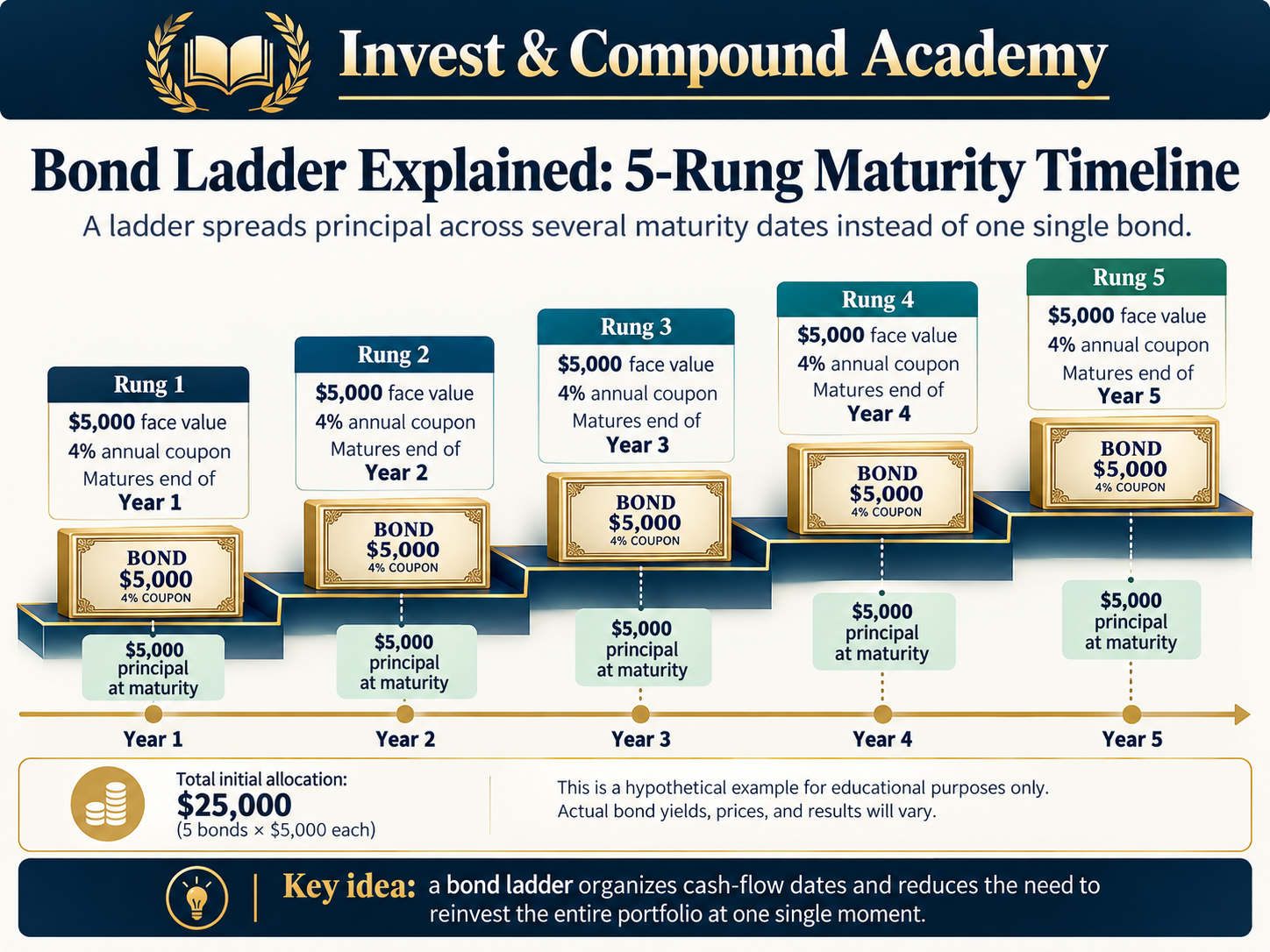
Consider an investor allocating $25,000 across five non-callable securities bought at par. Each has $5,000 face value and an illustrative 4% annual coupon. Coupon payments are annual for simplicity, and every issuer pays as promised.
| Initial rung | Purchase cost | Face value | Annual coupon | Scheduled maturity |
|---|---|---|---|---|
| 1 | $5,000 | $5,000 | $200 | End of year 1 |
| 2 | $5,000 | $5,000 | $200 | End of year 2 |
| 3 | $5,000 | $5,000 | $200 | End of year 3 |
| 4 | $5,000 | $5,000 | $200 | End of year 4 |
| 5 | $5,000 | $5,000 | $200 | End of year 5 |
Using the same coupon across terms keeps the arithmetic transparent. Real market quotes will differ, and buying every position at par may not be possible. The example is a calendar exercise rather than a representation of today’s yield curve.
At the end of year one, the first rung returns $5,000 principal and its final $200 coupon. The investor then decides what that principal is for. Spending it and reinvesting it are different actions, not two simultaneous uses of the same dollars.
Follow a ladder used for spending
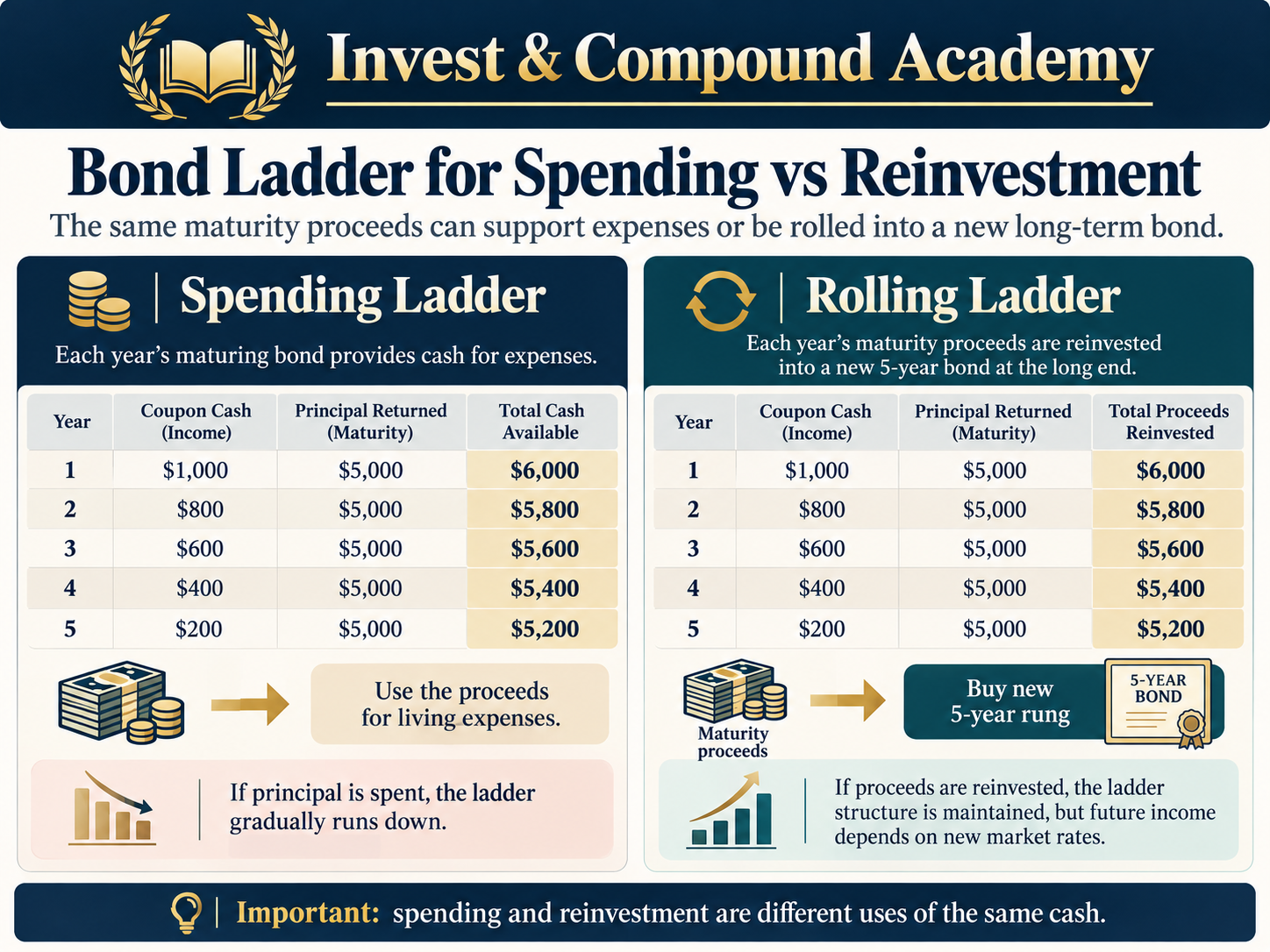
Suppose principal is spent at each maturity and no replacement bonds are purchased. All outstanding positions pay their annual coupons at year-end in this simplified example.
| Year | Outstanding rungs paying coupons | Coupon cash | Principal returned |
|---|---|---|---|
| 1 | 5 | $1,000 | $5,000 |
| 2 | 4 | $800 | $5,000 |
| 3 | 3 | $600 | $5,000 |
| 4 | 2 | $400 | $5,000 |
| 5 | 1 | $200 | $5,000 |
Total coupon cash is $3,000 over the five years. Total principal returned is $25,000. If the investor spends all maturity proceeds, the original ladder is exhausted after the final rung.
The declining coupon column matters. A spending ladder does not automatically maintain its initial interest income while principal leaves the portfolio. A household that budgets $1,000 of annual coupon income for all five years would overstate later cash flow in this example.
Returned principal also should not be labeled investment profit. It can fund spending, but doing so consumes capital. A useful budget distinguishes income received from assets used to meet obligations.
Follow a ladder maintained through reinvestment
For a rolling ladder, the investor may use the first maturity’s $5,000 to buy a new five-year security. The remaining original positions have moved one year closer to maturity, so a new long-end rung restores the sequence.
The new coupon is determined by the available investment and price at that time. It is not automatically the original 4%. If a replacement bought at par pays 3%, its annual coupon is $150; at 5%, it is $250.
In this illustration, changing the replacement rate changes coupon dollars by $50 relative to the original $200 rung. Replacing several positions over time gradually changes the ladder’s income profile.
A rolling ladder spreads reinvestment decisions across dates, which can reduce dependence on one maturity event. It does not guarantee that the sequence produces the highest possible return or protects against every interest-rate path.
Why staggered dates can help planning
Staggering maturities creates scheduled opportunities to access principal. An investor does not have to decide what to do with the entire portfolio at one maturity date.
For planned spending, the arrangement can make a cash-flow calendar easier to inspect. A rung maturing before a tuition payment or another dated expense may provide a clearer funding route than relying entirely on an uncertain future sale price.
For reinvestment, the arrangement allows part of the portfolio to encounter future market conditions at each maturity. Higher or lower rates affect new purchases gradually rather than requiring one immediate decision about the whole amount.
These are organizational benefits, not guarantees. The outcome still depends on issuer payments, prices, costs and the decisions made when cash arrives. The ladder is a process for managing dates, not a prediction about the best time to invest.
A ladder does not remove price fluctuations
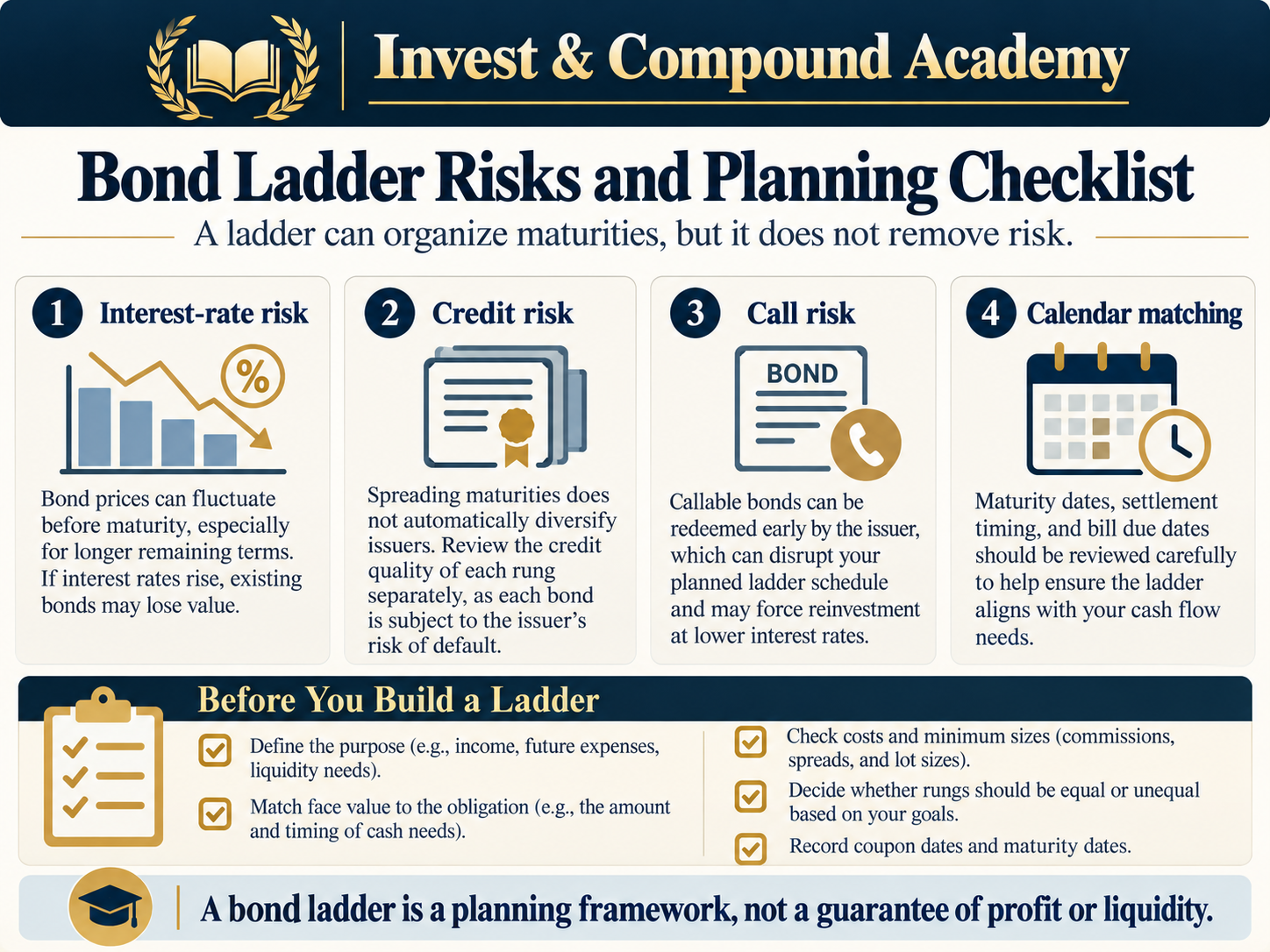
Before maturity, each bond has a market value that can change with required yields, credit conditions and liquidity. Longer remaining maturities can carry greater interest-rate sensitivity, other features being similar.
If the investor holds a position to maturity and the issuer pays as promised, the contractual principal can fund the planned use. If circumstances require an early sale, the price available then matters.
The ladder’s calendar therefore needs a separate contingency arrangement. A scheduled maturity six months away is not identical to accessible cash for a bill due tomorrow.
Do not count the same bond as both long-term ladder capital and immediate emergency cash without inspecting sale risk. Distinguishing those roles makes the plan more honest about what flexibility actually exists.
Credit quality must be reviewed rung by rung
Spreading maturities does not necessarily spread issuer exposure. Five bonds from one company still leave the investor dependent on that borrower’s finances across several payment dates.
Diversifying issuers can reduce concentration, but it does not eliminate broad credit risk. Multiple businesses in one stressed industry can share vulnerabilities even when their debt matures in different years.
For corporate debt, investigate liquidity, debt maturities, cash generation and creditor rights. For government securities, identify the actual issuer and terms rather than treating the category as one uniform risk level.
The selection process should not begin and end with finding the highest yield for each year. A maturity calendar with weak repayment assumptions may be visually tidy and financially fragile.
Call provisions can disturb the intended schedule
A callable issuer may redeem a bond earlier under its contractual rights. If that happens, principal returns before the date the investor originally expected to use or reinvest it.
Early repayment can change both cash-flow timing and future income. Reinvestment may be available at a less attractive yield, and the investor may need to rebuild a rung for the remaining obligation period.
Read call dates, call prices and conditions. Where calendar reliability is central, those terms deserve attention before purchase. A high coupon can be accompanied by rights that make the planned stream less predictable.
Do not assume every bond pays all advertised coupons until stated maturity. The correct planning inputs come from the full redemption arrangement, not just the final date printed in a short quote.
Match face value with the obligation
A $5,000 purchase does not necessarily create a $5,000 maturity payment. If a bond trades at a premium, the purchased face value may be lower than the cash spent. At a discount, it may be higher, subject to denomination constraints and costs.
Suppose a fictional security costs 105% of face value. Buying $5,000 face value costs $5,250 before accrued interest or charges. The scheduled principal payment remains $5,000.
If the spending target is $5,000, face value is the relevant principal figure for that simplified maturity plan. Purchase cost tells you how much funding the position requires today. Both belong in the worksheet.
Coupon receipts can also support expenses, but record their dates rather than adding annual totals to a bill due earlier. A payment arriving after the obligation does not solve a funding gap before it.
Calendar details deserve their own review
Match actual maturity and settlement dates with actual spending dates. A security maturing late in a year may not fund an expense due early in that year without another cash source.
Account processing, weekends, holidays and access rules can affect practical availability. Build a reasonable timing margin rather than assuming a bill and maturity can safely share an exact date.
For multiple currencies, record the currency of each obligation and payment. A maturity in USD does not promise a fixed CAD amount at the date of conversion.
The calendar is the ladder’s central feature. It deserves more care than a rough label such as year three. Exact dates can reveal a gap that an attractive annual diagram hides.
Equal rungs are optional
An equal-weight ladder is easy to describe, but real obligations can be uneven. A household might need $4,000 in one year, $8,000 in another and no scheduled principal draw in a third.
The ladder can be organized around those amounts rather than dividing capital equally. Doing so requires attention to face value, available denominations, purchase prices and the role of coupon cash.
Alternatively, an investor maintaining ongoing fixed-income exposure may prefer a regular structure for administrative simplicity. That is a different objective from precisely matching a list of expenses.
Choose the rule intentionally. Equal amounts can be convenient, but convenience should not silently override the actual cash-flow requirement the ladder is meant to support.
Funds can be used, but the structure changes
A collection of conventional bond ETFs with different duration ranges is not automatically a maturity ladder. These funds may keep replacing holdings and do not necessarily return shareholder principal on specific dates.
Target-maturity bond ETFs can provide exposure organized around specified years, with termination arrangements described in their documents. They still do not guarantee repayment of the investor’s purchase price.
If using those products, inspect credit exposure, expenses, cash management near termination and distribution timing. The calendar in the name is only part of the analysis.
Compare the administrative convenience with the uncertainty in proceeds. A fund can simplify diversification while leaving a different relationship between today’s share purchase and future cash than a directly owned bond.
Costs and minimum sizes affect implementation
Small direct portfolios may encounter minimum denominations, transaction-size constraints and costs that influence practical diversification. An elegant plan can be difficult to execute efficiently with limited capital.
Dealer markups, commissions and future reinvestment costs deserve a place in the budget. If a rung is small, fixed charges can consume a noticeable portion of its interest.
Funds introduce their own expenses and trading spreads. Compare the full implementation for your amount rather than assuming the most convenient route or the route without an expense ratio is automatically cheapest.
Before committing capital, obtain the total settlement amount and confirm that each proposed position satisfies account rules. Operational details can change the number of rungs or amounts that are realistically available.
Review the ladder without constantly redesigning it
Keep a worksheet showing issue identifiers, face values, costs, coupon dates, maturities and call provisions. Add the obligation each rung supports or the reinvestment rule that applies.
Review issuer developments and changes in the spending plan. A new obligation, material credit deterioration or early redemption can justify an update. A rate headline alone does not necessarily mean the original calendar has become useless.
At each maturity, record the action taken. If proceeds are spent, reduce the portfolio plan accordingly. If they are reinvested, record the new terms and expected income rather than retaining outdated assumptions.
This simple record makes the process auditable. You can see whether the strategy changed because the goal changed or because an investment failed to behave as expected.
Common questions about bond ladders
Does a ladder guarantee income?
No. Contractual payments depend on the securities and issuers, and call provisions can change timing. Reinvestment terms also affect future income in a rolling ladder.
Is maturing principal income?
It is returned capital. It can fund expenses, but spending it reduces assets unless other resources replenish them. Keep it separate from interest when describing recurring income.
How many rungs should a ladder have?
There is no universal number. Capital, denominations, transaction costs, obligation dates and monitoring capacity affect a workable design.
Does a ladder benefit from higher rates?
Future reinvestments may offer more income, while existing holdings can fall in market value. The overall outcome depends on cash flows, time horizon and the actual path of rates and credit conditions.
Let the calendar serve the goal
A bond ladder is useful when its schedule explains how money reaches a specific purpose. Staggering dates can organize spending and reinvestment, but the structure still needs dependable payment assumptions and realistic costs.
Begin with the amount and date of each obligation. Then choose securities or fund structures whose terms you understand. The ladder becomes a practical planning tool when every rung has a job and every returned dollar has a clearly stated next use.
Educational information only. Examples are hypothetical and do not prescribe a portfolio. Investing involves risk, including loss of principal.
Bond ladder explained: Equal-rung spending ladder worksheet
Equal face-value rungs maturing annually from year 1 to the selected final year. All bought at par; identical fixed coupon; coupons paid annually; no replacement purchases, default, calls, fees or taxes. Denomination limits are ignored.
Continue Learning in the Invest & Compound Academy
Explore related explanations of bond risk, credit quality, and portfolio construction.
Bonds, rates and fixed income
How bonds work Bond prices and rates Bond yield Government vs corporate Bond ETFs vs bonds Bond ladders Best bond ETFs
Sources and Further Reading
Primary educational references support the concepts. Numerical scenarios and worksheets are original hypothetical examples, not current quotes or forecasts.