Accounting Identities vs Behavioral Equations. What Must Add Up and What People Choose
Some economic equations are true by definition, while others describe how people choose. This guide explains the difference, shows how identities and behavioral equations work together and walks through the classic mistakes that come from mixing them up.
Identities hold by definition, behavioral equations describe choices
An identity alone cannot predict what happens when something changes
Statements rest on identities, forecasts on uncertain behaviour
Two statements that look alike but mean very different things
A household earns $6,000 a month after tax, spends $5,400 and saves $600. The statement income equals spending plus saving is always true for that household, in every month, because saving is defined as whatever income is not spent. Now consider a different statement: when this household’s income rises by $1,000, it spends about $700 more. That one might be true or false. It describes how the family chooses to behave, and it could change if circumstances change. The first statement is an accounting identity. The second is a behavioral equation. Confusing the two is one of the most common errors in economic reasoning.
Both kinds of statements appear in economic models, often side by side, and both are written as equations. Identities are essential for keeping numbers consistent. Behavioral equations are essential for explaining and predicting what people do. But an identity cannot tell you what will happen when something changes, and treating it as if it could leads to confident conclusions that do not follow.
This guide explains the difference between accounting identities and behavioral equations, shows how each is used, and walks through the classic mistakes that come from mixing them up. It builds on Equations as Economic Relationships and Choosing a Model for a Question.
What an accounting identity is
An accounting identity is an equation that holds by definition. It follows from how quantities are measured and classified, not from how anyone behaves. It must be true for every set of correctly recorded numbers, past, present or future.
Common identities include profit equals revenue minus costs, a household’s income equals its spending plus its saving, a balance sheet’s assets equal liabilities plus equity, and, for a whole economy, total output equals consumption plus investment plus government purchases plus net exports. None of these says anything about why the numbers take the values they do. They only say how the numbers must fit together.
Identities are powerful precisely because they cannot be violated. If an identity fails in a set of data, something has been measured or recorded incorrectly. That makes identities excellent tools for checking accounts, spotting data errors and ensuring that a model’s numbers are consistent.
What a behavioral equation is
A behavioral equation describes a choice or a response. It says how one quantity tends to change when conditions change, based on the decisions of people or organizations. Examples include a household spending a certain share of extra income, firms investing more when interest rates fall, or drivers buying less gasoline when its price rises.
Behavioral equations are claims about the world. They can be tested against evidence, estimated from data and revised when new evidence appears. They may hold well in some periods and poorly in others. A household’s spending pattern might change after a job loss, a pandemic or a change in interest rates. A behavioral equation is therefore never guaranteed to hold, but it is the kind of equation that can explain and predict.
| Feature | Accounting identity | Behavioral equation |
|---|---|---|
| Why it holds | By definition | Because of how people choose |
| Can it be wrong? | Only if data are mismeasured | Yes, it can fail or change |
| Explains behaviour? | No | Yes |
| Main use | Consistency checks, bookkeeping | Explanation and prediction |
| Example | Income = spending + saving | Spending rises $0.70 per extra $1 of income |
A simple test captures the difference. Ask whether the statement could be shown false by gathering more evidence about how people behave. If more evidence could never overturn it, because it follows from definitions, it is an identity. If evidence could show it to be wrong in some places or periods, it is a behavioral claim. The gym owner who says higher prices mean higher revenue is making a behavioral claim disguised as arithmetic, because members may respond by leaving. The economist who says imports must be subtracted from total spending to measure domestic output is stating an identity, because that is how domestic production is defined. Keeping this test in mind makes it much easier to see when an argument has quietly slipped from bookkeeping into prediction without evidence to support the step.
A worked example: the household budget
Put the two kinds of equations together for the household above. The figures are illustrative.
Identity: income = spending + saving.
Behavioral equation: spending = $1,200 + 0.70 × income.
At income of $6,000: spending = $1,200 + $4,200 = $5,400. Saving = $6,000 − $5,400 = $600.
If income rises to $7,000: spending = $1,200 + $4,900 = $6,100. Saving = $7,000 − $6,100 = $900.
The identity ensures the numbers add up. The behavioral equation determines how the extra $1,000 is split: $700 more spending and $300 more saving.
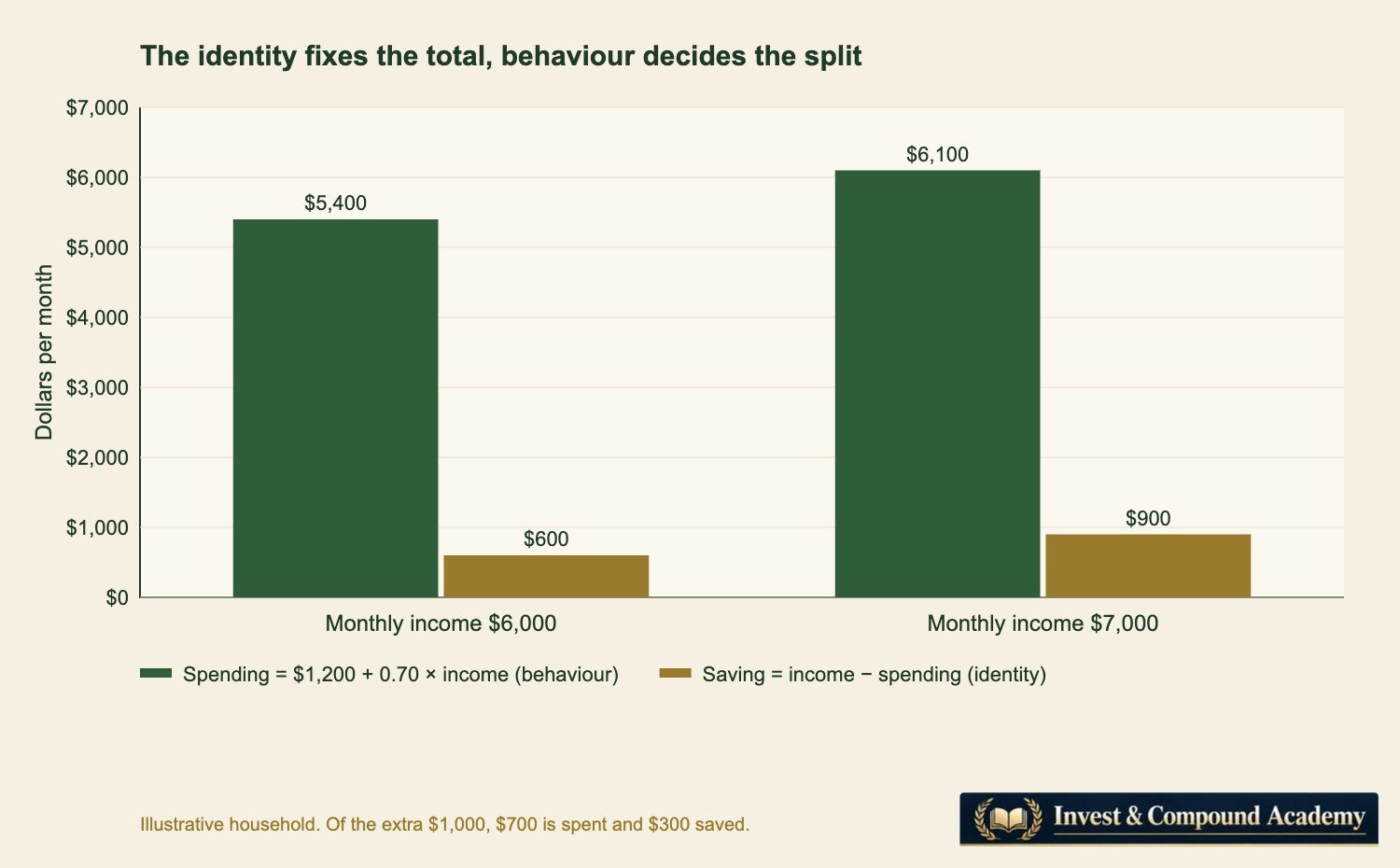
Notice what each equation contributes. The identity alone would allow any split of the extra $1,000, from spending all of it to saving all of it. Only the behavioral equation says which split is likely. If the family’s behaviour changed, perhaps because of worries about job security, the behavioral equation would change, but the identity would still hold.
The 0.70 in the behavioral equation is called the marginal propensity to consume, the share of an extra dollar of income that is spent. It is a parameter that must be estimated from evidence, and it can differ widely between households. Families with little savings often spend a larger share of extra income than wealthier families. Marginal thinking of this kind is explored in Marginal vs Average.
The national accounts identity
The best-known identity in economics describes a whole economy’s output. Gross domestic product, or GDP, equals the sum of spending on what the economy produces: consumption by households (C), investment by businesses and in housing (I), government purchases of goods and services (G), and net exports, which are exports minus imports (NX).
Y = C + I + G + NX
This identity holds because of how GDP is measured. Every dollar of final output is counted as bought by someone, with goods produced but not sold counted as inventory investment. Statistical agencies such as Statistics Canada build national accounts so that the identity holds, apart from statistical discrepancies that arise from imperfect data.
The identity is enormously useful for organizing data and checking consistency. It is not, by itself, a theory of how the economy works. It does not say that raising government purchases by $1 billion will raise GDP by $1 billion. That depends on how households, businesses and foreign buyers respond, which requires behavioral equations. The identity leaves room for GDP to rise by more, by less or not at all.
Classic mistakes from treating identities as theories
Many arguments in public debate draw behavioural conclusions from identities alone. The reasoning looks airtight because the identity is true, but the conclusion does not follow.
Mistake one: if government spends more, GDP must rise by the same amount. The identity Y = C + I + G + NX holds, but an increase in G could be accompanied by changes in C, I or NX. If extra government spending raises interest rates and discourages private investment, or draws in more imports, GDP could rise by less than the increase in G. If it puts unemployed workers back to work and they spend their wages, GDP could rise by more. The identity cannot say which.
Mistake two: cutting imports must raise GDP. Imports enter the identity with a minus sign, so it can look as if fewer imports mechanically mean more output. But the minus sign is there only because imports are already counted inside C, I and G and must be subtracted to avoid counting foreign production as domestic. If a tariff reduces imports, households may simply buy less in total, or other countries may retaliate against exports. The effect on GDP depends on behaviour, not on the sign in the identity.
Mistake three: higher prices must mean higher revenue. Revenue equals price times quantity, an identity. But raising the price changes the quantity people buy. Whether revenue rises or falls depends on how strongly buyers respond, a behavioral relationship explored in Equations as Economic Relationships.
A gym charges $50 a month and has 800 members, so revenue = $50 × 800 = $40,000 a month.
Raising the price to $60 is a 20 percent increase. If membership stays at 800, revenue rises to $48,000.
If 200 members leave, membership falls to 600 and revenue = $60 × 600 = $36,000, lower than before.
The identity holds in both cases. Only the members’ behaviour decides which outcome occurs.
Saving equals investment, and what it does not mean
Another famous identity says that, in a closed economy without trade, total saving equals total investment. It follows from the national accounts: output not consumed by households or the government is, by definition, investment, and income not consumed is, by definition, saving.
This identity is sometimes used to argue that more saving automatically produces more investment. It does not. If households suddenly try to save more by spending less, businesses may see sales fall and unsold goods pile up. Inventories rise, which counts as investment, so the identity still holds. But firms may then cut production and lay off workers, reducing incomes and possibly reducing total saving. John Maynard Keynes called this possibility the paradox of thrift in the 1930s: attempts by everyone to save more can reduce total income. Whether the paradox occurs depends on behaviour, interest rates and the state of the economy, not on the identity. This links to the fallacy of composition, explained in The Fallacy of Composition.
How identities help
Identities may not explain behaviour, but they are indispensable in several ways.
Checking data and calculations. If a company’s reported revenue minus reported costs does not equal its reported profit, something is wrong. Auditors, statisticians and analysts rely on identities to catch errors.
Disciplining arguments. Identities reveal what must give when something changes. If a country wants to reduce its trade deficit, the national accounts show that either domestic saving must rise relative to investment, or investment must fall relative to saving. The identity does not say which will happen, but it rules out claims that ignore these links. Economists often describe identities as constraints that any credible story must respect.
Organizing information. Identities provide frameworks for collecting and presenting data, from household budgets to national accounts. They make sure every dollar is counted once and only once.
Linking behavioral equations. In a model, identities connect behavioral equations so that the whole system stays consistent. A consumption equation and an investment equation can be combined through the GDP identity to show how total output responds to changes in conditions.
A worked example: combining identity and behaviour
A simple textbook model shows how identities and behavioral equations work together. The figures are illustrative and ignore trade and taxes for simplicity.
Identity: output Y = consumption C + investment I + government purchases G.
Behavioral equation: C = 100 + 0.75Y, with all figures in billions of dollars.
With I = 200 and G = 300: Y = 100 + 0.75Y + 200 + 300, so 0.25Y = 600 and Y = 2,400.
If G rises by 20 to 320: 0.25Y = 620 and Y = 2,480. Output rises by 80, four times the increase in G.
The multiplier of 4 comes from the behavioral parameter 0.75, not from the identity. If households spent only 0.50 of extra income, the multiplier would be 2. If extra government spending crowded out private investment, the effect would be smaller still.
The example is deliberately simple. Real economies include taxes, imports, interest rate responses and central bank policy, all of which tend to reduce the multiplier. Estimates of fiscal multipliers in advanced economies vary widely, often between less than one and about two depending on conditions, such as whether interest rates are near zero and whether the economy has unused capacity. The point is that the size of the effect depends on behaviour, and the identity only keeps the accounting straight.
The open economy identity
For an economy that trades with the rest of the world, the saving and investment identity includes a third term. National saving equals domestic investment plus net lending to the rest of the world, which is closely related to the current account balance. A country that invests more than it saves must borrow the difference from abroad and typically runs a current account deficit. A country that saves more than it invests lends the surplus abroad.
This identity is often invoked in debates about trade. It shows that a country’s trade balance is linked to its saving and investment decisions, not only to trade policy. Tariffs that leave national saving and investment unchanged may do little to change the overall trade balance, even if they shift trade between partners or products. The identity does not prove that tariffs are ineffective, because tariffs can change saving, investment and exchange rates. But it shows that any credible claim about the trade balance must explain what happens to saving and investment.
For Canada, which trades heavily with the United States and other partners, these links help explain why the current account balance moves with commodity prices, business investment and household saving, not just with trade agreements. Comparative advantage, which explains why countries trade at all, is discussed in Comparative Advantage.
How national accounting identities developed
Modern national accounts are relatively recent. During the 1930s and 1940s, economists including Simon Kuznets in the United States and Richard Stone and James Meade in the United Kingdom developed systematic ways to measure national income and output. Their work was spurred by the Great Depression and the need to plan wartime production. Kuznets later received the Nobel Memorial Prize in 1971, and Stone in 1984, in part for this work.
The United Nations published its first System of National Accounts in 1953, providing international standards that countries, including Canada, have updated several times since. These standards define the identities that link production, income and spending, so that GDP measured by adding up spending should equal GDP measured by adding up incomes. In practice, the different measures differ slightly because of data limitations, and statistical agencies report the gap as a statistical discrepancy.
Kuznets himself warned that national income measures are not measures of welfare. GDP adds up market activity, but it leaves out unpaid household work, leisure and environmental damage, as discussed in Households and Nonmarket Production.
Identities and behaviour in business
Business analysis uses the same distinction. The identity profit = revenue − costs always holds. A plan to raise profit by cutting advertising costs looks good in the identity, because costs fall. But advertising may affect sales, so revenue may also fall. Whether profit rises depends on how customers respond, which is a behavioral question.
Similarly, cash flow identities show how a firm’s cash changes from operations, investment and financing. They are essential for financial planning. But forecasting future cash flows requires behavioral assumptions about customers, suppliers and competitors. Financial statements are built on identities, while business strategy is built on behavioral judgements. Understanding costs and their categories is covered in Explicit and Implicit Costs.
Government budgets and the identity trap
Government finances follow identities too. Each year, the budget deficit equals spending minus revenue, and the stock of debt rises by roughly the size of the deficit. These relationships hold by definition.
Debates about public finances sometimes treat these identities as if they settled policy questions. A claim that cutting spending by $10 billion will reduce the deficit by $10 billion assumes that revenue is unaffected. But spending cuts can reduce incomes and therefore tax revenue, especially in a weak economy. Tax increases may reduce economic activity and raise less than a static calculation suggests, or raise more if they are well designed. The deficit identity holds in every case, while the actual change in the deficit depends on behaviour.
The debt-to-GDP ratio adds another layer. The ratio falls if GDP grows faster than debt, even when debt is rising. Its path depends on the interest rate paid on debt, the growth rate of the economy and the budget balance before interest payments. The relationship among these is an identity, but their future values depend on behaviour and policy. This is why projections of public debt are typically shown under several scenarios, an approach covered in Sensitivity Analysis and Scenario Design.
The balance sheet identity
Every balance sheet, whether for a household, a company or a bank, rests on one identity: assets equal liabilities plus equity. Equity, or net worth, is defined as whatever remains after debts are subtracted from assets, so the identity always holds.
A family owns a home worth $500,000 and other assets of $50,000, for total assets of $550,000. It owes $350,000 on a mortgage. Equity = $550,000 − $350,000 = $200,000.
If home prices fall 10 percent, the home is worth $450,000 and total assets $500,000. Equity falls to $150,000, a 25 percent drop.
The identity shows how borrowing magnifies the effect of a price change on equity. It does not say whether home prices will fall, or how the family will respond, for instance by cutting spending to rebuild savings. Those are behavioral questions.
Economists have studied how such balance sheet effects influence spending. After housing prices fell sharply in the United States from 2006, research by Atif Mian and Amir Sufi found that areas where households had borrowed more saw larger declines in spending. The balance sheet identity described the loss in equity, while behavioral evidence showed how households responded to it.
How to tell which kind of equation you are reading
A few questions help classify any equation.
- Could it ever be false if the data were measured correctly? If not, it is an identity.
- Does it describe a choice or response? If it says how someone reacts to prices, income or rules, it is behavioral.
- Does it contain parameters estimated from data? Identities usually have coefficients of one, while behavioral equations contain parameters like 0.75 or −2,000 that come from evidence.
- Would it change if people’s preferences or circumstances changed? Behavioral equations would. Identities would not.
Some equations sit between the two categories. A production relationship, describing how much output a factory can make with given workers and machines, is technical rather than behavioral or definitional. Equilibrium conditions, such as quantity supplied equals quantity demanded, describe where forces balance rather than a definition, a topic explored in Equilibrium vs Adjustment.
What it means for investors
Financial statements are built on identities. A balance sheet must balance, cash flows must reconcile and earnings must equal revenue minus expenses. These identities help investors check that reported figures are consistent and spot warning signs, such as profits that grow while operating cash flow shrinks.
Investment stories, however, are behavioral. A claim that a company will grow earnings by 15 percent a year depends on assumptions about customers, competitors and costs. A claim that lower interest rates will lift share prices depends on how investors and businesses respond. Investors who treat an accounting relationship as a guarantee of future behaviour can be badly surprised. Identities tell you what must add up, while behavioural judgements, which are always uncertain, tell you what might happen. Broad diversification, explained in What Is Diversification in Investing, reduces exposure to any single behavioral bet going wrong.
Identities and behaviour in personal finance
Personal finance offers everyday examples. Your net worth equals what you own minus what you owe, an identity. Paying down a credit card with money from a savings account leaves net worth unchanged on the day it happens, because assets and debts fall by the same amount. Yet the decision can still be wise, because it changes future interest costs, a behavioural and financial consequence the identity does not show.
Similarly, a monthly budget identity says income equals spending plus saving. Setting a goal to save $500 a month is easy to write in the identity, but achieving it depends on behaviour, such as whether spending can actually be reduced or whether automatic transfers make saving easier. Many people find that setting up automatic contributions changes their behaviour more effectively than relying on willpower, a finding consistent with research in behavioural economics. Our investment growth calculator shows how steady monthly saving adds up over time.
Common mistakes
Drawing predictions from identities alone
An identity shows how numbers fit together, not how they will change. Predicting effects requires behavioral equations.
Treating behavioral equations as guaranteed
Behavioral relationships can shift with circumstances, expectations and policy. They should be tested and revised.
Ignoring offsetting changes
When one term in an identity changes, others may change too. Assuming everything else stays fixed is a behavioral assumption, not a fact.
Reading signs in identities as causes
The minus sign on imports in the GDP identity reflects accounting, not a claim that imports reduce output.
Forgetting statistical discrepancies
In real data, identities may not balance perfectly because of measurement errors. Small discrepancies are normal, while large ones suggest problems with the data.
Frequently asked questions
What is an accounting identity in simple terms?
It is an equation that is true by definition, such as profit equals revenue minus costs. It must hold for correctly measured numbers but does not explain why the numbers take the values they do.
What is a behavioral equation?
It describes how people, firms or governments respond to conditions, such as how much households spend when income rises. It can be tested, estimated and revised.
Why does the GDP identity not tell us the effect of government spending?
Because other components, such as consumption, investment and net exports, may change in response. The identity holds whatever happens, so it cannot predict the overall effect.
Is saving always equal to investment?
In national accounts for a closed economy, yes, by definition. In an open economy, the identity includes the trade balance and foreign borrowing. The identity does not mean more saving automatically creates more productive investment.
What is the marginal propensity to consume?
It is the share of an extra dollar of income that a household spends rather than saves. It is a behavioral parameter estimated from evidence and differs across households and over time.
Can an identity ever be useful for prediction?
Indirectly. Identities ensure that predictions from behavioral equations are consistent with each other, and they reveal what else must change if one quantity changes. On their own, they cannot say which outcome will occur.
Why do economists say identities are constraints?
Because any model or story about the economy must respect them. If a forecast predicts higher consumption, investment and government purchases with lower output and unchanged trade, it violates the GDP identity and must contain an error.
Does every behavioral equation need an identity beside it?
Not always, but in most models identities link behavioral equations together so that totals stay consistent. A consumption equation on its own predicts spending, while the budget identity then determines saving as whatever income is left.
Key takeaways
- Accounting identities hold by definition and are essential for consistency, but they do not explain behaviour.
- Behavioral equations describe how people respond and can be tested, estimated and revised.
- Predictions require behavioral equations, while identities ensure the predictions add up.
- Classic mistakes come from reading identities such as Y = C + I + G + NX or revenue = price × quantity as theories.
- Identities act as constraints that any credible economic story must respect.
- For investors, financial statements rest on identities, while forecasts rest on uncertain behavioural judgements.
Continue Learning with Invest & Compound Academy
Continue through the chapter on understanding economic models.
All topics in this chapter
More topics to explore
Sources and further reading
OpenStax, Principles of Economics, 3rd ed. · Statistics Canada, Gross domestic product · United Nations, System of National Accounts · John Maynard Keynes, The General Theory of Employment, Interest and Money, 1936 · Atif Mian and Amir Sufi, House of Debt, 2014
Educational disclosure
This article provides general economics education for informational purposes only. It is not financial, investment, tax or legal advice, and it does not consider your personal circumstances. Examples are simplified for teaching and do not describe real people, organizations or recommendations.