Equilibrium vs Adjustment. Where a Model Can Settle and How It Gets There
Equilibrium describes where forces balance, while adjustment describes the path to get there. This guide explains how markets move toward balance, what speeds or blocks adjustment, and why equilibrium never means good, permanent or instant.
Equilibrium is where forces balance, adjustment is the path there
Equilibrium is not necessarily good, permanent or instant
High profits attract new supply, so unusual results rarely last
Where a market can settle and how long it takes to get there
A new cycling trail opens near a small town, and demand for bicycle rentals jumps. On the first warm Saturday, the two rental shops run out of bikes by mid-morning and turn customers away. Over the following weeks, the shops raise their prices, buy more bikes and extend their hours. A third shop opens. By the end of the summer, prices have settled, most customers who want a bike can get one, and the shops are no longer turning people away. Economists would say the market moved from a disturbance toward a new equilibrium. The path it took to get there is called adjustment.
Equilibrium is one of the most used words in economics, and also one of the most misunderstood. It describes a situation in which forces balance and there is no internal pressure for change. It does not mean the situation is good, fair or permanent, and it does not say how quickly or smoothly the economy will get there. Adjustment describes the process, which can be fast or slow, smooth or bumpy, and sometimes never completes before conditions change again.
This guide explains what equilibrium means, why it is useful, how adjustment works, what can slow or block it, and how to avoid common misreadings. It builds on Equations as Economic Relationships and leads into Static vs Dynamic Models.
What equilibrium means
An equilibrium is a state in which the forces acting on a system balance, so that, unless something outside changes, the system has no tendency to move. In a market, it is usually the price at which the quantity buyers want to purchase equals the quantity sellers want to offer. At that price, no buyer is left wanting to buy at the going price and no seller is left wanting to sell, so there is no pressure on the price to rise or fall.
Equilibrium is a property of a model, given its assumptions. It answers the question: if conditions stayed as they are, where would things settle? It is a powerful tool because it lets economists predict the direction of change without tracing every step. If demand rises, the equilibrium price rises. If a new technology lowers costs, the equilibrium price falls. These predictions often hold well in practice, even when the path is messy.
A worked example: bicycle rentals
Consider the rental market in the town after the trail opens. The figures are illustrative.
Daily demand for rentals: Qd = 300 − 4P, where P is the daily rental price in dollars.
Daily supply of rentals once shops have adjusted: Qs = 20 + 3P.
Equilibrium where Qd = Qs: 300 − 4P = 20 + 3P, so 7P = 280 and P = $40. Quantity = 300 − 160 = 140 rentals a day.
At a price of $30, demand would be 180 rentals and supply 110, a shortage of 70. At $50, demand would be 100 and supply 170, a surplus of 70.
A shortage puts upward pressure on price, and a surplus puts downward pressure on price. Only at $40 is there no pressure either way.
The equilibrium tells us where the market tends to settle. It does not tell us how quickly shops will raise prices, how long it takes to buy and deliver new bikes, or whether shops might overshoot by buying too many. Those are questions about adjustment.
Thinking in terms of both equilibrium and adjustment gives a more complete picture than either alone. Equilibrium analysis answers where the market is heading and how a change in conditions alters that destination. Adjustment analysis answers how long the journey takes, what happens to prices and quantities along the way, and who bears the costs of the transition. A forecast that ignores adjustment may describe the destination correctly while badly misjudging the months or years in between, which is often exactly when decisions about prices, investment and policy must be made.
How adjustment works
When a market is out of equilibrium, buyers and sellers face pressures that push prices and quantities toward balance. In a shortage, sellers notice that customers are turned away and raise prices; some buyers give up or look elsewhere, and sellers expand supply. In a surplus, sellers cut prices to clear unsold stock, buyers are drawn in and some sellers reduce supply.
Suppose rental shops adjust their price each week by one tenth of the gap between demand and supply, measured in dollars per rental short. Starting at $30, with demand of 180 and supply of 110, the shortage is 70, so the price rises by $7 to $37.
At $37: demand 152, supply 131, shortage 21, so the price rises by $2.10 to $39.10.
At $39.10: demand 143.6, supply 137.3, shortage 6.3, so the price rises by about $0.63 to $39.73.
Each week, the gap shrinks, and the price approaches $40. The adjustment rule, not the equilibrium itself, determines how fast that happens.
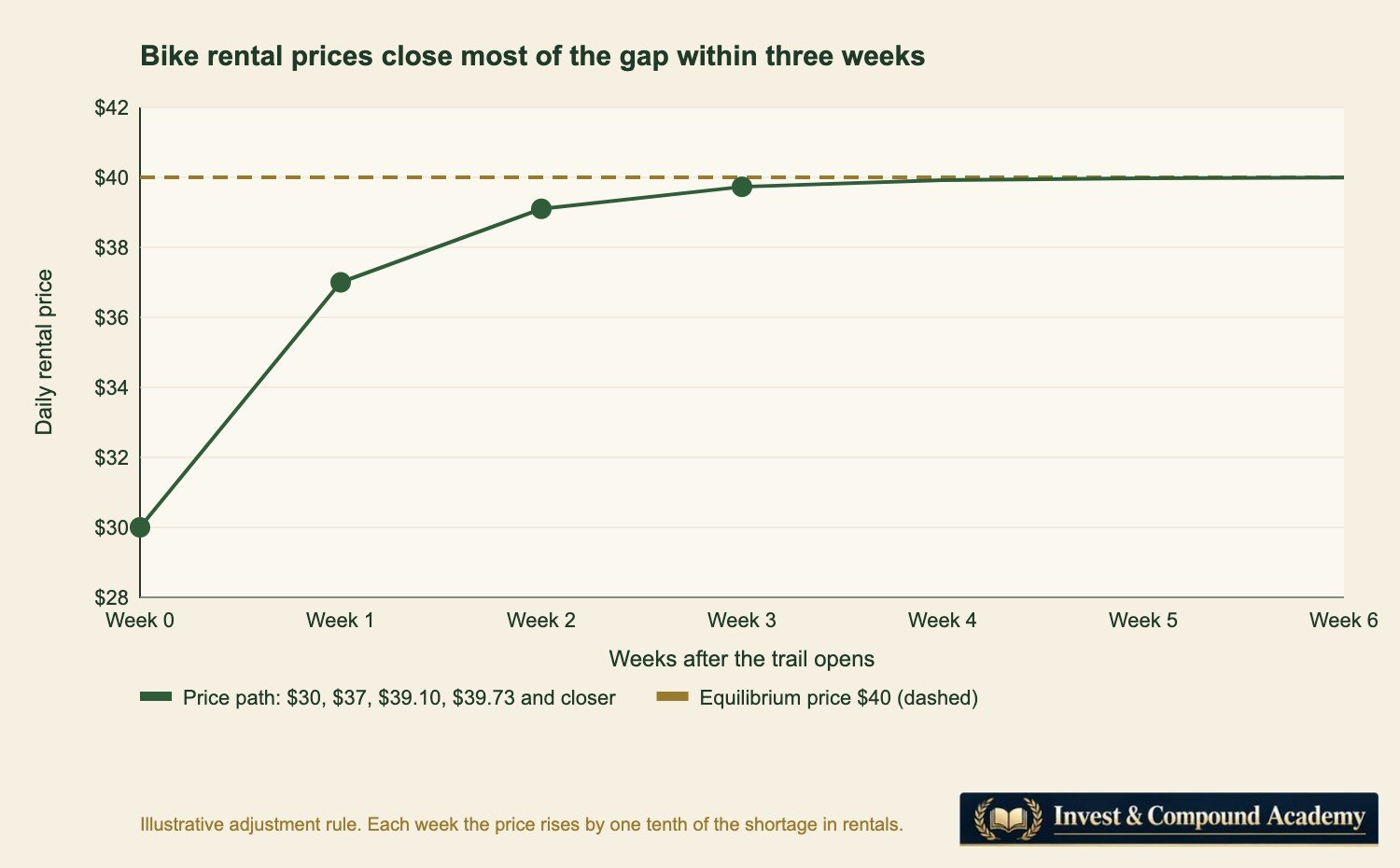
This simple rule produces smooth, steady convergence. Real adjustment is often less tidy. Prices may be set for a season and not changed weekly. Shops may need months to buy bikes. Some may overreact and buy too many, causing a temporary surplus. The speed and shape of adjustment depend on how decisions are made and how quickly information and resources can move.
What affects the speed of adjustment
Some markets adjust in seconds, others take years. Several factors explain the difference.
| Factor | Faster adjustment | Slower adjustment |
|---|---|---|
| Price flexibility | Prices change continuously, as in stock markets | Prices fixed by contracts, menus or regulation |
| Time to change supply | Output can rise quickly, as with digital goods | New capacity takes years, as with housing or mines |
| Information | Buyers and sellers see prices instantly | Information is scattered or delayed |
| Contracts | Short-term or spot deals | Long leases, wage agreements, supply contracts |
| Expectations | Clear signals about the future | Uncertainty about whether changes will last |
Housing is a classic slow-adjusting market. When demand for homes in a city rises, prices can respond quickly, but new construction takes years because of land, approvals and building time. During that period, prices may stay well above their long-run level. The distinction between short-run and long-run responses is discussed in Short Run vs Long Run Adjustment.
Labour markets also adjust slowly. Wages are often set annually and rarely cut, so when demand for workers falls, the adjustment may come through fewer hours, hiring freezes or layoffs rather than lower wages. Economists consider this stickiness an important reason why unemployment can stay high for long periods after a downturn.
Stable and unstable equilibria
An equilibrium is stable if, after a small disturbance, the system tends to return to it. A ball resting at the bottom of a bowl is in a stable equilibrium: nudge it and it rolls back. An equilibrium is unstable if a small disturbance pushes the system further away. A ball balanced on top of an upturned bowl is in an unstable equilibrium: the slightest push sends it rolling off.
Most basic market models have stable equilibria, because shortages raise prices and surpluses lower them. But some situations can be unstable. In a bank run, if depositors expect others to withdraw, they rush to withdraw first, which can make a sound bank fail. A small loss of confidence can push the system away from the calm equilibrium in which everyone keeps their money in the bank. Deposit insurance, such as that provided by the Canada Deposit Insurance Corporation, helps keep depositors confident and the system near the stable outcome.
Some models have multiple equilibria, where the system could settle in more than one place depending on history or expectations. Technology standards, discussed in Institutional Change and Path Dependence, are an example: a market might settle on one format or another, and once it does, it tends to stay there.
When adjustment overshoots: the cobweb pattern
Adjustment can overshoot when suppliers must decide how much to produce before they know the price. Farmers, for example, often decide how much to plant based on last season’s price. If last year’s price was high, many plant more, which creates a large harvest and a low price this year. Seeing the low price, they plant less next year, creating a shortage and a high price again. Plotted on a supply and demand diagram, the path of prices and quantities can look like a spider’s web, which is why economists call it the cobweb model.
Demand for a crop: Q = 200 − 10P. Supply this season depends on last season’s price: Q = 20 + 8Plast.
Equilibrium if prices stayed constant: 200 − 10P = 20 + 8P, so P = $10 and Q = 100.
Suppose last season’s price was $14. Farmers plant for 20 + 112 = 132 units. To sell 132 units, the price must fall to (200 − 132) ÷ 10 = $6.80.
Next season, farmers plant for 20 + 54.4 = 74.4 units, and the price rises to (200 − 74.4) ÷ 10 = $12.56.
Prices swing above and below $10, with the swings shrinking each season because supply responds less strongly than demand. If supply responded more strongly, the swings could grow instead.
The cobweb model is a simplification, and farmers in practice use futures markets, forecasts and experience to avoid such swings. But it shows that the existence of an equilibrium does not guarantee a smooth path to it. How expectations are formed matters a great deal. The role of time in models is developed in Static vs Dynamic Models.
Measuring the speed of adjustment
Economists often summarize adjustment speed with a half-life: the time it takes for half of a gap from equilibrium to close. In the bike rental example, the price closed 70 percent of the remaining gap each week, so the half-life was less than one week. In other markets, the half-life can be measured in years.
Suppose a gap closes by 20 percent each year, leaving 80 percent of the previous year’s gap.
After one year, 80 percent remains. After two years, 64 percent. After three years, about 51 percent. After four years, about 41 percent.
The half-life is a little over three years, because 0.8 raised to the power of about 3.1 equals 0.5.
Studies of exchange rates have found that deviations from purchasing power parity, the idea that the same basket of goods should cost the same in different countries after converting currencies, tend to have half-lives of several years. Kenneth Rogoff described this as a puzzle in a widely cited 1996 article, because such slow adjustment is hard to reconcile with simple models. Estimates like these help economists judge whether a model that assumes quick adjustment is reasonable for a given question.
Equilibrium beyond prices
Equilibrium does not always involve prices. In traffic, drivers choose routes based on travel times, and an equilibrium occurs when no driver can save time by switching routes. In queues, people decide whether to join based on the expected wait, and an equilibrium occurs when the expected wait discourages enough people to keep the line stable. In strategic situations, such as two firms deciding how much to produce, an equilibrium occurs when neither firm can do better by changing its decision, given what the other is doing. This last idea is called a Nash equilibrium, after the mathematician John Nash, who shared the 1994 Nobel Memorial Prize.
These examples show that equilibrium is a general idea about balanced choices, not just about markets clearing. In each case, the same questions apply: where would things settle, is that outcome stable, and how long would it take to get there?
When adjustment is blocked
Sometimes rules or circumstances prevent prices from reaching equilibrium. A price ceiling set below the equilibrium price, such as strict rent control, creates a persistent shortage because the price cannot rise to clear the market. A price floor set above equilibrium, such as some agricultural support programmes, creates a persistent surplus. In these cases, the market does not settle at the equilibrium of the simple supply and demand model. Instead, other mechanisms, such as waiting lists, queues or government purchases of surplus goods, decide who gets what.
Suppose the town caps bike rental prices at $30 a day, below the $40 equilibrium.
At $30, demand is 180 rentals and supply is 110, a shortage of 70 rentals a day that the price cannot close.
Customers who arrive early or book ahead get bikes. Others go without, even if they would have paid more. Shops have less reason to buy additional bikes, so the shortage may persist.
These effects do not mean price controls are always wrong. They may protect vulnerable people or respond to emergencies. But they change how a market adjusts, and their consequences should be weighed carefully. How price signals coordinate markets is explained in Prices as Coordination Signals.
Equilibrium and adjustment in the whole economy
The same ideas apply to economies as a whole, though the forces are more complex. Economists often describe a long-run equilibrium in which output is at its potential level, unemployment is near its natural rate and inflation is stable. After a shock, such as a recession or a jump in energy prices, the economy may take years to return to that state, if it returns at all.
Debates about economic policy often turn on adjustment. Some economists argue that markets adjust relatively quickly, so government intervention is mostly unnecessary. Others argue that wages and prices adjust slowly, so recessions can last a long time without active monetary and fiscal policy. John Maynard Keynes put the point memorably in 1923, noting that in the long run we are all dead, a reminder that the speed of adjustment matters for people living through it. Central banks, such as the Bank of Canada, adjust interest rates partly to speed the economy’s return toward stable inflation and full employment, as described in What Does the Federal Reserve Do.
What equilibrium does not mean
Several misunderstandings about equilibrium are common enough to deserve direct attention.
- Equilibrium is not necessarily good. A market can be in equilibrium with high prices, low wages or pollution that harms others. Equilibrium describes balance, not fairness or efficiency.
- Equilibrium is not permanent. Any change in outside conditions, such as tastes, technology or policy, shifts the equilibrium. Real economies are constantly adjusting toward moving targets.
- Equilibrium is not always reached. If conditions change faster than markets adjust, the economy may spend most of its time away from equilibrium.
- Equilibrium does not mean nothing happens. In a market equilibrium, millions of transactions may take place each day. It means the forces pushing prices up and down are balanced.
Keeping these points in mind prevents equilibrium from being misused as a slogan. Its value is analytical: it lets economists predict the direction of change and compare outcomes, a technique called comparative statics, explained in Comparative Statics.
Adjustment in real markets
Real markets show the full range of adjustment speeds. Financial markets adjust almost instantly: when a company reports unexpected earnings, its share price can move within seconds. Gasoline prices at the pump usually follow changes in crude oil prices within days or weeks, though economists have noted that pump prices sometimes rise faster than they fall, a pattern sometimes described as rockets and feathers.
Markets for durable goods and skilled labour adjust more slowly. When demand for nurses rises, training new nurses takes years, so wages and overtime absorb the pressure in the meantime. When world demand for a metal surges, opening a new mine can take a decade, so prices may stay high for an extended period before new supply arrives. When a city’s population grows quickly, housing supply lags, as noted earlier.
The COVID-19 pandemic offered a vivid illustration. Demand shifted suddenly from services toward goods, and supply chains could not adjust quickly. Shipping costs rose sharply, shortages of items such as semiconductors and bicycles appeared, and prices rose. Over the following two years, shipping capacity expanded, demand shifted back toward services and many of these pressures eased. The episode showed how long adjustment can take when many markets are disturbed at once.
A slow adjustment case: housing in a growing city
Housing shows how long adjustment can take and why it matters for people. Suppose a mid-sized Canadian city attracts thousands of new residents over a few years because of new employers. Demand for homes and rentals rises quickly. In the short run, the number of homes is nearly fixed, so prices and rents rise and vacancy rates fall.
Higher prices signal that building more homes would be profitable, and developers begin planning new projects. But land must be found and serviced, zoning approvals obtained, financing arranged and construction completed, a process that commonly takes several years for larger buildings. Meanwhile, renters face higher costs and some households move farther away or share housing. As new homes are completed, rent growth tends to slow and vacancy rates rise, moving the market toward a new equilibrium with more homes and somewhat higher prices than before the population growth.
The equilibrium analysis predicts the direction: higher prices and more construction. The adjustment analysis explains why the transition can be painful and why policies that speed up approvals or increase construction capacity can matter so much. Both views are needed to understand what residents actually experience.
What it means for investors
Investors constantly deal with markets in adjustment. Share prices respond quickly to news, but the underlying businesses adjust much more slowly. A surge in demand for a product may lift a company’s share price immediately, while the company needs years to build capacity. Competitors may also enter, eventually reducing profits toward a more normal level. Understanding that high profits often attract new supply helps investors avoid assuming that unusually good results will last forever.
Commodity markets show the cobweb pattern on a larger scale. High prices encourage investment in new production, which can lead to oversupply and falling prices years later. Investors who buy at the peak of such a cycle, assuming high prices are the new equilibrium, can suffer large losses. Long-term, diversified investing, discussed in What Is Diversification in Investing, reduces exposure to these swings. Market history, covered in Stock Market Crashes in History, shows that prices can stay far from apparent fundamentals for extended periods before adjusting.
Equilibrium thinking in everyday life
Equilibrium reasoning helps with everyday predictions. If a new restaurant becomes popular and has long waits, you can expect prices to rise, hours to expand or competitors to open nearby. If a highway lane is added to ease congestion, more drivers may use it until traffic becomes heavy again, a pattern transportation researchers call induced demand. If a type of job pays unusually well, more people may train for it over time, gradually moderating wages.
The key is to ask two questions: where would things settle if conditions stayed the same, and how long would it take to get there? The first question points to the direction of change. The second warns against expecting that change to happen overnight.
How economists came to think about equilibrium
The idea of balancing forces has a long history in economics. Adam Smith described how market prices tend to gravitate toward a natural price that covers the costs of production, with temporary deviations caused by shortages or gluts. In the 1870s, Léon Walras developed a model of general equilibrium in which all markets in an economy clear simultaneously. He imagined an auctioneer calling out prices and adjusting them until supply matched demand everywhere, a thought experiment that highlighted how difficult real adjustment might be.
Alfred Marshall, writing in 1890, emphasized time. He distinguished between very short periods, when supply is fixed, short periods, when firms can adjust output with existing plants, and long periods, when firms can build new plants or enter and exit industries. His framework remains the basis for how economists think about adjustment today. In the twentieth century, economists such as Kenneth Arrow and Gérard Debreu proved conditions under which a general equilibrium exists, while others pointed out that existence does not guarantee the economy will actually reach it.
Common mistakes about equilibrium and adjustment
Assuming equilibrium is reached immediately
Many markets take months or years to adjust. Predictions that ignore adjustment time can be badly wrong about what happens in the meantime.
Treating equilibrium as a value judgement
An equilibrium can be inefficient or unfair. Balance does not imply that the outcome is desirable.
Ignoring blocked adjustment
Price controls, contracts and regulations can prevent markets from reaching the equilibrium of a simple model.
Assuming stability
Some equilibria are unstable, and some systems have multiple equilibria. Expectations and history can determine where a system settles.
Confusing movements and shifts
A change in price moves along a curve, while a change in other conditions shifts the curve and moves the equilibrium itself.
Frequently asked questions
What is market equilibrium in simple terms?
It is the price at which the quantity buyers want to purchase equals the quantity sellers want to offer, so there is no shortage or surplus pushing the price up or down.
Does a market have to be in equilibrium?
No. Markets are often adjusting toward an equilibrium that keeps moving as conditions change. Some markets adjust quickly, others slowly, and some are prevented from reaching equilibrium by rules.
What is the difference between a stable and an unstable equilibrium?
A stable equilibrium is one the system returns to after a small disturbance. An unstable one is where a small disturbance pushes the system further away, as in a bank run.
Why do housing markets adjust so slowly?
Because building new homes takes years due to land, approvals and construction time. Prices can respond quickly, but supply takes much longer to catch up.
What is the cobweb model?
It describes markets where producers decide output based on past prices, which can cause prices and quantities to swing around the equilibrium over several periods before settling, or sometimes to diverge.
What is a Nash equilibrium?
It is a situation in a strategic setting where no participant can improve their outcome by changing their own decision while others keep theirs unchanged. It extends the idea of balance from markets to games between firms, governments or individuals.
Can an economy be in equilibrium while unemployment is high?
Some models allow equilibria with persistent unemployment, especially when wages are slow to adjust or when demand is weak. Economists disagree about how common such situations are and how much policy can help, which is one reason debates about recessions remain active.
Key takeaways
- Equilibrium is a state where forces balance and there is no internal pressure for change.
- Adjustment is the process of moving toward equilibrium, and its speed varies widely across markets.
- Price flexibility, time to change supply, contracts and expectations determine how fast markets adjust.
- Equilibria can be stable, unstable or multiple, and adjustment can overshoot.
- Price controls and other rules can block adjustment and create persistent shortages or surpluses.
- Equilibrium describes balance, not fairness, and it shifts whenever outside conditions change.
Continue Learning with Invest & Compound Academy
Continue through the chapter on understanding economic models.
All topics in this chapter
More topics to explore
Sources and further reading
OpenStax, Principles of Economics, 3rd ed. · Alfred Marshall, Principles of Economics, 1890 · Léon Walras, Elements of Pure Economics, 1874 · Kenneth Rogoff, “The Purchasing Power Parity Puzzle,” Journal of Economic Literature, 1996 · Canada Deposit Insurance Corporation, Deposit protection
Educational disclosure
This article provides general economics education for informational purposes only. It is not financial, investment, tax or legal advice, and it does not consider your personal circumstances. Examples are simplified for teaching and do not describe real people, organizations or recommendations.