Evaluating a Model’s Scope and Limits. Knowing Where a Model Works and Where It Breaks
Every model has a scope: the questions, settings, ranges and periods where its assumptions hold. This guide offers a practical framework for judging where a model works, spotting when it is being pushed too far and deciding how much its conclusions deserve trust.
Every model works within a scope of questions, ranges and periods
Predictions far outside past data rest on untested assumptions
Risk models built on calm years can understate severe declines
A good model used in the wrong place
A city’s transit planners have a reliable model of bus ridership. Built from fifteen years of data, it predicts how ridership responds to fare changes of 10 or 20 cents, and it has performed well for years. Then the city council asks a new question: what would happen if buses became completely free? The planners plug a fare of zero into their model and get an answer.
But the answer is far less reliable than anything the model has produced before. Fares have never been anywhere near zero during the period the model was built from, free transit might attract very different riders, and crowding could change how people feel about taking the bus. The model is still good. The question has moved outside its scope.
Every economic model has a scope: the questions, settings, ranges and time frames for which it was designed and tested. Inside that scope, it can be very useful. Outside it, its answers may be misleading, sometimes dangerously so. Evaluating a model’s scope and limits means asking where it works, where it breaks and how to tell the difference before relying on its conclusions.
This guide brings together the ideas of this chapter into a practical framework for judging any model. It builds on Choosing a Model for a Question and Sensitivity Analysis and Scenario Design.
What scope and limits mean
A model’s scope is the set of conditions under which its assumptions and evidence are reasonable. It includes the question the model was built to answer, the population and place it describes, the range of values its data covered and the time period over which its relationships were observed. A model’s limits are the boundaries beyond which its assumptions may fail or its evidence no longer applies.
Scope is not a fixed property written on a model. It must be judged by comparing the model’s assumptions and evidence with the situation at hand. A model of household spending built from Canadian data in normal economic times may apply well to another normal year in Canada, less well to a deep recession and poorly to a country with very different institutions. The statistician George Box’s remark that all models are wrong but some are useful captures the point: usefulness depends on where and how a model is applied.
Knowing a model’s scope and limits is not a sign of weakness in the model or in the person using it. It is what separates careful analysis from overconfident guessing. A doctor who knows a test’s false-positive rate interprets results more wisely than one who treats every result as certain. In the same way, an analyst who knows where a model works and where it struggles can use it with confidence inside its scope and with appropriate caution outside it, combining it with other evidence where needed.
Five dimensions of a model’s scope
A practical way to evaluate scope is to check five dimensions.
| Dimension | Key question | Example of a limit |
|---|---|---|
| Question | Was the model built for this kind of question? | A forecasting model used to estimate causal effects |
| Population and place | Does it describe these people and this setting? | Results from large cities applied to rural towns |
| Range of values | Are inputs within the range the evidence covered? | A fare model used for free transit |
| Time period | Do the relationships still hold today? | Pre-internet shopping patterns applied to online retail |
| Size of change | Is the change small enough to leave other conditions unchanged? | A partial model used for a policy affecting the whole economy |
A model can be well within scope on some dimensions and outside it on others. The transit model in the opening example fits the question type, the population and the time period, but fails on the range of values. Recognizing which dimension is the problem points to what extra evidence or modelling is needed.
A worked example: extrapolating a demand model
The danger of moving outside a model’s range is easiest to see with numbers. The figures are illustrative.
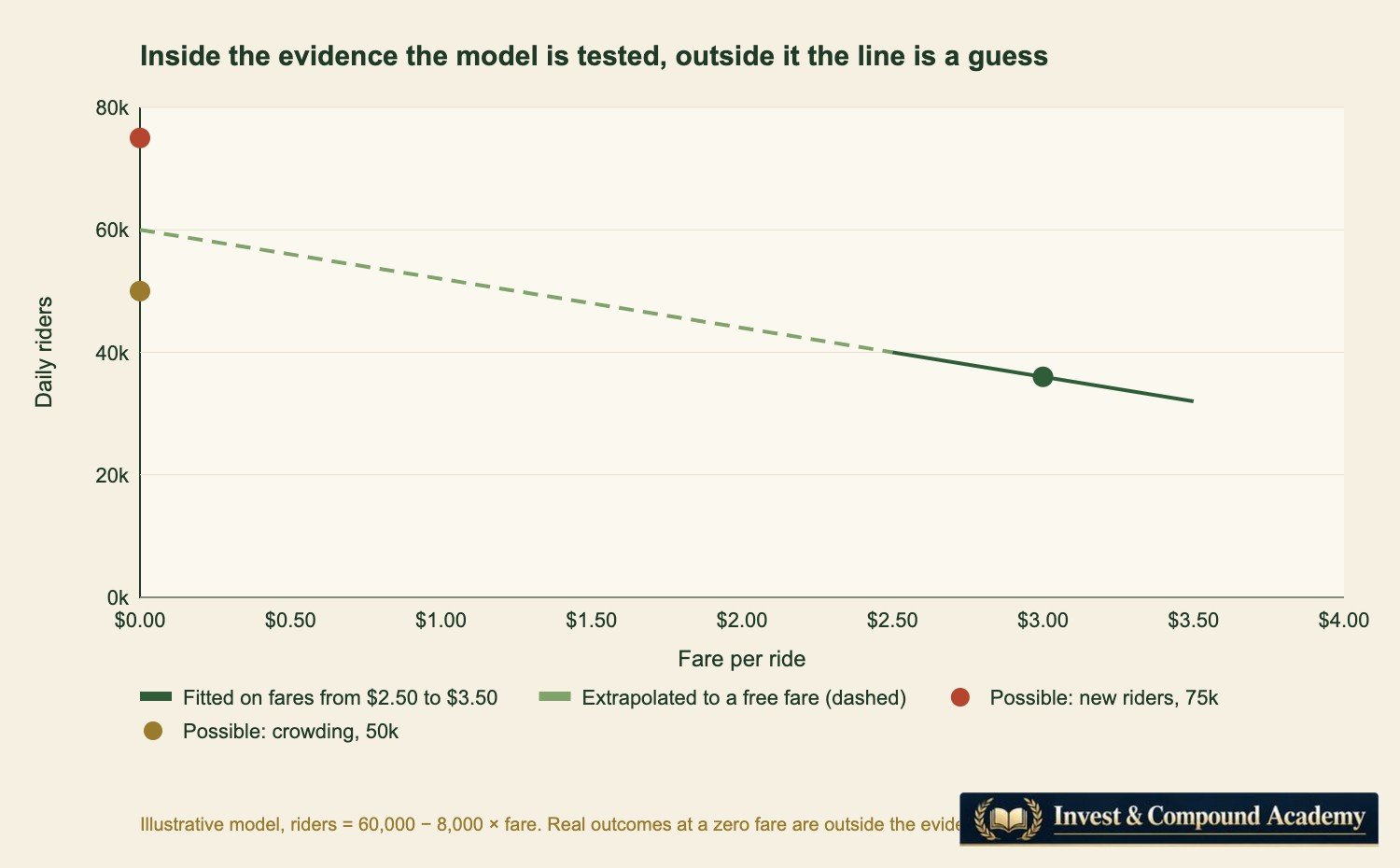
Over fifteen years, fares ranged from $2.50 to $3.50. A straight-line model fitted to that period is: daily riders = 60,000 − 8,000 × fare.
At $3.00, the model predicts 36,000 riders, close to what was actually observed. Within the range, it works well.
At a fare of zero, the model predicts 60,000 riders. But that prediction relies entirely on extending the straight line far beyond any fare ever charged.
If free fares attract many people who never considered transit before, ridership might rise much more, perhaps to 75,000. If crowding discourages existing riders, it might rise less, perhaps to 50,000. The model cannot distinguish these possibilities because it has never seen anything like a zero fare.
This is why careful analysts flag extrapolation clearly and look for other evidence, such as experiences in cities that have tried free transit, before relying on a model far outside its range. Cities including Tallinn in Estonia, which made public transit free for residents in 2013, and Luxembourg, which made public transport free nationally in 2020, provide evidence that can help, though their circumstances differ. The ideas of equations and their valid ranges are discussed in Equations as Economic Relationships.
The chart makes the problem visible. Within the range of fares actually charged, from $2.50 to $3.50, the model has been checked against reality many times. The dashed extension to a free fare is simply the same straight line continued, with nothing in the data to confirm it. Two quite different outcomes, more riders because transit becomes attractive to new groups, or fewer than expected because buses become crowded, are both consistent with everything the model has ever seen.
When relationships change over time
A model built from past data assumes that the relationships it captured will continue to hold. Sometimes they do not. Technology, policy, preferences and institutions change, and relationships that were stable for decades can shift.
The Phillips curve offers a famous example. In 1958, the economist A. W. Phillips documented a relationship between unemployment and wage growth in the United Kingdom: when unemployment was low, wages rose faster. In the 1960s, many policymakers treated a similar relationship between unemployment and inflation as a stable menu of choices. In the 1970s, however, many countries experienced high inflation and high unemployment together, and the relationship broke down. Economists including Milton Friedman and Edmund Phelps had warned that once people came to expect inflation, the trade-off would shift. The episode showed that a relationship observed in one period can change when the conditions behind it change.
The Lucas critique, discussed in Choosing a Model for a Question, generalizes this point: relationships estimated under one set of policies may not hold under different policies, because people adjust their behaviour to the new rules. Models used to evaluate major policy changes must therefore be built on relationships that are likely to survive those changes, or must be treated with extra caution.
When models fail in a crisis
The 2008 financial crisis exposed limits in many economic and financial models. Risk models used by banks and investors often relied on data from relatively calm periods and assumed that house prices across different regions would not fall sharply at the same time. When a nationwide decline in US house prices occurred, losses on mortgage-related securities were far larger than many models had suggested. Some widely used macroeconomic models also paid limited attention to the financial system, making it harder to anticipate how problems in banking could spread to the wider economy.
These failures did not mean models were useless. They showed the danger of applying models outside the conditions they were built from and of treating model outputs as certain. Since then, regulators and economists have placed more emphasis on stress tests, scenarios that include severe events and models that link the financial system to the rest of the economy. The role of scenarios is explored in Sensitivity Analysis and Scenario Design.
Checking assumptions against the situation
Every model rests on assumptions, and evaluating scope and limits means checking whether they fit the situation at hand. Common assumptions include competitive markets, people who respond to prices in predictable ways, stable relationships over time and changes small enough to leave the rest of the economy unaffected.
A useful exercise is to list a model’s key assumptions and ask, for each one, whether it is plausible in the current setting and what would happen to the conclusions if it were wrong. Some assumptions are harmless simplifications that barely affect the answer. Others are critical: if they fail, the conclusions collapse. Distinguishing the two focuses attention where it matters. The assumption of holding other factors constant, central to many models, is discussed in Ceteris Paribus.
When individual and aggregate behaviour differ
Some models describe individual decisions, while others describe whole markets or economies. Moving between levels is another place where models can be stretched too far. A model of how one household responds to a price change may not capture what happens when millions of households respond at once, because their combined actions can change prices, wages and incomes. A model showing that one company benefits from cutting costs may not apply if every company in an industry cuts costs together, reducing demand for each other’s products.
This is the fallacy of composition applied to models, explained in The Fallacy of Composition. Evaluating scope therefore includes asking whether a model built for individuals is being used to answer a question about the whole, or the reverse. When it is, the analysis may need the broader, general equilibrium perspective discussed in Partial vs General Equilibrium.
A practical framework for judging scope and limits
Drawing together the topics in this chapter, a model can be evaluated with a short series of questions.
Question fit. Is the model built for this type of question, whether accounting, forecasting, causal explanation or constrained choice? A forecasting model should not be trusted for causal claims without further evidence.
Structure. Are the endogenous and exogenous variables sensibly chosen? Do the equations make sense in signs, sizes and units? Are identities and behavioral relationships kept distinct?
Parameters. Where do the key numbers come from, and do they fit this setting? Were they estimated from suitable data or calibrated to credible facts? How uncertain are they?
Scope. Are the inputs within the range of the evidence? Does the model describe this population, place and period? Is the change small enough for a partial analysis, or does it require a general view?
Robustness. How much do conclusions change under different assumptions? Has the model been tested on data it was not built from?
Communication. Does the presentation state assumptions, ranges and limits clearly, or does it present a single number as certain?
A model does not need to pass every test perfectly to be useful. The purpose is to understand how much confidence its conclusions deserve and where additional evidence would help most. Earlier topics in this chapter, from Endogenous vs Exogenous Variables to Model Calibration vs Estimation, explain each of these checks in more detail.
Signs that a model is being pushed too far
Several warning signs suggest that a model is being used beyond its limits. Predictions far outside past experience, such as values never observed in the data, deserve suspicion. Results that change dramatically with small changes in assumptions indicate fragility. Conclusions that rely on one critical assumption, especially an untested one, are vulnerable. Very precise numbers for highly uncertain questions suggest false confidence.
Another warning sign is a model that always supports the conclusions its builder prefers. Models can be shaped, sometimes unconsciously, by choices about data, assumptions and scenarios. Independent review, transparency about methods and willingness to report inconvenient results are important safeguards. In public policy, institutions such as Canada’s Parliamentary Budget Officer provide independent analysis that can be compared with government estimates.
Finally, be wary when a model is presented as the only possible answer. Most important economic questions can be approached with several models, and their disagreements are informative. If different reasonable models reach similar conclusions, confidence rises. If they disagree sharply, the question deserves more caution and more evidence.
Using a model’s track record
One of the most practical ways to judge a model’s limits is to examine its track record. How accurate have its predictions been, and under what conditions did it succeed or fail? A forecasting model that has predicted next month’s sales within 5 percent for three years has earned some confidence for similar months. If it missed badly during holiday seasons or after a competitor opened nearby, those misses reveal specific limits.
Central banks and government forecasters often publish reviews of their past forecasts, comparing what they predicted with what actually happened. These reviews typically find that forecasts are reasonably accurate in normal times and much less accurate around turning points, such as the start of a recession or a sudden shock. That pattern is itself an important finding about the scope of forecasting models: they are better at describing continuations of current trends than at predicting sharp changes.
A track record is only informative if it covers conditions similar to the ones ahead. A model that performed well during a long period of low interest rates may not perform as well when rates rise. Asking whether past successes came from situations like the current one keeps a good track record from creating false confidence.
Where models end and values begin
Another limit is easy to overlook: models can describe consequences, but they cannot decide which consequences matter most. A model may show that a policy raises average income while increasing inequality, or reduces emissions while raising energy costs for some households. Choosing between those outcomes requires judgements about fairness, priorities and acceptable risk that lie outside any model.
Recognizing this boundary helps keep debates honest. Disagreements about evidence can be addressed with better data and models. Disagreements about values cannot be settled that way and need open discussion. Confusing the two, by presenting a value choice as a technical result, is a common way models are misused. The distinction between factual and value questions is explained in Positive vs Normative Economics.
Applying a model to a new place or group
Models often travel. A study of minimum wage effects in one country is cited in debates in another. A demand model built for one city is used to plan transit in a different city. Evidence from one group of workers is used to design programmes for another. Each transfer raises the question of whether the original conditions are similar enough.
Economists sometimes call this the problem of external validity. A study can be carefully designed and internally convincing, yet its results may not apply elsewhere because of differences in institutions, incomes, culture or market structure. A job training programme that worked well in a city with a strong labour market may produce weaker results where few jobs are available. A tax incentive that encouraged investment in a country with stable rules may have less effect where policy is unpredictable.
Evaluating transferability means comparing the key features that drive the model’s results. Are the relevant behaviours, institutions and market conditions similar? If not, can the model be adjusted, or should it be treated as a rough guide rather than a precise prediction? The challenge of applying results across settings is related to the institutional differences discussed in Comparing Economic Systems Without Slogans.
Scope and limits in public policy
Policy analysis frequently pushes models toward their limits, because new policies often involve changes never seen before. A carbon price higher than any previously implemented, a new kind of social programme or a major tax reform may move key variables outside historical ranges. Analysts must then combine models with other evidence, such as pilot programmes, international experience, laboratory or field experiments and expert judgement.
Pilot programmes are particularly valuable because they generate evidence within the actual setting before full implementation. Canada has a history of such experiments. The Mincome experiment in Dauphin, Manitoba, in the 1970s tested a guaranteed annual income, and later research by economist Evelyn Forget examined its effects on health and work. More recently, Ontario began a basic income pilot in 2017 that was cancelled in 2018 before its planned completion. Such pilots help reveal how people actually respond, extending the scope of evidence available to models.
What it means for investors
Investment models also have scopes and limits. A model that estimates future returns from historical averages assumes the future will resemble the past, which may not hold if interest rates, valuations or economic conditions differ substantially from historical norms. A risk model built on calm years may understate the chance of severe market declines, as many investors learned in 2008 and again in early 2020.
Investors can protect themselves by asking what period a model’s data cover, whether current conditions are similar, and what happens under scenarios outside historical experience. Historical market downturns, described in Stock Market Crashes in History, show how often markets have moved beyond what simple models expected. Simple, robust strategies, such as broad diversification explained in What Is Diversification in Investing, rely less on any single model’s predictions holding true.
Judging models in everyday life
People encounter models constantly, often without realizing it. A weather forecast, a fitness app’s calorie estimate, a mortgage calculator, a news report predicting house prices and a company’s sales projection all rest on models with scopes and limits. Asking a few simple questions helps judge them.
What was this model built to predict, and is that what I need? What information does it use, and does it reflect my situation? Is it predicting something within its normal range, or something unusual? How accurate has it been in the past? What happens if its key assumption is wrong? A mortgage calculator that assumes a fixed interest rate for 25 years, for example, is useful for comparing options but does not reflect the risk of rates changing at renewal, a limit worth keeping in mind.
These questions do not require technical training. They reflect the same habits of mind that economists use, and they help separate useful guidance from false precision. The broader habits of economic reasoning are introduced in Economic Thinking and Economic Decisions.
How to extend a model’s scope
When a question falls outside a model’s scope, there are several ways to respond. One is to gather new evidence that covers the missing range or setting, such as running a pilot programme or studying places that have made similar changes. Another is to build a broader model that includes the features the original model left out, such as effects in related markets or changes in behaviour over time. A third is to combine several models and compare their answers, giving more weight to conclusions on which they agree.
Sometimes the honest response is to say that the available models cannot answer the question with confidence. That statement is itself valuable. It tells decision makers that they face genuine uncertainty and should consider options that are flexible, reversible or robust across a range of possible outcomes, ideas explored in Sensitivity Analysis and Scenario Design.
Common mistakes about scope and limits
Extrapolating far beyond the data
Predictions for values never observed rely on assumptions the data cannot check. They should be flagged clearly and supported by other evidence.
Assuming relationships never change
Relationships can shift with technology, policy and expectations. Models built on past data need regular testing.
Transferring results without checking fit
Evidence from one country, city or group may not apply elsewhere if key conditions differ.
Ignoring warning signs of fragility
Results that swing with small assumption changes, or depend on one untested assumption, deserve caution.
Treating a model as the only answer
Comparing several reasonable models reveals how confident a conclusion should be.
A one-page checklist
Before relying on any model’s conclusion, it helps to run through a brief checklist. Write down the question the model was built to answer and the question you are asking, and confirm they match. Note the population, place and period the model describes, and compare them with your situation. Check whether the inputs you plan to use fall within the range of the model’s evidence. List the two or three assumptions that drive the result and judge whether they are plausible now. Look at how the result changes under reasonable alternative assumptions. Finally, consider what other evidence, such as experiments, pilot programmes or other models, supports or contradicts the conclusion.
If the model passes most of these checks, its conclusions deserve reasonable confidence. If it fails several, the conclusions should be treated as tentative, and decisions should allow for the possibility that they are wrong.
How economists came to emphasize limits
Economists have long debated how far models can be trusted. John Maynard Keynes, writing in the 1930s, warned that economics deals with material that changes over time, unlike the more stable relationships of physics, and that models must be applied with judgement. Friedrich Hayek, in his 1974 Nobel lecture titled “The Pretence of Knowledge,” cautioned against treating economic models as if they provided precise control over complex systems.
After the 2008 crisis, many economists reflected on the limits of the models that had been most widely used. The economist Dani Rodrik argued in his 2015 book Economics Rules that economics is best understood as a collection of models, each suited to particular circumstances, and that the key skill is choosing the right model for the situation at hand. That perspective runs through every topic in this chapter and offers a constructive way forward: models are tools, and their value depends on using them within their scope.
Frequently asked questions
What does a model’s scope mean?
It means the questions, settings, ranges of values and time periods for which the model’s assumptions and evidence are reasonable. Outside that scope, its conclusions become less reliable.
Why is extrapolation risky?
Because a model’s relationships are only tested within the range of data it was built from. Beyond that range, the true relationship may change shape, so predictions rest on untested assumptions.
What is external validity?
It describes whether results from one study or setting apply to other places, groups or times. A study can be well designed yet have limited external validity if conditions elsewhere differ.
Can a model be useful if it has clear limits?
Yes. Every model has limits. A model is useful when it is applied within its scope and when its limits are understood and communicated.
How can I tell if a model is being pushed too far?
Watch for predictions far outside past experience, results that swing with small changes in assumptions, heavy reliance on one untested assumption and unusually precise numbers for uncertain questions.
Do economists agree on which models to trust?
Not always. Economists often agree about the direction of effects and the importance of evidence, while disagreeing about specific models, assumptions or the size of effects. Comparing several models and the evidence behind them is the usual way to work through such disagreements.
Key takeaways
- Every model has a scope defined by its question, population, value range, time period and size of change.
- Inside its scope, a model can be very useful, while outside it, conclusions may mislead.
- Extrapolation far beyond observed data, changing relationships and unsuitable transfers are common ways models fail.
- Checking key assumptions, testing robustness and comparing models reveal how much confidence conclusions deserve.
- Pilot programmes and new evidence can extend a model’s scope.
- Saying that a model cannot answer a question confidently is a valuable and honest conclusion.
Continue Learning with Invest & Compound Academy
Continue through the chapter on understanding economic models.
All topics in this chapter
More topics to explore
Sources and further reading
OpenStax, Principles of Economics, 3rd ed. · A. W. Phillips, “The Relation Between Unemployment and the Rate of Change of Money Wage Rates,” Economica, 1958 · Friedrich Hayek, The Pretence of Knowledge, Nobel lecture, 1974 · Dani Rodrik, Economics Rules, 2015 · Evelyn Forget, “The Town with No Poverty,” Canadian Public Policy, 2011
Educational disclosure
This article provides general economics education for informational purposes only. It is not financial, investment, tax or legal advice, and it does not consider your personal circumstances. Examples are simplified for teaching and do not describe real people, organizations or recommendations.


