GBTC vs BITB ETF comparison
GBTC vs BITB
GBTC is the oldest fund here, converted from a long-running Grayscale trust, with the highest fee in the group, and BITB is the Bitwise fund, a low-fee trust that includes custody costs in its expense ratio. Both trusts hold bitcoin and nothing else, so they follow the same price.
What separates them is the fee, the share price, the custodian, the benchmark rate each uses and how heavily each one trades. GBTC charges 1.50% and BITB charges 0.20%. This page lines up what backs each share, what each trust costs, how each has performed and how each trades, with the date next to every number.
GBTC vs BITB, the short answer
GBTC and BITB hold the same asset. Both trusts hold bitcoin and nothing else, so they follow the same price. What separates them is the fee, the share price, the custodian, the benchmark rate each uses and how heavily each one trades. Expense ratios are 1.50% and 0.20%, which is $150 and $20 a year per $10,000. NAV total returns, annualized: 1 year -28.05% vs -26.76%. Neither is better for everyone; the choice turns on cost, trading needs and how much bitcoin risk you want.
Want the full picture of one fund before you compare? Read the complete guide for each fund: GBTC guide and BITB guide. Each guide covers fees, holdings, yield, returns and taxes.
GBTC vs BITB overlap, if you own both
Overlap is normally measured stock by stock. Here there is only one holding: each trust owns bitcoin held by a custodian, so every dollar in GBTC and every dollar in BITB is backed by the same asset. Owning both does not diversify anything; it only splits one position across two tickers.
The differences that remain are practical. GBTC charges 1.50% and BITB charges 0.20%. One share of GBTC is backed by about 0.000771 bitcoin and one share of BITB by about 0.000542, which only changes the share price, not the exposure. The custodian, the benchmark rate and the trading volume also differ, and those are compared below.
| GBTC | BITB | |
|---|---|---|
| Asset held | Bitcoin | Bitcoin |
| Bitcoin behind one share | 0.000771 | 0.000542 |
| Expense ratio | 1.50% | 0.20% |
| Custodian | Coinbase Custody Trust Company and Anchorage Digital Bank | Coinbase Custody Trust Co., LLC |
| Net assets | $9.25B (Nov 9, 2026) | $2.77B (Nov 8, 2026) |
GBTC vs BITB, one goal, which fund?
GBTC vs BITB, where the money goes
GBTC · Grayscale Bitcoin Trust ETF
BITB · Bitwise Bitcoin ETF
GBTC vs BITB returns compared on 1-year return and since launch
GBTC vs BITB, what each fund costs a year
The data room
Every figure behind the GBTC vs BITB cards above, with its source, date and evidence grade. Open the issuer documents before relying on any number.
GBTC vs BITB key facts
Evidence grade: Issuer issuer page · Mixed issuer plus provider · 3rd party| Metric | GBTC | BITB | Grade and source |
|---|
Portfolio characteristics
| Metric | GBTC | BITB | Grade and source |
|---|
Net assets are dated by fund (GBTC $9.25B on Nov 9, 2026; BITB $2.77B on Nov 8, 2026). Figures an issuer page does not show are left out or marked Not captured, not estimated.
GBTC vs BITB holdings, what backs each share
Issuer pages · Nov 2026| Item | GBTC | BITB |
|---|---|---|
| What the trust holds | Bitcoin | Bitcoin |
| Other holdings | None reported, apart from small cash amounts for expenses | None reported, apart from small cash amounts for expenses |
| Bitcoin behind one share | 0.000771 | 0.000542 |
| Custodian | Coinbase Custody Trust Company and Anchorage Digital Bank | Coinbase Custody Trust Co., LLC |
| Shares outstanding | 160.35M | 68.33M |
| Sponsor | Grayscale Investments | Bitwise |
| Reference rate | CoinDesk Bitcoin Benchmark Rate | Not captured |
A bitcoin trust has one holding, so there is no top-ten list. Each issuer publishes the bitcoin held for the trust. Custodian and share count are shown where the issuer page lists them, and gaps are marked Not captured.
GBTC vs BITB tracking, fund against bitcoin
One-year NAV return, benchmark and market price, issuer pages| Period | GBTC NAV | GBTC market | Benchmark | BITB NAV | BITB market | Benchmark |
|---|---|---|---|---|---|---|
| 1 year to Sep 30, 2026 | -28.05% | -28.05% | -26.96% | -26.76% | -27.10% | Not captured |
What you actually own
GBTC vs BITB performance
Issuer pages, both Sep 30, 2026All rows come from the issuer pages. Both funds are dated Sep 30, 2026. NAV returns include fees; market price and benchmark returns are shown where the issuer gave them. “Since inception” starts in different months (GBTC 2013, BITB 2024). Past performance does not guarantee future results.
Growth of a hypothetical $10,000 · NAV total return, 1 year
Derived from issuer NAV total returns (compounded). Fund expenses are already in NAV. Illustration, not a forecast.
GBTC vs BITB yield, dividends and dividend growth
Yield and distribution facts| Measure | GBTC | BITB |
|---|---|---|
| 30-day SEC yield | None | None |
| Distributions | None paid | None paid |
| How the fee is paid | Trust sells bitcoin | Trust sells bitcoin |
| Fee per $10,000 a year | $150 | $20 |
GBTC and BITB have no yield. Bitcoin earns no interest and pays no dividend, so neither trust distributes income, and the whole return comes from the bitcoin price less the fee. Anyone who needs income from a portfolio has to get it elsewhere or sell shares. See what is dividend yield and yield vs total return.
GBTC vs BITB trading and liquidity
Issuer fund pages · Nov 2026Both trusts trade on NYSE Arca. Spreads on the issuer pages were 0.02% for GBTC and 0.02% for BITB, and a spread of 0.02% is about $20 between the buy and sell price on $100,000. Larger trusts usually trade with tighter spreads, which matters more for frequent traders than for long-term holders. Use limit orders for large trades and avoid the first and last minutes of the session. See creation, redemption and trading for how NAV, premiums and spreads arise.
GBTC vs BITB expense ratio and fees in dollars
As stated by each issuer| Balance | GBTC (1.50%) | BITB (0.20%) | Gap per year |
|---|---|---|---|
| $10,000 | $150 | $20 | $130 |
| $50,000 | $750 | $100 | $650 |
| $100,000 | $1,500 | $200 | $1,300 |
The expense ratio is taken from the trust by selling bitcoin, not billed to you. Fees exclude the bid/ask spread, any premium or discount to NAV, brokerage commissions and taxes.
GBTC vs BITB, what each trust holds and how it is valued
Structure, in plain languageGBTC · CoinDesk Bitcoin Benchmark Rate
GBTC is a grantor trust that holds bitcoin and values it using the CoinDesk Bitcoin Benchmark Rate. It was launched in Sep 25, 2013 and charges 1.50%. Custody terms are described in the prospectus and on the issuer page.
BITB · Not captured
BITB is a grantor trust that holds bitcoin and values it using the Not captured. It was launched in Jan 10, 2024 and charges 0.20%. Custody terms are described in the prospectus and on the issuer page.
Custody, valuation and fee terms sit in each prospectus; read them before relying on this summary.
GBTC vs BITB, why yield and returns differ
The fee explains most of the gapBoth trusts hold bitcoin and nothing else, so they follow the same price. What separates them is the fee, the share price, the custodian, the benchmark rate each uses and how heavily each one trades.
A bitcoin trust has no manager choosing securities. Its NAV follows a bitcoin reference rate (CoinDesk Bitcoin Benchmark Rate for GBTC and Not captured for BITB), and the main reason it trails that rate is the fee. That is why the tracking comparison above matters more than any single stretch of returns.
How to decide between GBTC and BITB
A step-by-step frameworkStart with what separates them: Both trusts hold bitcoin and nothing else, so they follow the same price. What separates them is the fee, the share price, the custodian, the benchmark rate each uses and how heavily each one trades.
- Step 1 · Asset: both hold bitcoin, so this step is settled.
- Step 2 · Cost: GBTC 1.50% vs BITB 0.20%, or $150 vs $20 a year per $10,000.
- Step 3 · Trading: if you trade often or use options, the larger trust usually has tighter spreads; if you buy and hold, the fee matters more.
- Step 4 · What you own: check whether you already hold bitcoin through another fund with the Diversification Calculator.
Size the position against your whole portfolio. Bitcoin pays no income and can fall sharply, so it usually plays a small, deliberate role.
GBTC vs BITB for Canadian investors
Currency and account typeGBTC and BITB are U.S.-listed and trade in U.S. dollars, so buying them from a Canadian account usually involves converting Canadian dollars, which adds a cost on entry and exit. A move in the U.S. dollar also changes your return in Canadian dollars.
Neither trust pays dividends, so U.S. dividend withholding tax is not the main issue here. Tax on gains depends on the account type and your own situation. Confirm the rules for your account with a tax professional. This is general education, not tax advice.
Risks of GBTC and BITB
What can go wrongShared risks
- Bitcoin prices can fall sharply and stay low for long periods; both trusts show one-year NAV declines in the issuer data above.
- Bitcoin pays no interest or dividends, so the whole return depends on price.
- Each trust sells bitcoin to pay its fee, so the bitcoin behind each share declines slowly over time.
- The bitcoin is held by a custodian; see each prospectus for custody, insurance and security terms.
Fund-specific risks
- GBTC and BITB: bitcoin is driven by investor demand, regulation and liquidity, and has swung far more than stocks or gold.
- GBTC: expense ratio 1.50%, net assets $9.25B. BITB: expense ratio 0.20%, net assets $2.77B.
- Both: not registered investment companies under the Investment Company Act of 1940; see each prospectus.
GBTC vs BITB taxes and account placement
General education, not tax adviceIn the United States, bitcoin is generally treated as property for tax purposes, and gains on shares of a physically backed trust are generally capital gains: long-term if you held the shares more than a year, short-term (taxed as ordinary income) otherwise. The same general treatment applies to both GBTC and BITB, but the details depend on your account and situation.
For Canadian account types, see the Canadian section above. Confirm the rules for your account with a tax professional, and read how to build an ETF portfolio.
Other ETFs people compare
For context, not recommendationsInvestors comparing GBTC and BITB often also look at the other spot bitcoin trusts in this group: IBIT, FBTC, GBTC, ARKB, BITB and HODL. See the other bitcoin ETFs comparisons, the gold and silver ETFs and the ETF research hub.
GBTC vs BITB drawdown arithmetic
What a decline means in dollarsRecovery gain = decline ÷ (1 − decline). The scenarios use illustrative declines of 10%, 20% and 30% so you can see what a drop does to each fund. Bitcoin has fallen further than this in the past, so they are not a worst-case figure. See the Position Size Calculator.
Tools to compare GBTC vs BITB
Static weights from this pageIgnores taxes, spreads and holdings differences. ETF Fee Calculator.
Check shared exposure with the Diversification Calculator.
GBTC vs BITB, which fits which job
Characteristics, not recommendationsGBTC may suit investors who want…
Continuity with a long-held Grayscale position.
Strengths
- Larger trust: $9.25B against $2.77B
- Backed directly by bitcoin
- Exchange-traded and priced all day
Watch points
- Higher fee: 1.50% against 0.20%
- No income
- Not a complete portfolio
BITB may suit investors who want…
Bitcoin at a low fee with custody included.
Strengths
- Lower fee: 0.20% against 1.50%
- Backed directly by bitcoin
- Exchange-traded and priced all day
Watch points
- Smaller trust: $2.77B against $9.25B
- No income
- Not a complete portfolio
GBTC vs BITB investor scenarios
Characteristics that fit, not recommendationsGBTC vs BITB key terms
Plain-language definitions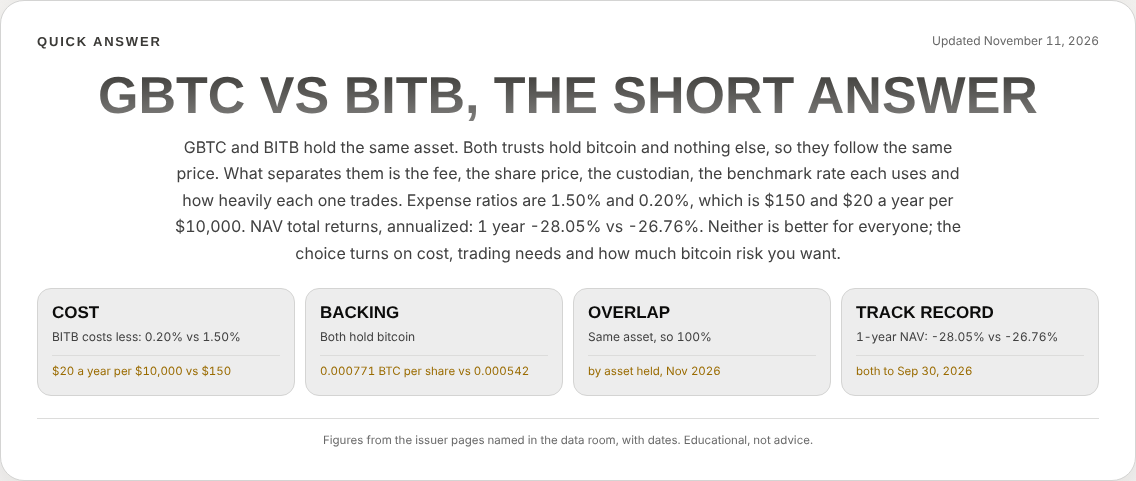
GBTC vs BITB, frequently asked questions
Answers use the figures and dates shown aboveIs GBTC or BITB better?
In the GBTC vs BITB question, neither is better for everyone. GBTC and BITB hold the same asset. Both trusts hold bitcoin and nothing else, so they follow the same price. What separates them is the fee, the share price, the custodian, the benchmark rate each uses and how heavily each one trades.
Expense ratios are 1.50% and 0.20%, which is $150 and $20 a year per $10,000. NAV total returns, annualized: 1 year -28.05% vs -26.76%. Neither is better for everyone; the choice turns on cost, trading needs and how much bitcoin risk you want.
GBTC vs BITB, what are the expense ratios?
GBTC charges 1.50% and BITB charges 0.20%, which is $150 and $20 a year per $10,000.
GBTC vs BITB, how much do the funds overlap?
On GBTC vs BITB, they overlap completely. GBTC and BITB both hold only bitcoin, so owning both repeats one position.
GBTC vs BITB, what does each ETF hold?
GBTC holds bitcoin valued at the CoinDesk Bitcoin Benchmark Rate. BITB holds bitcoin valued at the Not captured. Neither holds futures or mining stocks.
GBTC vs BITB, which has performed better?
NAV total returns, annualized: 1 year -28.05% vs -26.76%. The gap is close to the fee difference. Past performance does not guarantee future results.
GBTC vs BITB, how closely do they track bitcoin?
GBTC trailed its benchmark by 1.09 percentage points over one year (to Sep 30, 2026) against a fee of 1.50%; the issuer page for BITB did not show a benchmark return, so its tracking gap is Not captured.
GBTC vs BITB, can I own both?
On GBTC vs BITB, you can, but it adds nothing, because both hold bitcoin. One trust is enough for the exposure.
GBTC vs BITB, do the funds pay dividends?
On GBTC vs BITB, no. GBTC and BITB hold bitcoin, which earns no income, so neither pays a dividend or has a yield.
GBTC vs BITB, how are gains taxed?
On GBTC vs BITB, in the United States, gains on shares of physically backed bitcoin trusts are generally capital gains, long-term after a year. Rules differ by country and account, so confirm with a tax professional. This is general education, not tax advice.
GBTC vs BITB, are they suitable for Canadian investors?
On GBTC vs BITB, both are U.S.-listed and trade in U.S. dollars, so Canadians face currency conversion costs. Neither pays dividends, so dividend withholding is not the main issue. Treatment of gains differs across TFSA, RRSP and taxable accounts. This is general education, not tax advice.
GBTC vs BITB documents and sources
Open the issuer documents before relying on any figureGBTC · Grayscale
BITB · Bitwise
Third-party sources
Grayscale GBTC fund page · Bitwise BITB fund page.
Methodology and limits
- GBTC figures come from the Grayscale fund page and BITB figures from the Bitwise fund page.
- Dates are shown beside each figure; the issuer documents are linked below.
- Bitcoin per share: GBTC uses issuer bitcoin held divided by shares outstanding; BITB uses NAV divided by the iShares reference price of $74,759.39 (approximate, Bitwise data is dated Nov 8, 2026).
- Overlap is stated by asset held, because a physically backed trust has a single holding.
- Tracking gap is the benchmark return minus the NAV return for the same period, both from the issuer page, and is Not captured where no benchmark return was shown.
- Figures an issuer page does not show are marked Not captured, and nothing was filled from memory or from another fund.
- Return dates differ between some issuers; where they differ no winner is named.
Educational research, not personalized investment, tax or legal advice, and not a recommendation to buy or sell any fund. Investing involves risk, including loss of principal. Past performance does not guarantee future results. Calculators are hypothetical illustrations. Fund data are provided as published by the sources named and may differ from current figures.