Bitcoin ETFs
Six spot bitcoin trusts comparedA research hub for bitcoin ETFs and their comparisons: IBIT, FBTC, GBTC, ARKB, BITB and HODL. This page shows what backs each share, what each trust costs, how each has performed and how the fifteen pairs compare. Every comparison page carries dated figures and sources.
Fund data from iShares, Fidelity, Grayscale, ARK Invest, Bitwise and VanEck pages, Sep 30 to Nov 10, 2026 · Educational research, not advice
Bitcoin ETFs at a glance
Six things to know first- Direct bitcoin. All six trusts hold bitcoin in custody, not futures and not mining stocks.
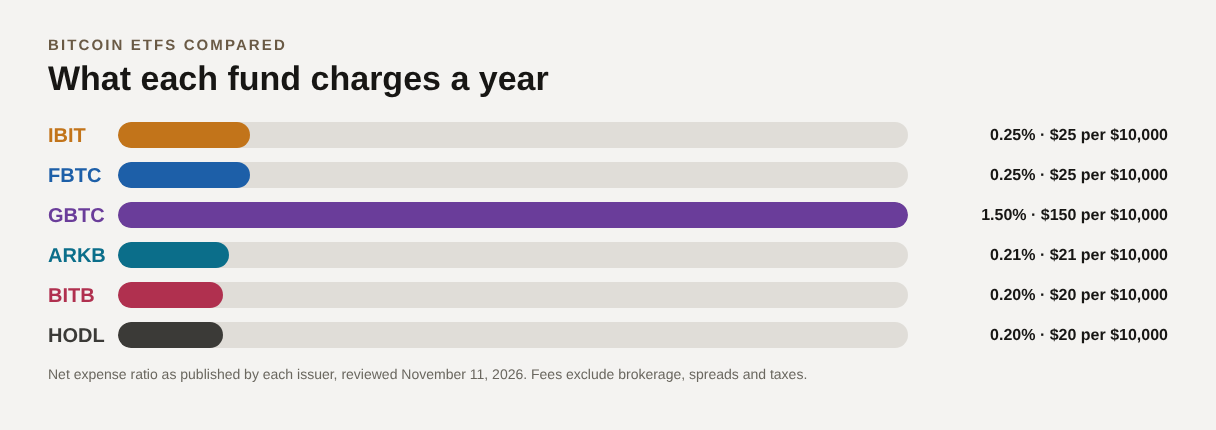
- Cost range. Expense ratios run from 0.20% to 1.50%, which is $1300 a year on $100,000.
- One asset, six prices. The fees are 0.25% (IBIT, FBTC), 0.21% (ARKB), 0.20% (BITB, HODL) and 1.50% (GBTC).
- No income. Bitcoin pays nothing, so none of the trusts has a yield.
- Not a registered fund. These trusts are not investment companies under the 1940 Act, so read each prospectus.
- Large swings. IBIT shows a year-to-date NAV return of -14.57% at Nov 9, 2026 and a one-year return of -26.80% to Sep 30, 2026.
Core bitcoin ETFs, the six funds side by side
Dated figures, sources on each comparison| IBIT | FBTC | GBTC | ARKB | BITB | HODL | |
|---|---|---|---|---|---|---|
| Fund | iShares Bitcoin Trust ETF | Fidelity Wise Origin Bitcoin Fund | Grayscale Bitcoin Trust ETF | ARK 21Shares Bitcoin ETF | Bitwise Bitcoin ETF | VanEck Bitcoin ETF |
| Expense ratio | 0.25% | 0.25% | 1.50% | 0.21% | 0.20% | 0.20% |
| Cost per $10,000 a year | $25 | $25 | $150 | $21 | $20 | $20 |
| Share price (NAV) | $42.31 (Nov 9, 2026) | $63.98 (Nov 10, 2026) | $57.69 (Nov 9, 2026) | $24.37 (Nov 10, 2026) | $40.55 (Nov 8, 2026) | $21.13 (Nov 9, 2026) |
| Bitcoin behind one share | 0.000566 | 0.000870 | 0.000771 | 0.000331 | 0.000542 | 0.000283 |
| Net assets | $59.50B (Nov 9, 2026) | $13.47B (Oct 31, 2026) | $9.25B (Nov 9, 2026) | $2.24B (Oct 31, 2026) | $2.77B (Nov 8, 2026) | $1.07B (Nov 9, 2026) |
| Custodian | Not captured | Not captured | Coinbase Custody Trust Company and Anchorage Digital Bank | Not captured | Coinbase Custody Trust Co., LLC | Not captured |
| Reference rate | CME CF Bitcoin Reference Rate – New York Variant | Fidelity Bitcoin Reference Rate | CoinDesk Bitcoin Benchmark Rate | CME CF Bitcoin Reference Rate – New York Variant | Not captured | MarketVector Bitcoin Benchmark Rate |
| Exchange | NASDAQ | Cboe BZX | NYSE Arca | Cboe BZX | NYSE Arca | Cboe BZX |
| Launched | Jan 5, 2024 | Jan 10, 2024 | Sep 25, 2013 | Jan 10, 2024 | Jan 10, 2024 | Jan 4, 2024 |
Figures come from each issuer page, with the date shown beside each number because the issuers update on different days. Bitcoin per share is the issuer figure for FBTC, GBTC and HODL and is computed from NAV and a bitcoin price for IBIT, ARKB and BITB. Custodians the issuer page did not list are marked Not captured.
HODL and BITB are the lowest-cost funds at 0.20%. GBTC is the most expensive at 1.50%. All six hold the same asset, so the fee, the share price, custody and trading depth are what set them apart.
Bitcoin ETFs, fund by fund
What each one is and where it differsIBIT
iShares Bitcoin Trust ETF launched in January 2024 and is the largest fund here at $59.50B on Nov 9, 2026. It charges 0.25% and lists a 30-day median spread of 0.02%. Its reference rate is the CME CF Bitcoin Reference Rate, New York Variant.
FBTC
Fidelity Wise Origin Bitcoin Fund launched in January 2024 and held $13.47B on Oct 31, 2026. It charges 0.25% and lists about 174,722 bitcoin in the fund on Nov 9, 2026. Its reference rate is the Fidelity Bitcoin Reference Rate.
GBTC
Grayscale Bitcoin Trust ETF began as a trust in 2013 and listed as an ETF in January 2024. It held $9.25B on Nov 9, 2026 and charges 1.50%, the highest fee in the group. Its custodians are Coinbase Custody Trust Company and Anchorage Digital Bank.
ARKB
ARK 21Shares Bitcoin ETF launched in January 2024 and held $2.24B on Oct 31, 2026. It charges 0.21% and is sponsored by 21Shares US LLC with ARK Investment Management as sub-advisor.
BITB
Bitwise Bitcoin ETF launched in January 2024 and held $2.77B on Nov 8, 2026. It charges 0.20%, and Bitwise states that the fee includes custody. Its custodian is Coinbase Custody Trust Co.
HODL
VanEck Bitcoin ETF launched in January 2024 and held $1.07B on Nov 9, 2026. It charges 0.20% and had about 14,352 bitcoin in the trust, which is 0.283 bitcoin for every 1,000 shares.
Fund guides for every ETF here
One page per fund, each with the same sectionsIBIT
iShares Bitcoin Trust ETF. Open the full IBIT guide with fees, holdings, yield, returns and taxes.
Fidelity · expense ratio 0.25%FBTC
Fidelity Wise Origin Bitcoin Fund. Open the full FBTC guide with fees, holdings, yield, returns and taxes.
Grayscale · expense ratio 1.50%GBTC
Grayscale Bitcoin Trust ETF. Open the full GBTC guide with fees, holdings, yield, returns and taxes.
ARK Invest · expense ratio 0.21%ARKB
ARK 21Shares Bitcoin ETF. Open the full ARKB guide with fees, holdings, yield, returns and taxes.
Bitwise · expense ratio 0.20%BITB
Bitwise Bitcoin ETF. Open the full BITB guide with fees, holdings, yield, returns and taxes.
VanEck · expense ratio 0.20%HODL
VanEck Bitcoin ETF. Open the full HODL guide with fees, holdings, yield, returns and taxes.
NEOS · expense ratio 0.99%BTCI
NEOS Bitcoin High Income ETF. Open the full BTCI guide with fees, holdings, yield, returns and taxes.
Bitcoin ETFs, what they hold and what they leave out
Bitcoin in custody, not futures or minersEach of these six funds is a trust that owns bitcoin. The coins are held by a custodian, and a share is a claim on a small slice of them. One share of FBTC is backed by about 0.000870 bitcoin and one share of HODL by about 0.000283, which is why their share prices differ even though the asset is the same.
These trusts do not hold futures contracts, so there is no roll cost of the kind that affects the broad commodity ETFs. They also do not hold bitcoin mining or exchange stocks, so they carry no business risk from a single company. The return is the change in the bitcoin price, less the fee.
The fee is paid by selling a little bitcoin. Because of that, the bitcoin behind each share falls slowly every year, by about the expense ratio. Over a decade a 0.25% fee uses up roughly 2.5% of the coins and a 1.50% fee about 15%.
Unlike a stock fund, these trusts are not registered investment companies under the Investment Company Act of 1940, so they do not carry the same protections. Read each prospectus. These descriptions say what the funds hold, not what to buy.
Bitcoin against stocks and gold, why it behaves differently
No cash flows, a young marketStocks pay earnings and dividends, bonds pay interest and gold has centuries of use as a store of value. Bitcoin pays nothing, so its price rests on what buyers are willing to pay. That makes it very sensitive to sentiment, liquidity and regulation.
The issuer data show how far it can move. IBIT returned -26.80% at NAV over the year to Sep 30, 2026 and 26.42% a year since launch, and by Nov 9, 2026 its year-to-date figure was -14.57%. Compare that with the physical metal trusts on the gold and silver ETFs page.
Because the six funds hold the same coin, they share every risk of bitcoin itself. Choosing between them does not change that exposure.
Bitcoin ETF returns, with the dates shown
NAV total return from the issuer pagesFour issuers report returns to Sep 30, 2026 and two, FBTC and HODL, showed month-end figures to Oct 31, 2026 on the pages read. Because the dates differ, compare funds with the same date and treat the others as context. Figures are NAV total returns, net of fees, and since-launch figures are annualized.
| Fund | 1 year | Since launch, annualized | Returns to |
|---|---|---|---|
| IBIT | -26.80% | 26.42% | Sep 30, 2026 |
| FBTC | -30.59% | 19.83% | Oct 31, 2026 |
| GBTC | -28.05% | 22.47% | Sep 30, 2026 |
| ARKB | -26.76% | 24.49% | Sep 30, 2026 |
| BITB | -26.76% | 24.52% | Sep 30, 2026 |
| HODL | -30.30% | 21.08% | Oct 31, 2026 |
Source: issuer fund pages (iShares, Fidelity, Grayscale, ARK Invest, Bitwise and VanEck). All six launched in 2024 apart from GBTC, whose trust dates from 2013, so none has a 3-year, 5-year or 10-year figure that is comparable. Past performance does not guarantee future results.
Among the funds reported to Sep 30, 2026, one-year NAV returns sit within about 1.3 points of each other, and GBTC, which charges the highest fee, trailed the others. Over a year that gap is close to the fee difference, as the comparison pages show.
A single year of bitcoin returns says little about the next one. Read how to measure investment growth and nominal vs real values before treating any of these numbers as a forecast.
Bitcoin ETF yield, why there is none
No interest, no dividendsBitcoin earns nothing. A coin does not pay interest and does not pay a dividend, so none of these six trusts has a yield or makes regular distributions. The whole return comes from the bitcoin price.
That makes the fee more visible than in a stock or bond fund, where income can cover it. Here the fee is taken by selling bitcoin, and an investor who needs cash has to sell shares.
See what is dividend yield and yield vs total return for how income and price change add up in other kinds of funds.
Bitcoin ETF holdings and overlap
One holding per trustOverlap is simple here. Every trust holds bitcoin and nothing else, so all fifteen pairs overlap completely. Owning two of them repeats one position and adds a second fee to track.
Since the asset is identical, the fee gap is the main thing to compare. It runs from 0.00 points for BITB and HODL to 1.30 points for GBTC and BITB or HODL.
| Comparison | Overlap by asset | Fee gap |
|---|---|---|
| IBIT vs FBTC | Same asset, 100% | 0.00 pts |
| IBIT vs GBTC | Same asset, 100% | 1.25 pts |
| IBIT vs ARKB | Same asset, 100% | 0.04 pts |
| IBIT vs BITB | Same asset, 100% | 0.05 pts |
| IBIT vs HODL | Same asset, 100% | 0.05 pts |
| FBTC vs GBTC | Same asset, 100% | 1.25 pts |
| FBTC vs ARKB | Same asset, 100% | 0.04 pts |
| FBTC vs BITB | Same asset, 100% | 0.05 pts |
| FBTC vs HODL | Same asset, 100% | 0.05 pts |
| GBTC vs ARKB | Same asset, 100% | 1.29 pts |
| GBTC vs BITB | Same asset, 100% | 1.30 pts |
| GBTC vs HODL | Same asset, 100% | 1.30 pts |
| ARKB vs BITB | Same asset, 100% | 0.01 pts |
| ARKB vs HODL | Same asset, 100% | 0.01 pts |
| BITB vs HODL | Same asset, 100% | 0.00 pts |
Use overlap before you add a second fund. Owning IBIT and FBTC repeats one position in bitcoin. Test your whole mix with the Diversification Calculator.
Bitcoin ETF comparison, all fifteen pairs
Head to head, same formatEach page below puts two trusts side by side on cost, what backs each share, tracking against the bitcoin reference rate, returns, trading and taxes. Every figure carries its date, and the data room at the bottom of each page lists the source and grade of each number.
IBIT vs FBTC
The same bitcoin at 0.25% and 0.25%, with different share prices and custodians.
Read the comparisonIBIT vs GBTC
The same bitcoin at 0.25% and 1.50%, with different share prices and custodians.
Read the comparisonIBIT vs ARKB
The same bitcoin at 0.25% and 0.21%, with different share prices and custodians.
Read the comparisonIBIT vs BITB
The same bitcoin at 0.25% and 0.20%, with different share prices and custodians.
Read the comparisonIBIT vs HODL
The same bitcoin at 0.25% and 0.20%, with different share prices and custodians.
Read the comparisonFBTC vs GBTC
The same bitcoin at 0.25% and 1.50%, with different share prices and custodians.
Read the comparisonFBTC vs ARKB
The same bitcoin at 0.25% and 0.21%, with different share prices and custodians.
Read the comparisonFBTC vs BITB
The same bitcoin at 0.25% and 0.20%, with different share prices and custodians.
Read the comparisonFBTC vs HODL
The same bitcoin at 0.25% and 0.20%, with different share prices and custodians.
Read the comparisonGBTC vs ARKB
The same bitcoin at 1.50% and 0.21%, with different share prices and custodians.
Read the comparisonGBTC vs BITB
The same bitcoin at 1.50% and 0.20%, with different share prices and custodians.
Read the comparisonGBTC vs HODL
The same bitcoin at 1.50% and 0.20%, with different share prices and custodians.
Read the comparisonARKB vs BITB
The same bitcoin at 0.21% and 0.20%, with different share prices and custodians.
Read the comparisonARKB vs HODL
The same bitcoin at 0.21% and 0.20%, with different share prices and custodians.
Read the comparisonBITB vs HODL
The same bitcoin at 0.20% and 0.20%, with different share prices and custodians.
Read the comparisonHow to compare bitcoin ETFs
A seven-point checklist- 1. Asset All six hold bitcoin, so exposure is the same. Decide how much bitcoin risk you want first.
- 2. Cost Expense ratios run from 0.20% to 1.50% here, and the fee is the main difference between funds.
- 3. Tracking Check how far the fund has trailed its reference rate. It should be close to the fee.
- 4. Trading Larger trusts usually trade with tighter spreads. Issuer pages showed 30-day median spreads of 0.02% to 0.04% where reported.
- 5. Share price A lower share price helps if you buy whole shares in small amounts. It does not make bitcoin cheaper.
- 6. Custody Read who holds the coins and how, and what insurance the prospectus describes.
- 7. Dates and sources Compare returns only when the periods match, and note where they do not.
Start with how to research an ETF if the terms are new, and size any bitcoin position inside your whole allocation with asset allocation explained.
Bitcoin ETF fees and what you really pay
Cost beyond the expense ratioOn a $100,000 balance, 0.20% is $200 a year, 0.25% is $250 and 1.50% is $1500. Because the funds hold the same coin, a fee gap flows almost one for one into the return gap. Use the ETF Fee Calculator to turn a fee gap into dollars over time.
Trading costs come from the bid/ask spread and from any premium or discount to NAV. The issuer pages showed premiums or discounts between -0.09%% and 0.19%% on the dates read (GBTC -0.09%%, FBTC -0.01%%, IBIT 0.03%%, HODL 0.05%%, ARKB 0.19%%), so the price you pay can differ from the value of the bitcoin on a given day. Use limit orders for larger amounts.
Someone who trades often may value the deepest market more than the lowest fee, while a long-term holder usually gains more from the lower fee. Both are reasonable positions, and the comparison pages show the figures for each pair.
Which bitcoin ETFs suit which investor
Matching the fund to the planYou want bitcoin at a low fee: BITB and HODL at 0.20%, then IBIT and FBTC at 0.25%. Compare them on the BITB vs HODL page.
You trade often or use options: IBIT is the largest trust. See IBIT vs FBTC and IBIT vs HODL.
You already hold GBTC: it charges the most, so see IBIT vs GBTC and GBTC vs BITB for what the fee gap is worth, and check the tax effect of selling first.
You want a mid-sized fund at a low fee: read ARKB vs HODL.
You already own stocks and bonds: bitcoin behaves differently and pays no income, so it usually plays a small role. Check what you own with the Diversification Calculator and size any position against your whole portfolio.
Common mistakes with bitcoin ETFs
Easy ones to avoidOwning two bitcoin trusts. IBIT plus FBTC is one position in bitcoin with two fees to track.
Reading a low share price as a bargain. $10,000 buys about the same amount of bitcoin through any of the six. Only the fee changes what you keep.
Ignoring the fee gap. GBTC charges 1.50% against 0.20% for HODL, a difference of $1300 a year on $100,000.
Expecting income. None of these trusts pays a distribution.
Sizing too large. A single year can bring a decline of a quarter or more, as the one-year returns above show.
Comparing returns on different dates. Check that two funds report to the same day before naming a winner.
Risks of bitcoin ETFs
What custody does not removeBitcoin can fall sharply
Bitcoin responds to sentiment, liquidity and regulation, and large declines are part of its history.
Nothing offsets the fee
With no interest or dividends, the fee and any fall in price come straight out of your return.
Coins held by a custodian
The bitcoin sits with a custodian. Read each prospectus for custody, insurance and security terms.
Holding bitcoin through a trust removes the work of storing it, but not the risk of the price. Past gains are not a limit on future losses, and the trust is not covered by the protections of a registered fund.
Bitcoin ETFs for Canadian investors
Currency and accountsU.S.-listed trusts such as IBIT, FBTC, GBTC, ARKB, BITB and HODL trade in U.S. dollars. Buying them from a Canadian account usually involves converting Canadian dollars, which adds a cost, and a move in the U.S. dollar also changes your return in Canadian dollars.
These trusts pay no dividends, so U.S. dividend withholding tax is not the main question. How gains are taxed depends on the account type and your own situation.
Confirm the rules for your accounts with a qualified tax professional, and see how to build an ETF portfolio for how a bitcoin position fits inside an allocation.
Tools for comparing bitcoin ETFs
Run your own numbersHow bitcoin ETFs are researched here
Sources and datesFigures come from the issuer pages for each fund: iShares for IBIT, Fidelity for FBTC, Grayscale for GBTC, ARK Invest for ARKB, Bitwise for BITB and VanEck for HODL. Fund facts are dated Nov 8 to Nov 10, 2026 and net assets are dated by fund. Gaps are shown as Not captured, and nothing was filled from memory or from another fund.
Bitcoin per share is the issuer figure for FBTC, GBTC and HODL. For IBIT and BITB it is NAV divided by the iShares reference price of $74,759.39 on Nov 9, 2026, and for ARKB it is NAV divided by the bitcoin price implied by the FBTC NAV and bitcoin per share on Nov 10, 2026. The tracking gap is the benchmark return minus the NAV return from the same issuer page. The pages are educational research, not personal advice, and they do not recommend any fund.
Bitcoin ETFs, questions answered
Plain answersWhat are bitcoin ETFs?
Bitcoin ETFs are exchange-traded trusts that hold bitcoin in custody. Each share represents a small amount of bitcoin, so the share price follows the bitcoin price, less the fee. This page compares six of them: IBIT, FBTC, GBTC, ARKB, BITB and HODL.
What is the difference between IBIT and FBTC?
Both hold bitcoin and both charge 0.25%. IBIT is larger, at $59.50B against $13.47B, and has a lower share price because each share represents less bitcoin.
Which bitcoin ETF has the lowest cost?
BITB and HODL list the lowest expense ratio at 0.20%, followed by ARKB at 0.21%, IBIT and FBTC at 0.25% and GBTC at 1.50%. On $100,000 that is $200 a year for the lowest against $1500 for GBTC.
Why does GBTC cost more than the others?
GBTC charges 1.50% against 0.20% to 0.25% for the others. Grayscale lists the higher fee on its fund page. For an investor choosing today, the gap is $1300 a year on $100,000 against HODL.
Do bitcoin ETFs hold real bitcoin?
Yes. These six trusts hold bitcoin with a custodian. They do not hold futures or mining stocks.
Do bitcoin ETFs pay dividends?
No. Bitcoin earns no income, so the trusts make no regular distributions and have no yield.
Are bitcoin ETFs the same as mutual funds?
No. These trusts are not registered under the Investment Company Act of 1940, so they do not carry the protections of a registered fund. Read each prospectus.
Should I own more than one bitcoin ETF?
Usually not. All six hold the same asset, so a second one adds no diversification.
How are bitcoin ETFs taxed?
In the United States, bitcoin is generally treated as property, and gains on shares of a physically backed trust are generally capital gains, long-term after a year. Rules differ by country and account, so confirm the details with a tax professional.
Are bitcoin ETFs a good fit for Canadian investors?
U.S.-listed trusts can work, but you face currency conversion, and the tax treatment of gains depends on the account. Confirm the details with a qualified tax professional.
Educational research, not personalized investment, tax or legal advice, and not a recommendation to buy or sell any fund. Investing involves risk, including loss of principal. Past performance does not guarantee future results. Fund data are provided as published by the sources named and may differ from current figures.