The Law of Demand and Its Conditions. Why Buyers Purchase Less When Prices Rise
When prices rise, people buy less, as long as other things stay the same. This guide explains the law of demand, the substitution and income effects behind it, the conditions it needs and the rare cases that seem to break it.
Higher prices mean lower quantity demanded, other things equal
Substitution, income effects and diminishing extra benefit
Weak responses to price signal a company’s pricing power
A pattern seen almost everywhere
When a grocery chain cuts the price of strawberries from $5.99 to $3.99 a box, the berries fly off the shelves. When a city raises transit fares, ridership dips. When a streaming service raises its monthly fee, some subscribers cancel. Across countless markets and centuries of evidence, the same pattern appears: when the price of a good rises, buyers purchase less of it, and when the price falls, they purchase more, as long as other conditions stay the same. Economists call this the law of demand. It is one of the most reliable relationships in economics, but it comes with conditions that are easy to forget and important to understand.
The law of demand is not a law in the sense of a law of physics. It is a strong regularity in human behaviour, based on how people make choices when resources are limited. Understanding why it holds, and under what conditions, helps explain everything from how businesses set prices to how taxes affect consumption and why sales events work.
This guide explains the law of demand, the reasons behind it, the conditions it requires, the rare cases that seem to break it, and what the evidence shows. It builds on What Is Demand in Economics? and Quantity Demanded vs Demand.
What the law of demand says
The law of demand states that, other things being equal, the quantity demanded of a good falls when its price rises, and rises when its price falls. In graphical terms, it means demand curves slope downward from left to right.
Three features of this statement deserve attention. First, it concerns quantity demanded, a movement along the demand curve, not a shift in demand. Second, it applies only when other factors, such as income, tastes and the prices of related goods, are held constant. Third, it describes a tendency across buyers and over a defined period, not a rule that every individual must follow at every moment. Some individual buyers may not respond to a small price change at all, but across many buyers the total quantity demanded falls.
It is worth noting that the law of demand describes what happens to the quantity bought when the price changes, not what happens to spending. When the price of a good rises, buyers purchase fewer units, but their total spending on it may rise or fall depending on how strongly they respond. A family might buy less electricity after a rate increase yet still pay a higher monthly bill. Keeping quantity and spending separate avoids a common source of confusion when reading about price changes.
Why the law of demand holds
Economists explain the law of demand through several connected reasons. Each captures part of how people respond when a price changes.
The substitution effect. When a good becomes more expensive, its alternatives become relatively cheaper. Buyers shift some of their purchases toward substitutes. If the price of beef rises while chicken stays the same, many shoppers buy more chicken and less beef. Substitution is often the most powerful force behind the law of demand, especially for goods with close alternatives.
The income effect. A higher price reduces what a buyer’s income can purchase. Even without changing their budget in dollars, people effectively become poorer when prices rise, so they tend to buy less of many goods, including the one whose price rose. For goods that take a large share of a budget, such as rent or fuel, the income effect can be substantial.
Diminishing marginal benefit. The extra satisfaction from each additional unit of a good usually falls as a person consumes more. The first coffee of the morning may be very valuable, the third much less so. A person will buy an extra unit only if its extra benefit is at least worth the price. A lower price makes it worthwhile to buy units with lower extra benefit, so quantity demanded rises. This idea is developed in Diminishing Marginal Benefits.
More buyers at lower prices. At high prices, only those who value a good highly buy it. As the price falls, people who value it less enter the market. A $300 concert ticket attracts devoted fans, while a $50 ticket also attracts casual listeners. Across a market, this entry and exit of buyers adds to the downward slope.
A worked example: the substitution and income effects
Consider a student with $60 a week to spend on lunches. She can buy sandwiches from the campus café or bring homemade lunches. The figures are illustrative.
When café sandwiches cost $8, she buys 5 a week, spending $40, and spends the remaining $20 on ingredients for homemade lunches on other days.
The café raises the price to $10. Buying 5 sandwiches would now cost $50, leaving only $10 for everything else.
Substitution effect: homemade lunches are now relatively cheaper compared with café sandwiches, so she switches some days to homemade.
Income effect: her $60 buys less than before, so she cuts back overall.
Result: she buys 3 sandwiches at $10, spending $30, and puts $30 toward homemade lunches. Quantity demanded fell from 5 to 3 when the price rose from $8 to $10.
The example shows how the two effects combine. The substitution effect pushes her toward the relatively cheaper option. The income effect reflects her reduced purchasing power. Both work in the same direction for most goods, reinforcing the law of demand.
The conditions behind the law
The law of demand holds when certain conditions are met. Ignoring them is the source of most apparent exceptions.
| Condition | What it means | What happens if it fails |
|---|---|---|
| Other things equal | Income, tastes and related prices stay fixed | Price and quantity can rise together if demand shifts |
| Defined period | Quantities measured over a consistent time | Short-run and long-run responses get mixed up |
| Real price change | The price itself changes, not just its label | Hidden fees or quality changes distort the comparison |
| Same good | Quality and features unchanged | A better product at a higher price may sell more |
| Stable expectations | Buyers do not expect further price moves | Rising prices can trigger buying ahead of more increases |
The first condition, other things equal, is the most important. If incomes rise at the same time as a price increases, people may buy more despite the higher price. That does not violate the law of demand; it reflects a shift in demand that outweighs the movement along the curve, as explained in Quantity Demanded vs Demand. The method of holding other factors fixed is discussed in Ceteris Paribus.
Apparent exceptions and what they really show
Several cases are sometimes presented as exceptions to the law of demand. Most turn out to be shifts in demand or changes in the conditions behind the law. A few are genuine but rare.
Rising prices and rising sales. During a housing boom, prices and sales can rise together. This usually reflects a shift in demand caused by low interest rates, population growth or expectations of further price increases, not an upward-sloping demand curve.
Expectations of further increases. If buyers expect prices to keep rising, a price increase today can prompt more buying now, as people try to purchase before prices climb further. This happened with some goods in the early months of the COVID-19 pandemic. The higher current price did not cause more buying; changing expectations shifted demand. The role of expectations is explored in Expectations and Consumer Demand.
Price as a signal of quality. When buyers cannot easily judge quality, a higher price may suggest a better product. A wine that costs $40 might sell better than an identical one priced at $12 because shoppers assume the expensive bottle is superior. Here the price changes perceived quality, which changes demand, so the comparison is no longer between the same good at different prices.
Status goods. The economist Thorstein Veblen observed in 1899 that some luxury goods are valued partly because they are expensive and display wealth. For such goods, a higher price might, within a range, increase their appeal to some buyers. Economists call these Veblen goods. Even here, demand eventually falls if prices rise far enough, and evidence for truly upward-sloping demand is limited.
Giffen goods. In theory, a staple food that takes a large share of a very poor household’s budget could see demand rise with its price. If the staple becomes more expensive, the household may no longer afford better foods and buy even more of the cheap staple. Such goods are named after the Victorian economist Robert Giffen. A 2008 study by Robert Jensen and Nolan Miller found evidence of this behaviour among very poor households in parts of China for rice and wheat. Giffen behaviour is real but rare and requires extreme circumstances.
What the evidence shows
The law of demand has been tested in a vast range of markets, and the evidence is strongly supportive. Studies of tobacco consumption in many countries have consistently found that higher cigarette taxes, which raise prices, reduce smoking, particularly among young people. Research on gasoline finds that higher prices reduce fuel use, modestly in the short run and more substantially over several years as people adjust vehicles and commuting habits.
Transit agencies observe that fare increases reduce ridership, while fare reductions raise it, though the size of the response varies with service quality and alternatives. Retailers know from experience that sales and promotions increase the quantity sold. Online platforms that test different prices with comparable groups of customers routinely find that higher prices reduce purchases.
The strength of the response varies widely. For some goods, such as basic medicines or electricity in the short run, quantity demanded changes little when prices change. For others, such as a particular brand of soft drink with many close substitutes, small price changes can lead to large shifts in purchases. Measuring the size of these responses is the subject of the later chapter on elasticity.
From individual choices to market demand
The law of demand is easiest to see at the level of a whole market. An individual might buy either one or zero of a particular item, regardless of small price changes. But across thousands of buyers with different incomes, tastes and alternatives, a price increase pushes some of them below the point where buying is worthwhile. The market quantity demanded falls even if many individuals do not change their behaviour at all.
Five potential customers would each buy one ticket to a local theatre show if the price is at or below their maximum willingness to pay: $60, $45, $35, $25 and $15.
At a price of $50, only the first customer buys: quantity demanded is 1.
At $30, the first three buy: quantity demanded is 3.
At $20, the first four buy: quantity demanded is 4.
At $10, all five buy: quantity demanded is 5.
No individual’s preferences changed, yet the market quantity demanded rose as the price fell, because more people found the show worth the price.
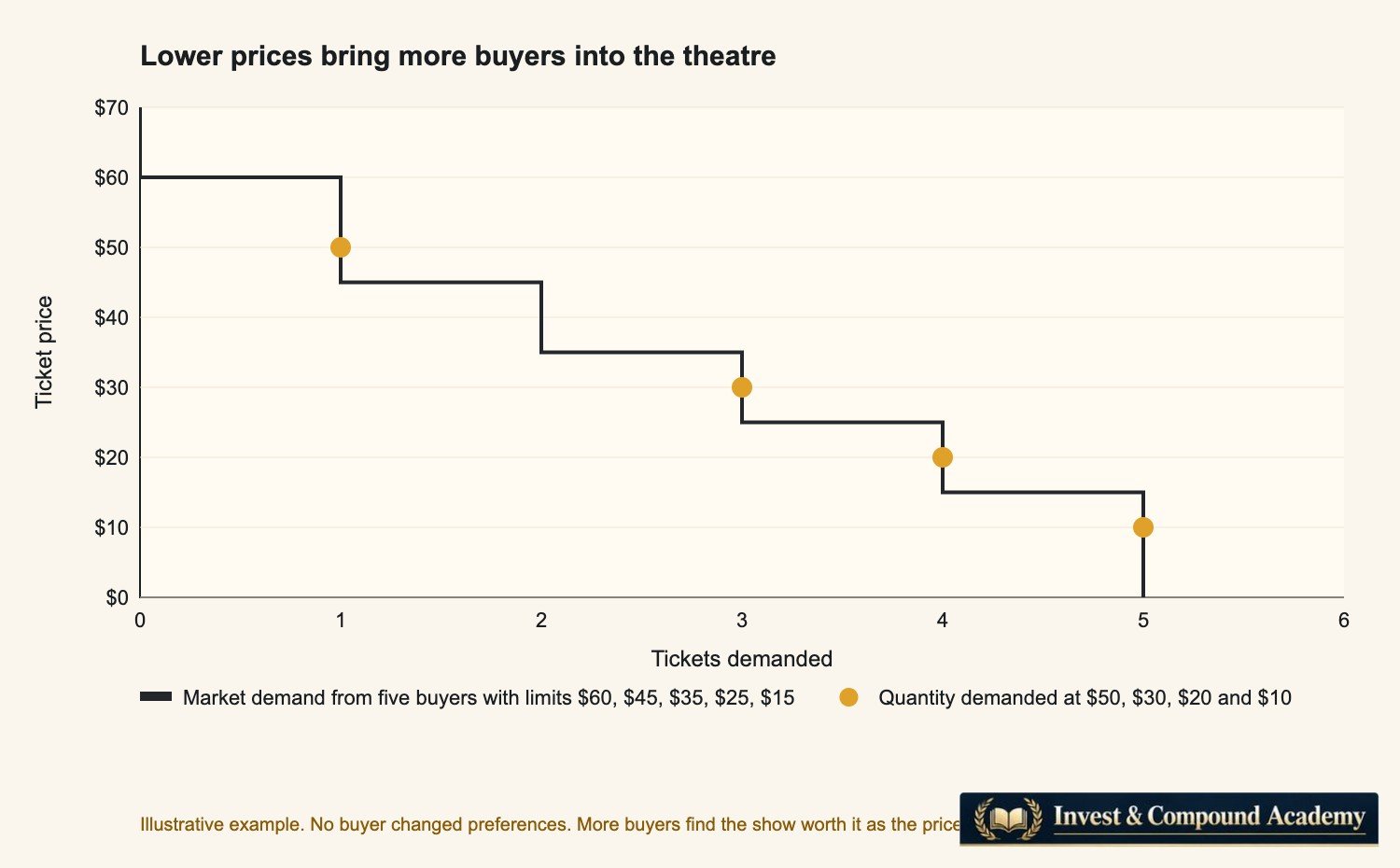
This simple example shows the logic behind downward-sloping market demand curves. Each buyer has a maximum price they are willing to pay. Lowering the price brings more buyers into the market. Real markets have thousands or millions of buyers, so the curve becomes smooth. How individual demand adds up to market demand is explained in Individual vs Market Demand, and the idea of maximum willingness to pay in Willingness to Pay vs Ability to Pay.
Drawn as a chart, the five buyers create a staircase that steps down to the right. Each step marks the price at which one more person decides the show is worth it. With thousands of buyers instead of five, the steps become so small that the staircase looks like the smooth downward-sloping curve seen in textbooks, which is exactly the law of demand at the scale of a whole market.
Time and the strength of the law
The law of demand usually becomes stronger over longer periods. In the short run, buyers may have few alternatives or may be locked into habits and contracts. Over time, they can find substitutes, change routines or buy different equipment. A sharp rise in home heating oil prices might reduce consumption only slightly during one winter, because households still need heat. Over several years, many may install heat pumps or improve insulation, reducing oil use much more.
This pattern matters for businesses and governments. A company that raises prices may see little immediate drop in sales and conclude customers are insensitive to price, only to lose customers gradually as they find alternatives. A tax designed to reduce consumption may appear ineffective at first but have larger effects over time. The difference between short-run and long-run responses is discussed in Short Run vs Long Run Adjustment.
The law of demand and public policy
Many public policies rely on the law of demand. Taxes on tobacco, alcohol and sugary drinks aim to reduce consumption by raising prices. Carbon pricing raises the cost of fossil fuels to encourage people and businesses to use less of them. Road tolls and congestion charges raise the price of driving at busy times to reduce traffic. Subsidies, such as rebates for energy-efficient appliances or lower transit fares, use the law in reverse, lowering prices to increase use of goods with public benefits.
The effectiveness of these policies depends on how strongly quantity demanded responds to price. Where buyers respond strongly, a modest price change can significantly change behaviour. Where they respond weakly, a policy may raise revenue but change behaviour less than hoped. Policymakers therefore need estimates of how responsive demand is, which is why the concept of elasticity, introduced in a later chapter, is so important. The broader role of government in markets is discussed in Government Roles in a Mixed Economy.
The law of demand in Canadian examples
Canadian experience offers clear illustrations. Provinces have raised tobacco taxes many times over the past few decades, and public health researchers have linked those higher prices to lower smoking rates, especially among young people, alongside other measures such as advertising restrictions and smoke-free laws. Separating the effect of price from these other measures requires careful study, but the direction of the price effect is consistent with the law of demand.
Gasoline offers another example. When pump prices rose sharply in 2022, many Canadian drivers reported cutting back on discretionary trips and combining errands. National fuel sales did not collapse, because most people still needed to drive to work, but the response was visible, and it tends to grow over time as people choose more efficient vehicles. Public transit agencies in Canadian cities similarly track how ridership responds to fare changes when planning budgets. In each case, the response to price is real but its size depends on alternatives and time.
The law of demand in business decisions
Every pricing decision a business makes is shaped by the law of demand. Raising prices increases revenue per unit but reduces the number of units sold. Lowering prices does the opposite. The best price depends on how strongly customers respond and on the cost of producing each unit.
A fitness studio estimates that weekly sign-ups for a class follow sign-ups = 120 − 4 × price, with prices between $10 and $25.
At $15: 120 − 60 = 60 sign-ups, revenue $900.
At $20: 120 − 80 = 40 sign-ups, revenue $800.
At $12: 120 − 48 = 72 people would sign up, which would bring in $864 if the room were large enough.
If the class can hold at most 60 people and the instructor’s pay is fixed, $15 fills the room and earns the most revenue of these options. A higher price leaves spaces empty, while at $12 the studio could admit only 60 people, earning $720 and turning 12 away.
Businesses use this logic constantly, through discounts, loyalty pricing, early-bird offers and premium tiers. Sales events rely on the law of demand to clear inventory. Dynamic pricing, used by airlines, hotels and ride-hailing services, adjusts prices as demand changes, raising them when demand is strong and lowering them when it is weak. Each approach assumes that customers buy less when prices rise and more when they fall.
Why discounts for some buyers make sense
The law of demand also explains why businesses often charge different prices to different groups. Students, seniors and early bookers frequently receive discounts. These groups tend to be more sensitive to price, so a lower price brings in many additional customers who would not buy at the full price, while customers who are less sensitive continue to pay more. A cinema that offers cheaper tickets on Tuesday afternoons is using the law of demand to fill seats that would otherwise stay empty. Airlines that charge more for last-minute bookings are doing the reverse, recognizing that travellers who book late are often less able to switch to alternatives. Such pricing must comply with consumer protection and human rights rules, but its logic rests on the same downward-sloping demand that this guide describes.
What it means for investors
For investors, the law of demand helps explain a company’s pricing power, its ability to raise prices without losing many customers. Companies with strong brands, unique products or few competitors often face demand that responds weakly to price, giving them room to raise prices and protect profits during inflation. Companies selling products with many close substitutes face stronger responses and must compete more on price.
When a company reports that it raised prices and volumes fell only slightly, it suggests demand for its products is relatively insensitive to price, a sign of pricing power. When volumes fall sharply after a price increase, it suggests customers have alternatives. Investors watch these patterns in earnings reports to judge how resilient a company’s revenue might be. Spreading investments across many companies, as explained in What Is Diversification in Investing, reduces exposure to any one company’s pricing decisions. The effect of inflation on companies and portfolios is discussed in Inflation and Investing.
The law of demand in your own choices
You follow the law of demand in your own decisions, often without noticing. When gas prices climb, you might combine errands or take the bus more often. When a favourite restaurant raises its prices, you might visit less frequently. When your grocery store discounts a product you like, you might stock up. Each response reflects the same logic: when something costs more, it becomes worth buying less of it, and when it costs less, it becomes worth buying more.
Recognizing this pattern can improve personal finances. Watching for sales on items you buy regularly, considering substitutes when prices rise and asking whether a purchase is still worthwhile at a higher price are simple ways to use the law of demand to your advantage. These choices connect to the broader idea of opportunity cost, explained in Opportunity Cost Explained.
How the law of demand was developed
Observations that higher prices reduce purchases go back centuries. Medieval and early modern writers noted that scarce goods commanded higher prices, and merchants understood that lower prices attracted more customers. The systematic statement of the law came with the rise of modern economics. In the 1690s, the English writer Gregory King compiled estimates of how the price of grain responded to harvest sizes, an early attempt to measure the relationship between quantity and price.
In the nineteenth century, economists including Antoine Augustin Cournot and Alfred Marshall formalized demand as a relationship between price and quantity. Marshall, writing in 1890, emphasized that the law holds other things being equal and introduced the term elasticity to describe how strongly quantity responds to price. In the twentieth century, John Hicks and Eugen Slutsky separated the substitution and income effects mathematically, showing precisely why demand curves usually slope downward and under what unusual conditions they might not.
Today, the law of demand is supported by an enormous body of evidence, from historical price data to modern field experiments and online price tests. It remains one of the foundations of economics, taught in the first weeks of introductory courses and applied in nearly every area of the field. Its broader role in economic thinking is discussed in Economic Thinking and Economic Decisions.
Common mistakes about the law of demand
Forgetting the other-things-equal condition
When incomes, tastes or related prices change at the same time as a price, quantity can rise despite a higher price. That reflects a demand shift, not a broken law.
Confusing a shift with a movement
The law of demand describes movements along a curve. Shifts in the curve come from other determinants.
Treating rare exceptions as common
Giffen and Veblen goods are real possibilities but rare. For almost all goods and services, demand slopes downward.
Assuming every buyer responds
The law describes market tendencies. Some individuals may not change their purchases after a small price change, while others do.
Ignoring time
Responses to price are often small at first and larger later, as buyers find alternatives.
Testing the law with experiments
Modern technology lets businesses and researchers test the law of demand directly. Online retailers and subscription services can show slightly different prices to randomly chosen groups of visitors and compare how many people buy. Because the groups are similar in every other way, any difference in purchases can be attributed to price. Such experiments must respect consumer protection laws and avoid unfair treatment, but when designed well they provide clear evidence of how demand responds.
Field experiments in other settings have produced similar findings. Studies in developing countries have offered health products, such as insecticide-treated bed nets or water-purification tablets, at different prices to comparable groups. Many found that even small price increases sharply reduced take-up, an important finding for programmes deciding whether to charge for products with large public health benefits. Research by economists such as Jessica Cohen and Pascaline Dupas contributed to this evidence. These results show the law of demand at work in decisions with serious consequences.
Frequently asked questions
What is the law of demand in simple terms?
When the price of a good rises, people buy less of it, and when the price falls, they buy more, as long as other things such as income and tastes stay the same.
Why does the law of demand hold?
Because buyers switch to relatively cheaper substitutes, higher prices reduce what their income can buy, the extra benefit of additional units falls, and more buyers enter the market at lower prices.
Are there exceptions to the law of demand?
Most apparent exceptions reflect shifts in demand or changes in quality or expectations. Genuine exceptions, such as Giffen goods for very poor households, are rare and occur only in unusual circumstances.
Does the law of demand apply to services?
Yes. It applies to services such as transit, haircuts, streaming subscriptions and medical visits, as well as to physical goods.
How strongly do people respond to price changes?
It varies. People respond weakly for necessities with few substitutes and strongly for goods with many alternatives. Responses are usually larger over longer periods.
Is the law of demand the same as the demand curve?
The law of demand describes the direction of the relationship, that quantity falls as price rises. The demand curve is the full picture of that relationship for a particular good, showing how much is demanded at each price.
Key takeaways
- The law of demand says quantity demanded falls when price rises, other things equal.
- It is explained by substitution, income effects, diminishing marginal benefit and more buyers at lower prices.
- It holds only when income, tastes, related prices, quality and expectations stay constant.
- Most apparent exceptions are shifts in demand, while true exceptions are rare.
- Evidence from taxes, transit, retail and experiments strongly supports the law.
- For businesses and investors, it underlies pricing decisions and pricing power.
Continue Learning with Invest & Compound Academy
Continue through the chapter on demand.
All topics in this chapter
More topics to explore
Sources and further reading
OpenStax, Principles of Economics, 3rd ed. · Alfred Marshall, Principles of Economics, 1890 · Thorstein Veblen, The Theory of the Leisure Class, 1899 · Robert Jensen and Nolan Miller, “Giffen Behavior and Subsistence Consumption,” American Economic Review, 2008 · Jessica Cohen and Pascaline Dupas, “Free Distribution or Cost-Sharing?” Quarterly Journal of Economics, 2010
Educational disclosure
This article provides general economics education for informational purposes only. It is not financial, investment, tax or legal advice, and it does not consider your personal circumstances. Examples are simplified for teaching and do not describe real people, organizations or recommendations.