Expectations and Consumer Demand. How Beliefs About Tomorrow Shift Buying Today
Buyers decide what to purchase today partly on what they expect tomorrow. Here is how expected prices, incomes and shortages shift demand, and why it matters for businesses, policy and investors.
A change in buyers’ beliefs about future prices, incomes or availability.
The current demand curve shifts, even when today’s price is unchanged.
Many expectation shifts move purchases in time and later reverse.
Buying today with an eye on tomorrow
In the weeks before a major holiday sale, many electronics stores notice something odd: television sales slow down even though prices have not changed. Shoppers have not lost interest in new televisions. They are waiting, because they expect lower prices soon. Expectations and consumer demand are closely linked, because buyers decide what to purchase today partly on what they think will happen to prices, incomes and availability tomorrow. This topic explains how expectations shift demand curves, why durable goods are especially sensitive and what these effects mean for businesses, policymakers and investors.
A demand curve shows how much buyers want at each price, holding other conditions constant. Expectations about the future are among those conditions. When expectations change, buyers want a different amount at every current price, so the whole curve shifts. Other factors that shift demand, such as income and the prices of related goods, are covered in Income and Demand Shifts and Substitutes, Complements and Demand.
Expectations as a determinant of demand
Three kinds of expectations matter most. Expectations about the good’s own future price affect when people buy. Expectations about future income affect how much they feel able to spend. Expectations about future availability, such as fears of shortages, can trigger sudden waves of buying. Each works through the same mechanism: today’s purchase is compared with the alternative of buying later or not at all.
Expectations differ from the actual future. Buyers act on what they believe, and those beliefs may turn out to be right or wrong. A rumour of an upcoming shortage can shift demand today even if no shortage ever arrives. That is why economists treat expectations as a separate determinant of demand rather than simply waiting to see what happens.
A worked example: waiting for a holiday sale
Suppose weekly demand for a popular television model at a store is described by sets = 400 − current price + 0.5 × expected price next month. The current price is $600. The figures are illustrative.
If buyers expect the price to stay at $600, demand this week = 400 − 600 + 300 = 100 sets.
If buyers come to expect a holiday price of $480, demand this week = 400 − 600 + 240 = 40 sets.
The current price did not change, yet weekly sales fell by 60 sets. The change in expectations shifted the current demand curve to the left at every price.
When the sale arrives and the price falls to $480, sales jump, as buyers who delayed their purchases return to the store.
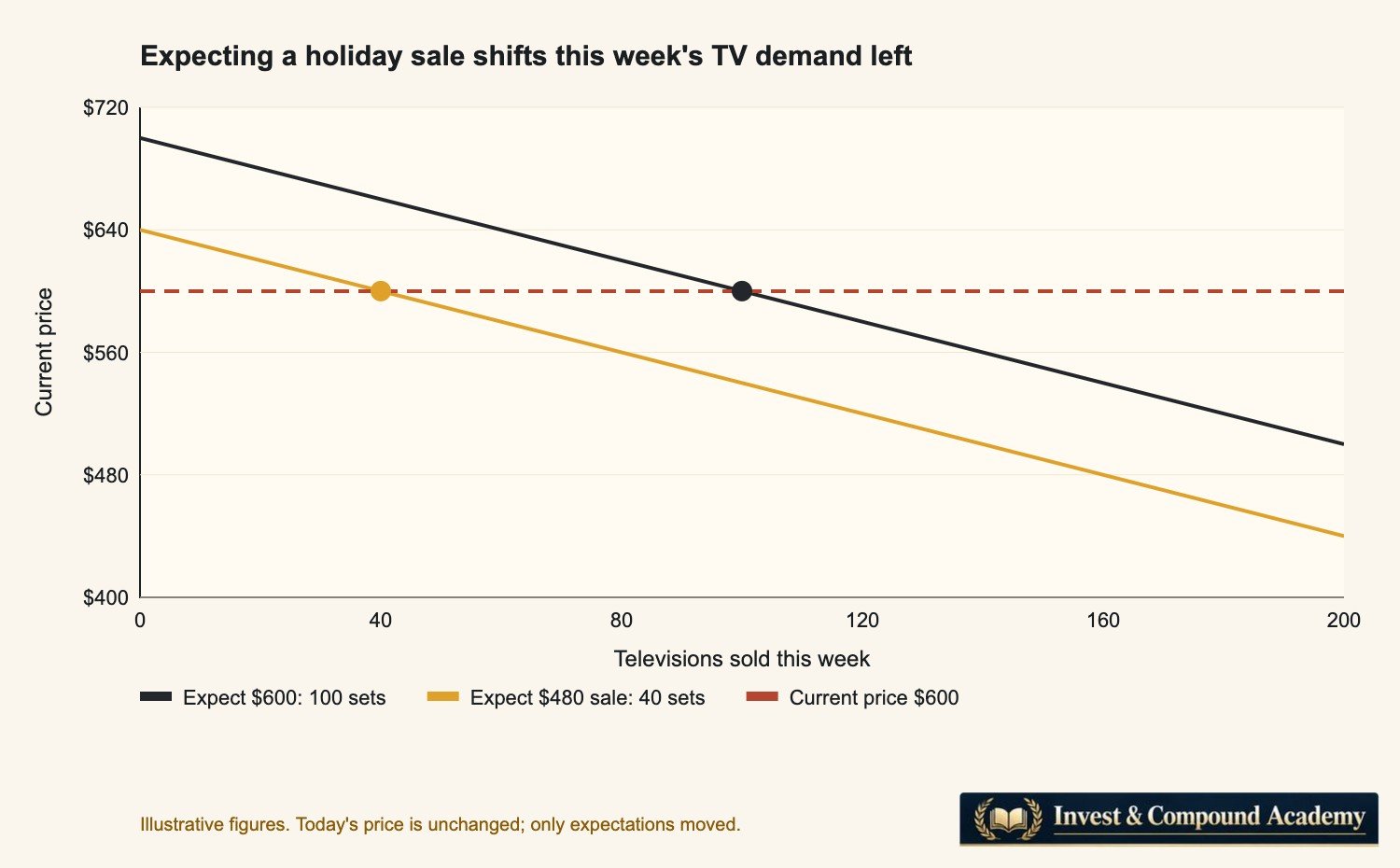
With the current price on the vertical axis, the original curve is price = 700 − sets, and the curve under the new expectation is price = 640 − sets. The new curve lies to the left of the old one, by 60 sets at every price. This is a shift caused entirely by beliefs about the future. The difference between shifts and movements along a curve is explained in Quantity Demanded vs Demand.
Expected prices: buying early or waiting
When buyers expect a price to rise, they tend to buy more now, before the increase. When they expect a price to fall, they tend to wait. Both responses shift the current demand curve, to the right in the first case and to the left in the second.
Everyday examples are easy to find. Drivers who hear that gasoline prices will rise next week often fill their tanks early, producing lines at gas stations. Shoppers who know that a store holds a big sale every November may postpone buying winter coats or electronics until then. Households that expect mortgage rates to rise may hurry to buy a home before borrowing becomes more expensive, while those expecting rates to fall may wait.
The effect depends on whether the good can be stored or postponed. Fresh food cannot be stockpiled for long, so expected price changes have only a small effect on current demand. Canned goods, paper products and fuel can be stored, so buyers can shift purchases in time. Large items such as cars and appliances can often be postponed for months. The more easily a purchase can be moved in time, the stronger the effect of expected prices on current demand.
Why durable goods are especially sensitive
Durable goods, such as cars, furniture, appliances and homes, last for years. Buyers of durable goods are choosing not just whether to buy but when. An old car can often be kept running for another year, and an old refrigerator can usually last a few more months. This flexibility makes demand for durable goods particularly sensitive to expectations.
When households expect hard times ahead, they often postpone durable purchases first, because they can keep using what they already have. When they become optimistic, postponed purchases return in a wave. As a result, spending on durable goods tends to swing more over the economic cycle than spending on services and everyday goods such as groceries. Economists watching for turning points in the economy pay close attention to durable goods orders for this reason.
A household plans to replace its car this year. Its current car is aging and costs about $150 a month more in repairs than a new one would.
Worried that one earner’s job may be cut, the household decides to wait 12 months. The extra repair cost over the year is about 12 × $150 = $1,800.
The household judges that keeping its savings intact during an uncertain year is worth more than $1,800. Its demand for a new car this year falls to zero, even though car prices have not changed.
Multiply this decision across many households and the demand curve for new cars shifts left.
Expected income and job security
Buyers also consider what they expect to earn in the future. A worker who expects a promotion may feel comfortable signing up for a gym membership, booking a holiday or buying furniture on credit. A worker who fears layoffs may cut back even before any change in pay. The current demand curve for many normal goods therefore shifts with expectations about future income, not just with current income.
This is one reason economists and businesses track measures of consumer confidence. Surveys such as the University of Michigan’s Surveys of Consumers and The Conference Board’s Consumer Confidence Index in the United States, and the Conference Board of Canada’s Index of Consumer Confidence, ask households how they feel about their finances, job prospects and the economy. Falling confidence often signals weaker spending ahead, especially on large and postponable purchases.
Expected availability and panic buying
Expectations about whether a good will be available can produce some of the most dramatic shifts in demand. When people believe a shortage is coming, they buy more now to make sure they are not left without. In early 2020, at the start of the COVID-19 pandemic, shoppers in many countries cleared store shelves of toilet paper, hand sanitizer, pasta and flour. Total long-run need for these goods had barely changed, but the fear of running out shifted current demand sharply to the right.
Panic buying can become self-reinforcing. When shoppers see empty shelves, they conclude that shortages are real and buy even more when goods return, which keeps shelves empty. Retailers responded in 2020 by limiting how many units each customer could buy, which helped calm expectations as well as share the available stock. Within months, as supply caught up and confidence returned, demand for most of these goods settled back toward normal levels, and some households had enough stored to buy less for a while.
The episode shows that expectations can shift demand without any change in prices, incomes or tastes. It also shows that a shift caused by expectations is often temporary, because purchases brought forward reduce purchases later.
Inflation expectations
When people expect prices in general to rise quickly, they have a reason to buy sooner rather than later, because money will buy less in the future. Expectations of high inflation can therefore increase current demand across many goods, which in turn can push prices up further. This is one reason central banks pay close attention to inflation expectations, not just to current inflation.
Central banks such as the Bank of Canada and the U.S. Federal Reserve aim to keep inflation low and stable, around 2 percent a year, and they communicate their goals clearly so that households and businesses expect stable prices. When expectations stay anchored near the target, people have less reason to rush purchases or demand large wage increases, which helps keep inflation under control. How central banks work and how inflation affects savers are explained in What Does the Federal Reserve Do and Inflation and Investing.
Announced tax changes
When governments announce tax changes in advance, buyers often respond before the change takes effect. If a sales tax increase is announced for next quarter, households may bring forward large purchases to beat it. Japan offers a well-documented example. Before the consumption tax rose from 5 percent to 8 percent in April 2014, household spending jumped in March as shoppers bought ahead, then dropped sharply in April and the months that followed.
A refrigerator costs $1,500 before tax. The sales tax rate is scheduled to rise from 5 percent to 8 percent next month.
Buying now costs $1,500 × 1.05 = $1,575. Buying next month costs $1,500 × 1.08 = $1,620.
Buying early saves $45. A household that planned to replace its refrigerator within a few months may decide to buy now.
Across many households, demand this month shifts right, and demand next month shifts left, even though the pre-tax price never changes.
Policymakers and statisticians take such timing effects into account when interpreting spending data around tax changes. A surge followed by a slump may simply reflect shifted timing rather than a lasting change in demand. Similar logic applies when a temporary rebate or subsidy is scheduled to end. Comparing outcomes before and after a change is the essence of Comparative Statics.
How people form expectations
Economists have long debated how people form their expectations. One view, known as adaptive expectations, holds that people base their forecasts mainly on recent experience. If prices have risen 3 percent a year for several years, people expect about 3 percent next year. If inflation suddenly climbs, expectations adjust gradually as people see the new pattern.
Another view, known as rational expectations, was introduced by John Muth in 1961 and developed by Robert Lucas and others in the 1970s. It holds that people use all available information, including announced policies and how the economy works, to form forecasts that are correct on average. Under this view, a clearly announced and credible policy change can shift expectations immediately, without waiting for experience to accumulate.
Real behaviour seems to combine elements of both. Many households pay attention to prices they see often, such as groceries and gasoline, and form expectations partly from those. Announcements matter too, especially when they are clear and widely reported. Research in behavioural economics also shows that recent vivid events, such as a sudden price spike, can carry extra weight in people’s minds. Understanding how beliefs are formed helps explain why demand sometimes reacts sharply to news and sometimes hardly at all. The role of beliefs and incentives in decisions is discussed in What Are Economic Incentives.
When expectations become self-fulfilling
Expectations can influence the very outcomes people are predicting. If many people expect house prices to keep rising, they may rush to buy before prices climb further. Their buying raises demand, which pushes prices up, which seems to confirm their expectation. This cycle can continue for some time, contributing to rapid price increases that may later reverse when expectations change.
The reverse can also happen. If people expect a recession, they may cut spending and postpone purchases. Businesses see falling sales and reduce hiring and investment. Incomes fall, which seems to confirm the original fears. Economists sometimes describe this as a self-fulfilling prophecy. It does not mean expectations alone determine outcomes, but it shows how beliefs and demand can reinforce each other. How bubbles and crashes have unfolded in financial markets is explored in Stock Market Crashes in History.
Expectations and business decisions
Businesses manage customer expectations carefully, because those expectations shape demand. Retailers that hold regular, predictable sales may find that customers wait for them, which reduces full-price sales. Some retailers respond by using less predictable discounts, or by promising price protection so customers do not fear buying just before a markdown.
Technology companies face a related challenge. When a company announces a new model months in advance, customers may stop buying the current model and wait. This pattern is sometimes called the Osborne effect, after the Osborne Computer Corporation. According to the widely told account, the company announced improved computers in 1983 well before they were ready, and sales of its existing model fell sharply, contributing to its financial collapse. Historians debate how much the announcement alone was to blame, but the point about expectations has become a standard caution in product planning.
Companies can also use expectations to encourage purchases. Announcing that a price increase will take effect next month can prompt customers to buy now. Limited-time offers work in a similar way, by creating the expectation that a good deal will soon disappear. Used responsibly, these signals inform customers; used misleadingly, they can damage trust.
Short-lived and lasting shifts
Shifts in demand caused by expectations are often temporary. When buyers bring purchases forward, demand rises now but falls later, because those buyers no longer need the good. When buyers delay purchases, demand falls now but rises later when they finally buy. Over a full year, total purchases may change very little, even though monthly sales swing sharply.
Some expectation shifts are more lasting. If households come to expect permanently lower income because of a change in their industry, they may reduce spending for years. If people expect a product to become obsolete, they may stop buying it entirely. Distinguishing between temporary timing effects and lasting changes is one of the main challenges in interpreting sales data. Analysts often compare several months or quarters before drawing conclusions, a habit related to the distinction drawn in Short Run vs Long Run Adjustment.
A store normally sells 100 televisions a month. Buyers expect a big sale in month three.
Month one: 70 sets, as some buyers wait. Month two: 60 sets, as more buyers wait. Month three, during the sale: 190 sets.
Total over three months: 70 + 60 + 190 = 320 sets, compared with 300 at the normal pace.
Most of the sale’s jump came from purchases moved in time. Only about 20 sets reflect truly extra demand, which may be due to the lower price attracting new buyers.
What it means for investors
Investors watch expectations because they help forecast company sales. Measures of consumer confidence, inflation expectations and announced tax or policy changes all give clues about how demand may shift in coming months. Retailers, carmakers, home builders and travel companies are particularly sensitive, because they sell goods and services that buyers can postpone or bring forward.
Investors also need to be careful when interpreting strong or weak quarterly results. A surge in sales before a tax increase or a product launch may reflect timing rather than lasting growth. A dip after such a surge may not signal lasting weakness. Looking at results over longer periods and reading management commentary on customer behaviour helps separate timing effects from real changes in demand. Financial markets themselves run on expectations, since prices of shares and bonds reflect investors’ beliefs about the future. A clear investment plan with an appropriate investment time horizon helps avoid overreacting to short-term swings driven by changing expectations.
Expectations in your own spending
Your own expectations shape your spending more than you might notice. Waiting for an annual sale can save money on items you will buy anyway. But waiting has costs too: you go without the good in the meantime, and the expected discount may not arrive. Before delaying a purchase, it is worth asking how confident you are that the price will fall and how much you lose by waiting, a comparison rooted in Opportunity Cost Explained.
Similarly, rushing to buy because of a limited-time offer or fears of shortage can lead to spending on things you did not really need. Pausing to ask whether you would buy the item at the same price with no deadline is a simple way to check whether expectations, rather than real need, are driving the decision.
How expectations are measured
Because expectations cannot be observed directly, economists measure them in several ways. Surveys ask households what they expect for prices, incomes and the economy. The University of Michigan’s Surveys of Consumers in the United States asks about expected inflation over the next year and the next five to ten years. The Bank of Canada runs its own Canadian Survey of Consumer Expectations, which asks households about expected inflation, wage growth and spending plans.
Financial markets offer another measure. The difference between yields on ordinary government bonds and inflation-protected bonds gives an indication of the inflation investors expect. Business surveys ask companies about expected sales, prices and hiring. Each measure has limits. Survey answers may not match what people actually do, and market measures reflect the views of investors rather than typical households. Analysts usually look at several measures together.
Researchers studying demand also look for natural experiments, such as announced tax changes or product launches, where expectations change at a known moment. Comparing spending just before and after such events helps estimate how strongly expectations affect current demand, while keeping in mind the risk of confusing correlation with causation, discussed in Correlation vs Causation in Economics.
Expectations in the housing market
Housing shows the power of expectations especially clearly. A home is both a place to live and a large investment, so buyers care about future prices as well as current ones. When people expect prices to rise, buying sooner looks attractive, because waiting may mean paying more. When they expect prices to fall, waiting looks attractive, because they may buy more cheaply later.
Expectations about mortgage rates matter too. Because most buyers borrow, the expected cost of borrowing affects how much they can afford. If buyers expect rates to rise, some hurry to lock in a mortgage at today’s rate. If they expect rates to fall, some wait. These shifts can make housing markets swing more than underlying needs for housing would suggest. Interest rates and their effect on borrowers are discussed in How Bonds Work.
Why credibility matters
Expectations respond to announcements only when people believe them. A government that announces a temporary tax cut but has a history of extending such cuts may find that households treat it as permanent. A store that announces a final clearance every few weeks may find that customers no longer believe the word “final.” A central bank that repeatedly misses its inflation target may see expectations drift away from it.
Credibility is built by consistent action over time. When an organization does what it says, its announcements shape expectations more strongly and more predictably. This is why central banks place such weight on communication and why businesses that use pricing promises try to keep them. In each case, the aim is for buyers’ expectations to match reality as closely as possible, so that demand responds in a stable and predictable way.
Businesses are buyers with expectations too
Expectations shape demand from businesses as well as households. A manufacturer that expects the price of steel to rise may order extra steel now and hold it in inventory. A restaurant that expects coffee bean prices to climb may sign a longer supply contract at today’s price. A company that expects strong sales next year may order new equipment early, while one that expects a slowdown may postpone investment.
Because businesses buy large quantities, these decisions can shift market demand significantly. When many firms build inventories at once in anticipation of higher prices or shortages, they can create the very price increases they feared. When they all cut orders because they expect weaker sales, suppliers can see demand fall faster than final consumer spending. Economists have long observed that swings in business inventories add to the ups and downs of the economy. Firms’ decisions about when to adjust are linked to the costs explained in Explicit and Implicit Costs.
Telling an expectations shift from other changes
When sales change, it can be hard to know whether expectations are the cause. A quick check helps. First, ask whether the good’s own price changed. If it did, at least part of the change is a movement along the curve. Second, ask whether current incomes, related prices or tastes changed. If not, and buyers have a clear reason to expect future changes, such as an announced sale, a tax increase or news of a shortage, expectations are a likely cause. Third, watch what happens afterwards. A shift driven by expectations often reverses once the expected event passes, while a change in tastes or income tends to persist.
Applying this check takes judgment, because several influences often act at once. A holiday season may combine expected sales, higher incomes from bonuses and seasonal tastes. Good analysis tries to separate each influence rather than attributing everything to one cause, using the ceteris paribus approach of changing one factor at a time in the analysis.
Common mistakes
Treating an expectations shift as a price movement
When expectations change, the whole current demand curve shifts, even if today’s price is unchanged.
Reading timing effects as lasting change
A surge before a tax rise or sale is often followed by a slump. Look at longer periods before drawing conclusions.
Ignoring durability
Goods that can be stored or postponed respond much more to expectations than perishable goods and services.
Assuming expectations are always correct
Buyers act on beliefs, which can be wrong. A feared shortage can shift demand even if it never happens.
Overlooking credibility
Announcements shape expectations only when people believe them.
Frequently asked questions
How do expectations affect consumer demand?
Expectations about future prices, incomes or availability shift the current demand curve. Expected price rises and shortages tend to increase demand now, while expected price cuts and weaker income tend to reduce it.
Why do sales slow down before a big sale event?
Buyers who expect lower prices soon postpone purchases, shifting current demand to the left until the sale begins.
Why are durable goods so sensitive to expectations?
Buyers can usually keep using their existing car, furniture or appliance a little longer, so they can easily delay or bring forward purchases.
What is panic buying in economic terms?
It is a sharp rightward shift in current demand caused by expectations of future shortages, often followed by a fall in demand once stockpiles are built.
Why do central banks care about inflation expectations?
If people expect high inflation, they may buy sooner and ask for larger wage increases, which can push prices up further. Stable expectations help keep inflation low.
Key takeaways
- Expectations about future prices, incomes and availability shift today’s demand curve.
- Expected price increases bring purchases forward, while expected decreases delay them.
- Durable and storable goods are most sensitive to changes in expectations.
- Many expectation-driven shifts are timing effects that reverse later.
- Credible announcements shape expectations more strongly than doubtful ones.
- Investors and businesses track consumer confidence and inflation expectations to anticipate demand.
Continue Learning with Invest & Compound Academy
This topic is part of the Demand chapter. Continue with the core guide and the other topics below.
All topics in this chapter
More topics to explore
Sources and further reading
- OpenStax, Principles of Economics 3e, Shifts in Demand and Supply
- University of Michigan, Surveys of Consumers
- Bank of Canada, Canadian Survey of Consumer Expectations
- John F. Muth, Rational Expectations and the Theory of Price Movements, Econometrica (1961)
Educational disclosure
This article provides general economics education for informational purposes only. It is not financial, investment, tax or legal advice, and it does not consider your personal circumstances. Examples are simplified for teaching and do not describe real people, organizations or recommendations.