Willingness to Pay vs Ability to Pay. Why Wanting Something Is Not Enough to Buy It
Demand is desire backed by the means to pay. Here is how willingness and ability to pay combine to decide who buys, and why the difference matters for pricing, credit, fairness and investing.
The most a buyer would give up, based on how much they value the good.
What the buyer can actually spend from income, savings and credit.
Happens only when the price is at or below both limits.
Wanting something is not the same as buying it
A university student might value a front-row concert ticket at $150, yet have only $60 left in her budget for the month. Her neighbour, a busy lawyer, could easily afford the ticket but would not pay more than $80 for it, because he does not much care for the band. At a price of $90, neither buys. Willingness to pay vs ability to pay is the distinction that explains this outcome. Demand in economics is not just desire. It is desire backed by the means to pay. This topic explains both ideas, how they combine to determine what people actually buy and why the difference matters for pricing, credit, fairness and investing.
The demand curve introduced in What Is Demand in Economics? records purchases that buyers are both willing and able to make. Inverse demand, explained in Demand Schedules and Inverse Demand, reads that curve as the price buyers will pay for each unit. This topic looks underneath the curve at the two ingredients that produce it.
Willingness to pay and ability to pay defined
Willingness to pay measures value. It answers the question: how much would this good be worth to me, compared with everything else I could do with the money? It depends on tastes, needs, the availability of substitutes and circumstances. A thirsty hiker may be willing to pay much more for a bottle of water than someone sitting at home next to a tap.
Ability to pay measures means. It answers the question: how much can I actually spend? It depends on current income, accumulated savings, access to borrowing and other commitments such as rent and debt payments. Two people with identical tastes can have very different abilities to pay.
Economists sometimes call the combination of the two effective demand, meaning desire that can actually be turned into purchases. Wishes that cannot be paid for do not appear in market demand, however strong they are.
A worked example: six concert fans
Suppose six fans are interested in a concert. Each has a willingness to pay, based on how much they value the show, and an ability to pay, based on what they can spend this month. The figures are illustrative.
| Fan | Willingness to pay | Ability to pay | Effective maximum |
|---|---|---|---|
| Maya | $150 | $60 | $60 |
| Sara | $120 | $300 | $120 |
| Jonas | $100 | $90 | $90 |
| Leo | $80 | $500 | $80 |
| Priya | $60 | $200 | $60 |
| Tom | $40 | $30 | $30 |
Each fan’s effective maximum is the lower of willingness and ability to pay.
At a ticket price of $90, Sara ($120) and Jonas ($90) buy. That is 2 tickets.
If we counted willingness alone, Maya, Sara and Jonas would all want a ticket at $90, giving 3. Maya values the ticket most of all but cannot afford it.
At $60, Maya, Sara, Jonas, Leo and Priya all buy, giving 5 tickets under both measures. Tom is left out because both his willingness and his ability fall below $60.
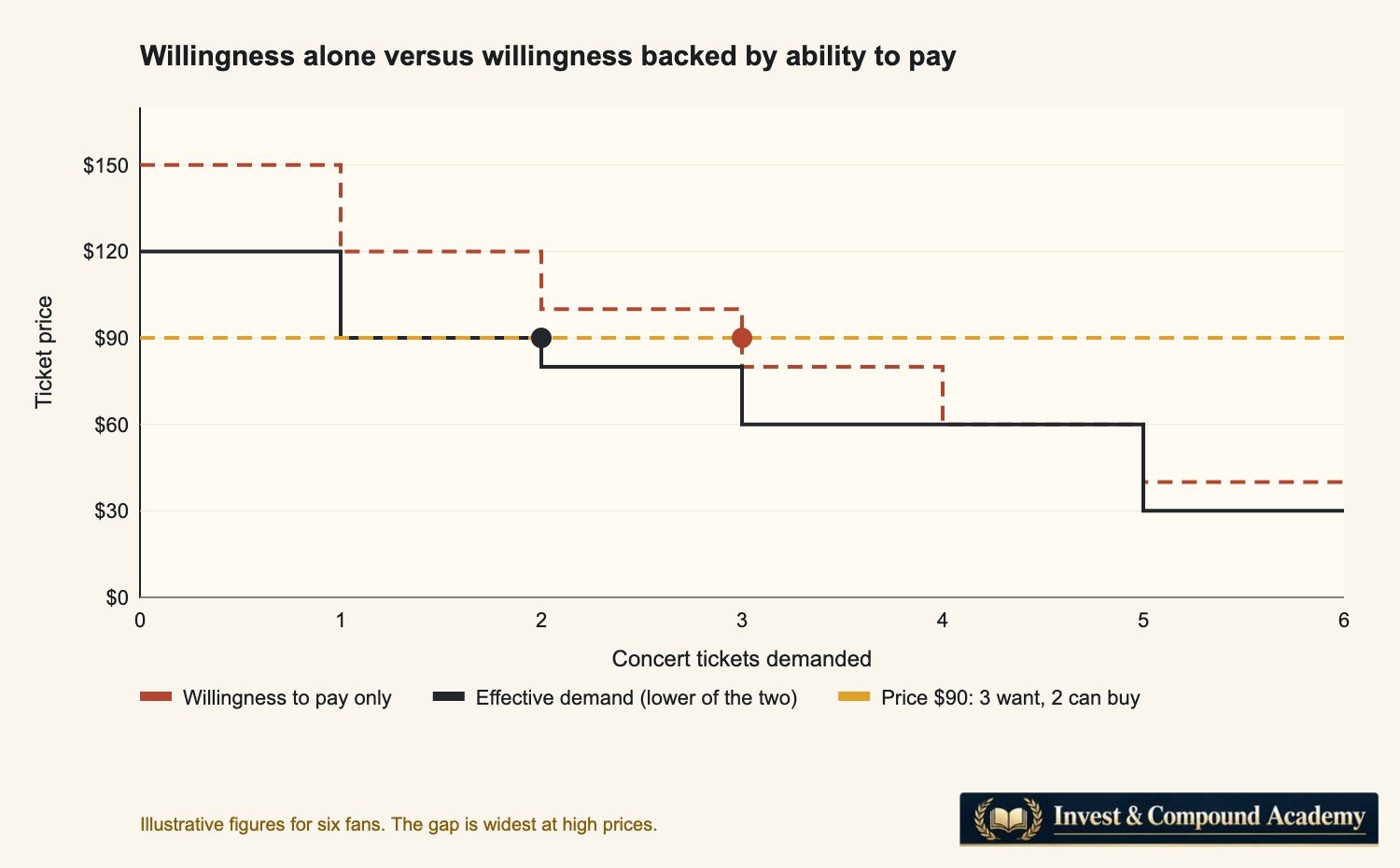
The example shows that the market demand curve is built from effective maximums, not from willingness alone. Where ability to pay is the binding limit, the market curve sits below the curve that willingness alone would trace. The gap is widest at high prices, where some keen but cash-constrained buyers drop out.
The budget constraint
Ability to pay is shaped by the budget constraint: the limit set by income and prices on what a household can buy. A household with $3,000 a month after taxes, spending $1,500 on rent and $800 on other essentials, has about $700 left for everything else. Every purchase from that $700 means less available for other things. Even goods the household values highly must compete for a share of a limited budget.
This is why willingness to pay is itself influenced by income. A person with more money to spare can afford to value a concert ticket in dollars more highly, because each dollar represents a smaller sacrifice of other goods. Economists sometimes note that willingness to pay is measured in money, and money means different things to people with different budgets. A $100 ticket might represent a few hours’ work for one person and several days’ groceries for another. The idea that every choice involves giving something up is developed in Opportunity Cost Explained and Trade-offs in Economics.
How credit stretches ability to pay
Borrowing allows people to spend more than their current income or savings. A credit card, a car loan or a buy-now-pay-later plan can turn a purchase that is unaffordable today into one that is possible, by spreading the cost over time. In this sense, credit expands ability to pay. It also adds a cost, because borrowed money usually carries interest or fees.
A student needs a $1,200 laptop but has only $400 in savings.
Option A: wait and save $100 a month for 8 months, then pay cash.
Option B: buy now with a store plan of 12 monthly payments of $110, for a total of $1,320.
Option B raises the student’s ability to pay today, but the laptop costs $120 more in total, about 10 percent of the price.
If having the laptop now is worth more than $120 to the student, for instance because it is needed for courses that start immediately, financing may be reasonable. If not, waiting is cheaper.
Because credit extends ability to pay, changes in credit conditions can shift demand across the economy. When banks lend readily and interest rates are low, households can buy more cars, homes and appliances. When lending tightens or rates rise, demand for these goods often falls, even if incomes and tastes are unchanged. How interest rates are set and how they affect borrowers is explained in What Does the Federal Reserve Do.
Credit can also stretch ability to pay further than is wise. Borrowing for purchases that are not truly valuable, or at high interest rates, can leave households with debt payments that reduce their future ability to pay for essentials. Keeping borrowing within comfortable limits is a basic principle of sound personal finance.
How willingness to pay is measured
Willingness to pay cannot be observed directly, so economists and businesses use several methods to estimate it. The simplest is to ask: surveys can present a product and ask how much people would pay for it. Answers to hypothetical questions are often too high, however, because saying a number costs nothing.
More reliable methods involve real money. Auctions reveal how much bidders are prepared to pay. Experiments can offer people a product at a randomly drawn price and see whether they buy, a design that encourages honest answers. Businesses also infer willingness to pay from actual behaviour, called revealed preference, by observing which customers buy at which prices. Each method measures willingness to pay for people who also have the ability to pay, so the results always reflect both ingredients to some degree.
For goods not sold in markets, such as clean air or a public park, economists use techniques such as contingent valuation surveys, which ask people what they would pay for an improvement. These methods are widely used in environmental policy but also widely debated, because hypothetical answers can be sensitive to how questions are worded.
Pricing with both ideas in mind
Businesses care about willingness to pay because it sets the ceiling on what customers will accept. They care about ability to pay because it determines how many customers can actually buy at a given price. Many pricing strategies try to capture both.
Student, senior and youth discounts are partly a response to ability to pay. These groups often value products such as cinema tickets, museum entry or software as much as anyone else, but have less income. A lower price brings them into the market without cutting the price for everyone. Sliding-scale fees at some clinics and community programs follow similar logic, tying the price to income.
Instalment plans and subscriptions address ability to pay in another way, by breaking a large price into smaller regular amounts. A $1,200 phone might be out of reach as a single payment but affordable at $50 a month over two years. Premium versions, in contrast, target customers with high willingness and ability to pay, offering extra features at higher prices. Offering several versions at different prices lets customers sort themselves according to both their valuation and their budget.
Return to the six concert fans. At a single price of $90, the organizer sells 2 tickets for $180 in revenue.
Suppose Maya and Tom are students, and the organizer offers a student price of $55 while keeping $90 for everyone else.
Maya buys at $55, because both her willingness ($150) and her ability ($60) exceed $55. Tom’s ability to pay is only $30, so he still cannot buy.
Revenue becomes $180 + $55 = $235, and one more fan attends.
The example works only if the organizer can verify who is a student and prevent students from reselling cheap tickets to others. Such price differences are discussed further in later chapters on pricing and market structure. The choice between rewarding customers and protecting margins is an example of the incentive design discussed in Incentive Compatibility in Everyday Choices.
Ability to pay and fairness
Because markets allocate goods to buyers who are both willing and able to pay, outcomes depend partly on how income and wealth are distributed. When goods are scarce, those with greater ability to pay can outbid those with less, even if the latter value the good more highly in some broader sense. In the concert example, Maya values the ticket most but is priced out, while a wealthier fan with lower enthusiasm attends.
For entertainment, many people accept this outcome. For essentials such as food, housing, health care and education, it raises harder questions. Societies often intervene so that access to essentials does not depend entirely on ability to pay. Public health systems, school funding, food assistance and housing support all aim to make sure basic needs are met regardless of income. Some events use lotteries or verified fan programs to allocate scarce tickets by enthusiasm rather than wealth.
These choices involve trade-offs. Pricing goods by ability to pay can encourage efficient use and fund production, while other allocation methods may be seen as fairer but can create waiting lists or resale markets. Balancing these goals is discussed in Efficiency vs Equity, and the role of government in such choices in Government Roles in a Mixed Economy.
Policy tools that change ability to pay
Governments often influence demand by changing ability to pay rather than prices. A cash transfer, such as a child benefit, raises household income and so expands ability to pay across many goods. A voucher or targeted subsidy, such as a rebate on heat pumps or a grant for tuition, raises ability to pay for a specific good. Tax credits work in a similar way, lowering the effective cost for eligible households.
The choice between these tools depends on goals. Cash transfers respect households’ own judgments about what they need most, because recipients can spend the money on whatever they value. Targeted subsidies steer spending toward goods that policymakers want to encourage, such as energy efficiency or education. Economists debate the merits of each approach, and the answer often depends on the specific situation.
An efficient furnace costs $6,000. A household values it at $5,500, because of expected energy savings and comfort, and has $4,000 available to spend.
Without help, the household does not buy: the price exceeds both willingness and ability to pay.
A $2,000 government rebate lowers the effective price to $4,000. The household’s willingness to pay ($5,500) and ability to pay ($4,000) now both meet the effective price, so it buys.
The rebate worked by closing the gap on both sides at once.
Willingness to pay in cost-benefit analysis
Governments often use willingness to pay to measure the benefits of public projects. If residents would collectively pay $50 million for a new park, and it costs $30 million to build, cost-benefit analysis suggests the park is worthwhile. This approach gives a consistent way to compare very different projects, from highways to flood defences.
The method has a well-known limitation. Because willingness to pay depends partly on ability to pay, projects that benefit wealthier people can appear more valuable than projects that benefit poorer people, even if the poorer residents would gain more in terms of wellbeing. Analysts sometimes address this by giving extra weight to benefits for lower-income groups or by reporting results separately for different income levels. Understanding this limitation helps in interpreting cost-benefit studies critically, a skill connected to Evaluating a Model’s Scope and Limits.
Time, effort and other ways to pay
Money is not the only way people pay for things. Waiting in line, travelling to a distant store or filling out complicated forms are costs paid in time and effort. Someone with plenty of money but little time may prefer to pay more for convenience, while someone with more time than money may wait in line for a discount or a free ticket.
This means that ability to pay has a time dimension too. Allocating goods by queue, for example, favours people whose time is less costly to them, while allocating by price favours those with more money. Neither method is neutral. The value of time and how it shapes decisions is explored in The Opportunity Cost of Time, and free offers that cost time in other ways in The Economics of Free Offers.
How changes in each ingredient shift demand
Because effective demand depends on both willingness and ability to pay, a change in either can shift the demand curve. A rise in income raises ability to pay and shifts demand for normal goods to the right, as explained in Income and Demand Shifts. A change in tastes, such as a new health trend, raises willingness to pay for some goods and lowers it for others. Easier access to credit raises ability to pay for large purchases. A good review or a popular recommendation raises willingness to pay.
Knowing which ingredient changed helps predict what will happen next. A shift caused by easier credit may reverse if lending tightens. A shift caused by a lasting change in tastes may persist. A shift caused by a temporary income boost, such as a one-time payment, may fade once the money is spent. Analysts who separate the two ingredients can make better forecasts than those who treat demand as a single block.
Suppose every fan’s ability to pay rises by $40 after payday, while willingness to pay stays the same.
Maya’s effective maximum rises from $60 to $100, Jonas’s from $90 to $100 and Tom’s from $30 to $40. The others are unchanged, because willingness was their binding limit.
At $90, Maya, Sara and Jonas now buy: 3 tickets instead of 2.
The market demand curve shifts right, but only for buyers whose ability to pay had been holding them back.
What it means for investors
Investors watch both ingredients when judging demand for a company’s products. Strong brand loyalty and unique products raise customers’ willingness to pay, which supports pricing power and profit margins. Healthy household finances, rising wages and available credit raise ability to pay, which supports sales volumes. A company with high willingness to pay among customers who are losing ability to pay may see sales weaken despite its strong brand.
Affordability measures are especially important in sectors such as housing and autos, where purchases are large and often financed. When house prices rise faster than incomes, or when mortgage rates climb, fewer buyers can afford homes, and sales may slow even if many people still want to buy. Consumer credit trends, debt levels and delinquency rates offer clues about whether ability to pay is growing or shrinking. These indicators help investors assess how sensitive a sector may be to economic conditions, alongside the sector descriptions in Market Capitalization and Stock Market Sectors and the principles in Risk Tolerance in Investing.
Using the distinction in your own finances
Separating willingness from ability can help with personal decisions. Before buying something, ask two questions. First, how much is this really worth to me, compared with other uses of the money? Second, can I comfortably afford it without borrowing at high cost or cutting essentials? If the answer to the first is high but the second is low, saving up or waiting may be better than borrowing. If the answer to the second is high but the first is low, the purchase may not be worth making, however affordable it is.
The distinction also helps resist sales pressure. A salesperson who offers easy monthly payments is addressing ability to pay, not whether the product is worth its total cost. Converting monthly payments back into a total price, including interest, gives a clearer picture. Over time, saving and investing steadily builds ability to pay for future goals, as illustrated by the Compound Interest Calculator.
An old distinction
The difference between wanting and being able to pay has been part of economics from the start. Adam Smith, in The Wealth of Nations of 1776, distinguished between absolute demand and what he called effectual demand. He observed that a very poor man may be said in some sense to have a demand for a coach and six horses, but his demand is not effectual, because it can never bring the commodity to market. Only demand from people willing and able to pay the going price influences what gets produced.
Later, the term effective demand took on a broader meaning in macroeconomics, especially in the work of John Maynard Keynes in the 1930s, where it refers to total spending across the whole economy. The microeconomic idea used in this topic is closer to Smith’s: individual demand that is backed by the means to pay. Both uses share the same insight, that desire alone does not move markets.
Ability to pay across countries
Differences in ability to pay are especially large between countries. The same smartphone, medicine or software subscription may be easily affordable for a typical household in a high-income country and out of reach for many households in a low-income one. People in both places may value the product similarly, but their abilities to pay differ greatly.
Some companies respond by charging different prices in different countries, adjusting for local incomes. Pharmaceutical companies and international health organizations have used tiered pricing for some vaccines and medicines, charging lower prices in lower-income countries. Streaming services and software firms often set lower subscription prices in countries with lower average incomes. These strategies widen access while still covering costs, provided the lower-priced products cannot easily be resold in higher-priced markets.
A $10 monthly subscription costs a household earning $5,000 a month 0.2 percent of its income.
For a household earning $500 a month, the same $10 is 2 percent of income, ten times the burden.
A price of $3 in the second market would cost 0.6 percent of income, still higher than the first household’s share but much more affordable.
Willingness to pay in negotiation
When prices are negotiated rather than posted, as with used cars, homes or business contracts, each side tries to learn the other’s limits. A buyer’s reservation price is the highest amount they would accept paying, set by the lower of their willingness and ability to pay. A seller’s reservation price is the lowest amount they would accept. A deal is possible only when the buyer’s limit is above the seller’s.
A buyer values a used car at $14,000 but has financing approval for only $12,000. Her reservation price is $12,000.
The seller will accept no less than $10,500.
Any price between $10,500 and $12,000 leaves both sides better off than walking away. Where the final price lands within that range depends on bargaining skill and information.
If the seller learned of the buyer’s $14,000 valuation but not her financing limit, he might hold out for a price she cannot pay, and no deal would happen.
The example shows why both ingredients matter in negotiation. Revealing a high valuation can weaken a buyer’s position, while a firm budget limit can strengthen it, because the seller knows the buyer genuinely cannot pay more.
Common mistakes
Treating desire as demand
Demand in economics counts only purchases buyers are both willing and able to make.
Assuming high willingness means a sale
A buyer who values a good highly will not purchase it if the price exceeds what they can spend.
Ignoring how income shapes willingness
Willingness to pay is measured in money, so it is influenced by how much money a person has.
Forgetting the cost of credit
Borrowing expands ability to pay today but adds interest or fees that raise the total cost.
Reading cost-benefit results without context
Benefits measured by willingness to pay can favour projects that serve people with greater ability to pay.
Which limit binds?
For any buyer and any good, one of the two limits is usually the one that matters. For everyday low-cost items, such as a cup of coffee or a magazine, ability to pay is rarely the constraint for most people, so willingness to pay determines whether they buy. For large purchases, such as a home, a car or university tuition, ability to pay often binds first. Many people would happily pay more for a bigger home in a better neighbourhood, but their income and borrowing capacity set the limit.
Knowing which limit binds helps predict how buyers will respond to changes. If ability to pay binds, an income rise or easier credit will increase purchases, while a marketing campaign that raises enthusiasm may have little effect. If willingness binds, better products, information or marketing may increase purchases, while extra income may not. Businesses that understand which limit applies to their customers can choose the right strategy, whether that means offering financing or improving the product itself.
Frequently asked questions
What is the difference between willingness to pay and ability to pay?
Willingness to pay is the most a buyer would give up for a good, based on how much they value it. Ability to pay is how much they can actually spend, based on income, savings and credit.
What is effective demand?
Effective demand is desire backed by both willingness and ability to pay. Only effective demand appears in market demand curves.
Does credit increase demand?
Credit raises ability to pay, so it can increase demand, especially for large purchases. It also adds interest costs and future repayment obligations.
Why do businesses offer student discounts?
Students often value products as much as others but have less ability to pay. A lower price brings them into the market without cutting prices for everyone.
Is willingness to pay a good measure of value?
It is useful and widely used, but because it depends partly on income, it can understate how much people with less money value a good.
Key takeaways
- Willingness to pay reflects how much a buyer values a good, while ability to pay reflects what they can spend.
- A purchase happens only when the price is at or below both limits.
- Market demand is built from effective demand, desire backed by the means to pay.
- Credit, income and savings shape ability to pay, and income also influences willingness to pay.
- Pricing strategies, subsidies and allocation rules often target one ingredient or the other.
- Investors watch both brand strength and household affordability to judge demand for a company’s products.
Continue Learning with Invest & Compound Academy
This topic is part of the Demand chapter. Continue with the core guide and the other topics below.
All topics in this chapter
More topics to explore
Sources and further reading
- OpenStax, Principles of Economics 3e, Demand, Supply and Equilibrium
- OpenStax, Principles of Economics 3e, The Budget Constraint Model
- Adam Smith, The Wealth of Nations, Book I, Chapter 7, Online Library of Liberty
- Financial Consumer Agency of Canada, Credit and Borrowing Guidance
Educational disclosure
This article provides general economics education for informational purposes only. It is not financial, investment, tax or legal advice, and it does not consider your personal circumstances. Examples are simplified for teaching and do not describe real people, organizations or recommendations.