Thematic ETFs
Six theme funds comparedA research hub for thematic ETFs and their comparisons: SMH, SOXX, BOTZ, ROBO, AIQ and SKYY. This page covers semiconductor, robotics, AI and cloud funds and shows what each holds, what it costs, how concentrated it is and how much it shares with the others. Every comparison page carries dated figures and sources.
Fund data from VanEck, iShares, Global X, ROBO Global and First Trust pages, Sep 30 to Nov 9, 2026 · Educational research, not advice
Thematic ETFs at a glance
Six things to know first- One idea each. These funds hold semiconductors, robotics, AI or cloud companies, not the whole market.
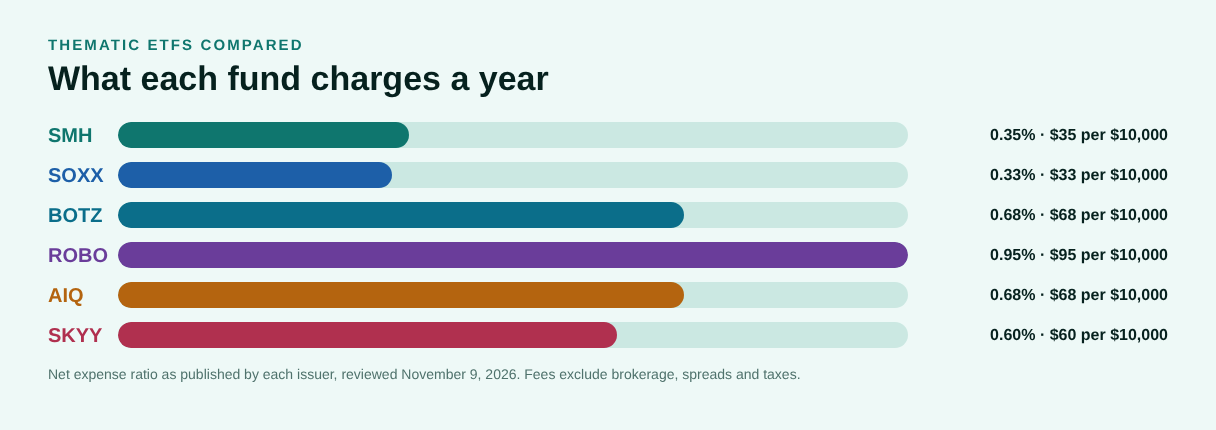
- Cost range. Expense ratios run from 0.33% to 0.95%, which is $620 a year on $100,000.
- Concentration varies. The ten largest holdings are 69% of SMH and 18% of ROBO.
- Labels mislead. BOTZ and ROBO are both robotics funds but share only 28% of their weight.
- Wide return gaps. One-year NAV returns to Sep 30, 2026 ran from 0% to 110%.
- Little income. SEC yields are close to zero, so returns depend on price.
Core thematic ETFs, the six funds side by side
Dated figures, sources on each comparison| SMH | SOXX | BOTZ | ROBO | AIQ | SKYY | |
|---|---|---|---|---|---|---|
| Fund | VanEck Semiconductor ETF | iShares Semiconductor ETF | Global X Robotics & Artificial Intelligence ETF | ROBO Global Robotics and Automation Index ETF | Global X Artificial Intelligence & Technology ETF | First Trust Cloud Computing ETF |
| Theme | Semiconductors | Semiconductors | Robotics and automation | Robotics and automation | Artificial intelligence | Cloud computing |
| Index | MVIS US Listed Semiconductor 25 Index | NYSE Semiconductor Index | Indxx Global Robotics & Artificial Intelligence Thematic Index | ROBO Global Robotics and Automation Index | Indxx Artificial Intelligence & Big Data Index | ISE CTA Cloud Computing Index |
| Expense ratio | 0.35% | 0.33% | 0.68% | 0.95% | 0.68% | 0.60% |
| Stocks held | 25 | 30 | 81 | 79 | 88 | 65 |
| Ten largest holdings | 69.1% | 62.7% | 57.3% | 17.9% | 34.0% | 34.6% |
| Largest holding | Nvidia 18.9% | Advanced Micro Devices 9.5% | Intuitive Surgical 10.9% | Intuitive Surgical 2.4% | Microsoft 4.3% | Everpure 4.2% |
| 1-year NAV return (Sep 30) | 86.89% | 110.14% | 0.06% | 23.09% | 32.28% | 21.95% |
| Net assets | $62.63B (Nov 9) | $37.53B (Nov 9) | $2.92B (Nov 9) | $1.82B (Nov 9) | $9.37B (Nov 9) | $3.11B (Nov 9) |
| Launched | 2011 | 2001 | 2016 | 2013 | 2018 | 2011 |
Holdings are dated Nov 9, 2026 (SOXX Nov 6, 2026) and returns Sep 30, 2026, all from issuer pages. Net assets are issuer figures dated Nov 9, 2026.
SOXX is the lowest-cost fund at 0.33%. ROBO is the most expensive at 0.95%. The bigger difference is concentration: the ten largest holdings run from 18% of ROBO to 69% of SMH.
Thematic ETFs, fund by fund
What each one is and where it differsSMH
VanEck Semiconductor ETF follows the MVIS US Listed Semiconductor 25 Index and holds 25 chip companies weighted by market value. Nvidia is 18.9% of the fund. It charges 0.35% and had $62.63B on Nov 9, 2026, the largest fund in this group.
SOXX
iShares Semiconductor ETF follows the NYSE Semiconductor Index and holds 30 chip companies with caps on the largest names, so its biggest holding is 9.5%. It charges 0.33% and had $37.53B on Nov 9, 2026.
BOTZ
Global X Robotics & Artificial Intelligence ETF holds about 80 robotics and AI companies worldwide. About a third of the fund is in the United States and a third in Japan. It charges 0.68% and had $2.92B on Nov 9, 2026.
ROBO
ROBO Global Robotics and Automation Index ETF holds about 80 companies at similar weights, so its largest holding is only 2.4%. It charges 0.95%, the highest fee here, and had $1.82B on Nov 9, 2026.
AIQ
Global X Artificial Intelligence & Technology ETF holds about 90 companies that build or use AI, including chip makers, software firms and internet platforms. It charges 0.68% and had $9.37B on Nov 9, 2026.
SKYY
First Trust Cloud Computing ETF follows the ISE CTA Cloud Computing Index and holds 65 cloud companies of many sizes. It charges 0.60% and had $3.11B on Nov 9, 2026.
Fund guides for every ETF here
One page per fund, each with the same sectionsSMH
VanEck Semiconductor ETF. Open the full SMH guide with fees, holdings, yield, returns and taxes.
iShares · expense ratio 0.33%SOXX
iShares Semiconductor ETF. Open the full SOXX guide with fees, holdings, yield, returns and taxes.
Global X · expense ratio 0.68%BOTZ
Global X Robotics & Artificial Intelligence ETF. Open the full BOTZ guide with fees, holdings, yield, returns and taxes.
ROBO Global · expense ratio 0.95%ROBO
ROBO Global Robotics and Automation Index ETF. Open the full ROBO guide with fees, holdings, yield, returns and taxes.
Global X · expense ratio 0.68%AIQ
Global X Artificial Intelligence & Technology ETF. Open the full AIQ guide with fees, holdings, yield, returns and taxes.
First Trust · expense ratio 0.60%SKYY
First Trust Cloud Computing ETF. Open the full SKYY guide with fees, holdings, yield, returns and taxes.
Thematic ETFs, what they hold and what they leave out
One idea per fundA thematic ETF is built around one idea instead of the whole market. The six funds here cover four ideas that sit close together: the chips that power computing, the robots and automation that use them, artificial intelligence, and the cloud platforms that deliver it. Each fund follows an index that decides which companies belong to the theme and how much of each to hold.
The two semiconductor funds, SMH and SOXX, hold only chip companies and overlap by 71%. The two robotics funds, BOTZ and ROBO, overlap by only 28% even though the labels sound alike, because one weights by size and the other spreads weight evenly. AIQ reaches across chips, software and internet platforms, and SKYY holds cloud software and infrastructure companies.
What these funds leave out matters as much. None of them holds banks, health insurers, energy producers or consumer staples, and several are more than 90% technology. They are satellites to place beside a core fund, such as the ones on the broad market ETFs page.
When SMH or SOXX fits: you want direct exposure to chip makers. When BOTZ or ROBO fits: you want industrial and medical robotics, much of it outside the U.S. When AIQ fits: you want a wide AI basket. When SKYY fits: you want cloud software and infrastructure. These describe what the funds hold, not recommendations.
Thematic index rules, why similar funds differ
Weighting decides the resultTwo funds can share a theme and still behave differently, because the index rules differ. SMH weights 25 companies by market value, so Nvidia alone is 18.9% of the fund and the ten largest holdings are 69%. SOXX caps its largest names, so its top holding is 9.5% and the top ten are 63%.
The robotics pair shows the same thing more sharply. BOTZ puts 57% in its ten largest holdings, led by Intuitive Surgical, Fanuc and Keyence. ROBO spreads its money so that the top ten are only 18%. Over the year to Sep 30, 2026, that difference in design produced returns of 0.06% for BOTZ and 23.09% for ROBO.
The table below groups each fund’s holdings by main business, using one scheme for all six funds.
| Fund | Largest industry groups | Holdings date |
|---|---|---|
| SMH | Semiconductors 100.0% | Nov 9, 2026 |
| SOXX | Semiconductors 100.0% | Nov 6, 2026 |
| BOTZ | Robotics and automation 55.3%, Health care technology 14.3%, Other holdings 12.6% | Nov 9, 2026 |
| ROBO | Robotics and automation 62.7%, Semiconductors 10.4%, Hardware and networking 9.3% | Nov 9, 2026 |
| AIQ | Software and cloud 31.8%, Semiconductors 25.1%, Internet platforms 19.6% | Nov 9, 2026 |
| SKYY | Software and cloud 75.1%, Hardware and networking 17.1%, Internet platforms 7.8% | Nov 9, 2026 |
Industry groups are assigned by this site from each stock’s main business, so they are comparable across funds but will not match an issuer’s own sector table. Cash and futures are left out.
Thematic ETF returns, same dates for all six
NAV total return to Sep 30, 2026All six issuers report returns to Sep 30, 2026, so the table compares like with like. Figures are annualized NAV total returns, net of fees.
| Fund | 1 year | 3 years | 5 years | 10 years | Since inception |
|---|---|---|---|---|---|
| SMH | 86.89% | 62.00% | 37.37% | 34.41% | 29.90% |
| SOXX | 110.14% | 54.08% | 31.76% | 32.41% | 14.71% |
| BOTZ | 0.06% | 12.93% | -0.47% | 9.27% | 9.46% |
| ROBO | 23.09% | 17.23% | 4.72% | 11.29% | 9.69% |
| AIQ | 32.28% | 34.47% | 16.95% | Not captured | 19.54% |
| SKYY | 21.95% | 29.23% | 9.41% | 17.33% | 15.04% |
Source: issuer fund pages (VanEck, iShares, Global X, ROBO Global and First Trust). AIQ launched in 2018, so it has no 10-year figure. Past performance does not guarantee future results.
The spread is wide. Over one year the funds ran from 0.06% for BOTZ to 110.14% for SOXX. Over five years they ran from -0.47% a year for BOTZ to 37.37% for SMH. A theme can be right about the technology and still disappoint as an investment if the stocks were expensive to begin with.
Semiconductor returns above 100% in a single year are unusual, and VanEck’s own month-end figures show SMH at 44.47% for the year to Oct 31, 2026 against 86.89% a month earlier, which shows how fast these numbers move. Read how to measure investment growth and P/E ratio explained before treating any figure as a forecast.
Thematic ETF yield and dividends
Growth funds, little incomeThese funds pay very little. The 30-day SEC yield was 0.23% for SMH and 0.11% for SOXX, and Global X reports -0.01% for BOTZ and -0.07% for AIQ, which means fund costs use up roughly all of the dividends their stocks pay. ROBO and SKYY did not show a comparable figure on the pages used.
Payout schedules differ. SOXX pays quarterly, SMH and ROBO once a year and the Global X funds twice a year. None of the amounts is large enough to be a reason to hold the fund.
See what is dividend yield and yield vs total return for how income and price change add up.
Thematic ETF holdings and overlap
Matched stock by stock on tickerEvery comparison page matches the two funds’ full holdings by ticker and adds up the smaller of the two weights for each stock both hold.
Overlap runs from 0% for SMH and SKYY to 71% for SMH and SOXX. Only the two chip funds repeat most of each other. AIQ shares 20% with SMH because it holds the large chip makers, and 28% with SKYY because both hold the large cloud platforms.
| Comparison | Portfolio overlap |
|---|---|
| SMH vs SOXX | 71% |
| SMH vs BOTZ | 7% |
| SMH vs ROBO | 6% |
| SMH vs AIQ | 20% |
| SMH vs SKYY | 0% |
| SOXX vs BOTZ | 7% |
| SOXX vs ROBO | 5% |
| SOXX vs AIQ | 18% |
| SOXX vs SKYY | 0% |
| BOTZ vs ROBO | 28% |
| BOTZ vs AIQ | 8% |
| BOTZ vs SKYY | 2% |
| ROBO vs AIQ | 9% |
| ROBO vs SKYY | 0% |
| AIQ vs SKYY | 28% |
Overlap is an estimate from issuer holdings dated Nov 9, 2026 (SOXX Nov 6, 2026). Foreign shares are matched on the exchange ticker each issuer reports. Cash and futures are excluded.
Check overlap with your core fund too. Nvidia, Microsoft, Amazon and other large holdings here are also big weights in S&P 500 and Nasdaq-100 funds. Test your own mix with the Diversification Calculator.
Thematic ETF comparison, all fifteen pairs
Head to head, same formatEach page below puts two funds side by side on cost, holdings overlap, industry mix, concentration, returns and trading. Every figure carries its date, and the data room at the bottom of each page lists the source and grade of each number.
SMH vs SOXX
Two semiconductors funds with 71% overlap and fees of 0.35% and 0.33%.
Read the comparisonSMH vs BOTZ
Semiconductors against robotics and automation, with 7% overlap.
Read the comparisonSMH vs ROBO
Semiconductors against robotics and automation, with 6% overlap.
Read the comparisonSMH vs AIQ
Semiconductors against artificial intelligence, with 20% overlap.
Read the comparisonSMH vs SKYY
Semiconductors against cloud computing, with 0% overlap.
Read the comparisonSOXX vs BOTZ
Semiconductors against robotics and automation, with 7% overlap.
Read the comparisonSOXX vs ROBO
Semiconductors against robotics and automation, with 5% overlap.
Read the comparisonSOXX vs AIQ
Semiconductors against artificial intelligence, with 18% overlap.
Read the comparisonSOXX vs SKYY
Semiconductors against cloud computing, with 0% overlap.
Read the comparisonBOTZ vs ROBO
Two robotics and automation funds with 28% overlap and fees of 0.68% and 0.95%.
Read the comparisonBOTZ vs AIQ
Robotics and automation against artificial intelligence, with 8% overlap.
Read the comparisonBOTZ vs SKYY
Robotics and automation against cloud computing, with 2% overlap.
Read the comparisonROBO vs AIQ
Robotics and automation against artificial intelligence, with 9% overlap.
Read the comparisonROBO vs SKYY
Robotics and automation against cloud computing, with 0% overlap.
Read the comparisonAIQ vs SKYY
Artificial intelligence against cloud computing, with 28% overlap.
Read the comparisonHow to compare thematic ETFs
A seven-point checklist- 1. Theme Read what the index counts as part of the theme. Two funds with similar names can hold different companies.
- 2. Weighting Check whether the fund weights by size or spreads weight evenly. It changes concentration and returns.
- 3. Top holdings Look at the largest position and the top ten. They run from 18% to 69% here.
- 4. Cost Expense ratios run from 0.33% to 0.95% here. Add the bid/ask spread when you trade.
- 5. Overlap Compare with your core fund as well as with other theme funds.
- 6. Geography BOTZ is about a third U.S. companies, while SMH is nearly four fifths.
- 7. Dates and sources Compare returns only when the periods match, as they do on this page.
Start with how to research an ETF if the terms are new, and size any theme fund inside your whole allocation with asset allocation explained.
Thematic ETF fees and what you really pay
Cost beyond the expense ratioTheme funds cost more than broad index funds. On a $100,000 balance, 0.33% is $330 a year, 0.68% is $680 and 0.95% is $950. Use the ETF Fee Calculator to turn a fee gap into dollars over time.
Trading costs vary more than usual in this group. Issuers reported 30-day median bid/ask spreads of 0.02% for SMH, SOXX and AIQ, 0.03% for BOTZ, 0.08% for SKYY and 0.32% for ROBO. Funds with many foreign holdings can also trade at a premium to NAV, as BOTZ did at about 1.4% on Nov 9, 2026. Use limit orders.
A fee that looks small against a 50% year looks large against a flat one. BOTZ returned about zero over five years to Sep 30, 2026 while charging 0.68% a year.
Which thematic ETFs suit which investor
Matching the fund to the planYou want chip makers: SMH is more concentrated and SOXX flatter. Compare them on the SMH vs SOXX page.
You want robotics and automation: BOTZ concentrates in a few leaders and ROBO spreads out. See BOTZ vs ROBO.
You want a broad AI basket: AIQ holds chips, software and platforms together. Read SMH vs AIQ and BOTZ vs AIQ.
You want cloud computing: SKYY holds cloud software and infrastructure. See AIQ vs SKYY.
You already own a Nasdaq-100 or S&P 500 fund: you already hold many of these companies. Check with the Diversification Calculator and size any theme position against your whole portfolio.
Common mistakes with thematic ETFs
Easy ones to avoidBuying the label. BOTZ and ROBO share a theme and only 28% of their weight. Read the holdings.
Ignoring concentration. Nvidia is 18.9% of SMH. A theme fund can be a bet on a few companies.
Doubling up on big technology. Many top holdings here also lead the S&P 500 and Nasdaq-100.
Chasing last year. SOXX returned 110% in the year to Sep 30, 2026 after losing 35% in calendar 2022, on iShares figures.
Forgetting the fee. A 0.95% fee is paid in flat years too.
Making a theme the core. These funds leave out most of the economy, so they belong beside a diversified core.
Risks of thematic ETFs
What a good story does not removeA few stocks drive the result
Market-weighted theme funds can hold a fifth of their money in one company.
High expectations are priced in
Popular themes often trade at high multiples, so prices can fall sharply when growth slows.
Technology spending moves in waves
Chip, cloud and automation orders rise and fall with the business cycle.
Owning dozens of companies inside one theme lowers single-company risk, but it does not remove theme risk. The funds can fall together and the recovery can take years. Past gains are not a limit on future losses.
Thematic ETFs for Canadian investors
Currency, withholding tax and accountsU.S.-listed funds such as SMH, SOXX, BOTZ, ROBO, AIQ and SKYY trade in U.S. dollars. Buying them from a Canadian account usually involves converting Canadian dollars, which adds a cost, and a move in the U.S. dollar also changes your return in Canadian dollars.
Dividends paid to Canadian holders are generally subject to U.S. withholding tax, with treatment that depends on the account type. These funds pay little income, so the effect is small.
Confirm the rules for your accounts with a qualified tax professional, and see how to build an ETF portfolio for how a theme fund fits inside an allocation.
Tools for comparing thematic ETFs
Run your own numbersHow thematic ETFs are researched here
Sources and datesFigures come from the issuer pages for each fund: VanEck for SMH, iShares for SOXX, Global X for BOTZ and AIQ, ROBO Global for ROBO and First Trust for SKYY. Fund facts and holdings are dated Nov 9, 2026 (SOXX holdings Nov 6, 2026) and returns Sep 30, 2026. Gaps are shown as Not captured, and nothing was filled from memory or from another fund.
Overlap sums the smaller weight of each ticker held by both funds and is an estimate. Industry groups are assigned by this site so every fund uses the same labels. The pages are educational research, not personal advice, and they do not recommend any fund.
Thematic ETFs, questions answered
Plain answersWhat are thematic ETFs?
Thematic ETFs are funds built around one idea or industry, such as semiconductors, robotics, artificial intelligence or cloud computing, instead of the whole market. This page compares six of them: SMH, SOXX, BOTZ, ROBO, AIQ and SKYY.
What is the difference between SMH and SOXX?
Both hold chip companies. SMH holds 25 stocks weighted by size, with Nvidia at 18.9%, and charges 0.35%. SOXX holds 30 stocks with caps on the largest, with a top holding of 9.5%, and charges 0.33%. They overlap by about 71%.
What is the difference between BOTZ and ROBO?
Both are robotics funds, but BOTZ puts 57% in its ten largest holdings and ROBO only 18%. BOTZ charges 0.68% and ROBO 0.95%. They overlap by about 28%.
Which thematic ETF has the lowest cost?
SOXX lists the lowest expense ratio at 0.33%, followed by SMH at 0.35%. ROBO is the most expensive at 0.95%.
Do thematic ETFs pay dividends?
Only small amounts. SEC yields on the issuer pages were close to zero, so these funds are held for growth, not income.
Are thematic ETFs risky?
Yes. They are concentrated in one industry, and prices can fall sharply. iShares reports that SOXX lost about 35% in calendar 2022 and gained about 67% in 2023.
Should I own more than one thematic ETF?
It depends on overlap. SMH and SOXX share about 71% of their weight, so a second chip fund adds little. Funds from different themes share far less.
Do thematic ETFs overlap with the S&P 500 or Nasdaq-100?
Yes, in part. Nvidia, Microsoft, Amazon, Broadcom and other top holdings here are also large weights in those indexes, so a theme fund adds to positions you may already hold.
How much of a portfolio should be in thematic ETFs?
There is no single answer. Because theme funds are narrow and volatile, they are usually sized as a small satellite beside a diversified core. Use your own plan and risk tolerance.
Are thematic ETFs a good fit for Canadian investors?
U.S.-listed funds can work, but you face currency conversion and U.S. withholding tax on the small dividends, and treatment depends on the account. Confirm the details with a qualified tax professional.
Educational research, not personalized investment, tax or legal advice, and not a recommendation to buy or sell any fund. Investing involves risk, including loss of principal. Past performance does not guarantee future results. Fund data are provided as published by the sources named and may differ from current figures.