What to Do During a Market Correction: A Practical Investor’s Guide
Review liquidity, investment horizon, concentration and leverage before deciding whether to hold, rebalance or reassess your exposure.
Knowing what to do during a market correction starts with reviewing your financial position, not predicting the next market move. A stock market correction can change the emotional atmosphere of investing almost overnight. Only weeks earlier, rising portfolio values may have reinforced confidence in a long-term investment strategy. Financial commentators were discussing growth opportunities, corporate earnings, and new market highs. Investors may have felt comfortable making regular contributions or increasing their exposure to equities. Then prices begin falling.
A broad stock market index declines 5%, then 8%, and eventually crosses the conventional 10% correction threshold. Financial headlines become increasingly negative. Economic forecasts change. Previously popular investments experience significant losses, and investors begin questioning whether the downturn represents a temporary interruption or the beginning of something more serious. The uncertainty creates an understandable desire to act. Should investments be sold before losses deepen? Is it better to hold everything and wait? Should additional money be invested at lower prices? Would a more conservative asset allocation provide greater protection?
There is no single answer that applies to every investor. The appropriate response to a market correction depends on the investor’s financial objectives, liquidity requirements, portfolio composition, investment horizon, and capacity to withstand further losses. An investor accumulating retirement savings over several decades faces a different challenge from someone preparing to purchase a home next year. A person holding a diversified portfolio without borrowing has different risks from an investor using margin to maintain concentrated positions.
The practical task is to examine whether the existing financial plan remains suitable under conditions that may be more difficult than initially expected. A correction can reveal excessive concentration, insufficient emergency savings, inappropriate leverage, unrealistic return assumptions, or a mismatch between investment risk and spending requirements. At the same time, declining markets can create opportunities for investors who retain sufficient liquidity, understand the assets they own, and can accept uncertainty about future prices.
This guide develops a practical framework for making those decisions. It explains how to assess portfolio risk, manage liquidity, evaluate whether selling is justified, consider purchases at lower valuations, rebalance investments, and prepare for the possibility that a correction becomes a deeper bear market. The objective is to make sound financial decisions when the future is uncertain.
First, Understand What Has Actually Changed
A market correction generally refers to a decline of at least 10% from a recent market peak. Completed declines below 20% are commonly distinguished from bear markets at or beyond 20%; an unfolding correction can still deepen. For example, if the S&P 500 reaches 6,000 and subsequently falls to 5,400, the index has declined 10%. That movement describes the change in market price. It does not establish that corporate earnings have fallen by the same amount, that a recession has begun, or that the market will continue declining.
Stock prices reflect expectations about future business performance, financing conditions, interest rates, and investor risk preferences. These expectations can change faster than the underlying economic data. A correction may therefore emerge while many businesses remain profitable and economic growth continues. Alternatively, falling prices may represent the early stages of a more substantial deterioration in financial conditions. The initial decline alone cannot reliably distinguish those outcomes.
Price Changes Are Not Always Fundamental Changes
Consider a fictional company generating $10 in annual earnings per share. Suppose its stock trades at $250, representing a price-to-earnings ratio of 25. If investors subsequently become willing to pay only 22 times earnings, the implied share price falls to $220. The stock has declined 12%. Yet the company’s assumed earnings have not changed. The decline reflects a reduction in its valuation multiple.
Now consider another company trading at the same initial price. Its expected earnings fall from $10 to $8, and investors reduce the valuation multiple to 20. The implied share price becomes $160. That represents a 36% decline. In this case, both expected earnings and valuation have deteriorated. A broad repricing caused by changing discount rates may call for a different analysis from a company-specific decline caused by unsustainable debt or collapsing profitability.
Establish the Nature of the Decline
Before changing investments, identify what is declining and why. Is the entire equity market falling, or is weakness concentrated in one industry? Are corporate earnings expectations changing materially? Have interest-rate expectations increased? Is there evidence of significant credit-market stress? Has the investor’s own financial position changed? These questions are more useful than assuming that every decline represents either a buying opportunity or an imminent financial crisis.
For definitions and context, read what a market correction means. Our P/E ratio guide explains the valuation arithmetic used here.
Start With Your Financial Situation, Not the Market Forecast
The first practical step during a correction is to assess personal finances. This may seem less exciting than analyzing stock charts, but liquidity and financial obligations often determine which investment decisions are realistic. An investor who needs money for essential spending cannot necessarily afford to wait several years for an uncertain recovery. Someone with stable income, adequate emergency savings, and a long investment horizon may have considerably more flexibility.
The SEC’s investor education guidance emphasizes that asset allocation should reflect investment time horizon and risk tolerance. This principle becomes especially important during periods of volatility.
Review Upcoming Financial Obligations
Identify expenses that may require substantial cash over the next several months or years. These might include housing costs, education expenses, business commitments, debt repayments, medical expenses, or planned major purchases. The purpose is to determine whether invested capital may be needed before markets recover. For example, suppose an investor has $40,000 intended for a home down payment in nine months. If the entire amount is invested in equities and suffers a 15% decline, the balance falls to $34,000.
The investor may not have enough time to recover the missing $6,000 before the payment becomes due. That is a materially different situation from an investor holding the same amount for a retirement goal twenty-five years away.
Separate Essential Capital From Long-Term Capital
Financial plans become more resilient when money is assigned to clear purposes. Capital needed for near-term obligations generally has a different risk profile from capital intended for long-term growth. Cash, insured deposits where applicable, and other suitable short-term instruments may help meet foreseeable obligations. However, each option carries its own terms, costs, limitations, and risks. Holding long-term investment capital entirely in cash also creates opportunity costs and exposure to inflation.
The aim is to match the characteristics of assets with the timing and importance of financial obligations.
Evaluate Your Emergency Cash Reserve
Market corrections often coincide with broader economic uncertainty. Employment conditions may weaken. Business revenue may become less predictable. Financing costs may rise. Investors without adequate accessible savings may be forced to sell investments to cover unexpected expenses. Selling after a decline can realize a loss and leave fewer shares available to participate in a future rebound, if one occurs.
Why Liquidity Creates Flexibility
Imagine two investors who each hold $100,000 in diversified equity investments. Both portfolios decline 20%, reaching $80,000. Investor A has sufficient accessible cash to cover essential expenses during an unexpected period without income. Investor B has almost no cash outside the investment portfolio. If both face a $15,000 emergency expense, their options differ substantially. Investor A may be able to preserve the investment allocation while using available reserves. Investor B may need to sell approximately $15,000 of depressed investments. The same market decline therefore produces different financial consequences.
How Much Emergency Cash Is Appropriate?
There is no universally correct amount. Emergency reserve requirements depend on household spending, income stability, dependents, insurance coverage, debt obligations, and access to other reliable resources. Someone with variable self-employment income may need different reserves from a household with stable employment and predictable expenses. A retiree who depends on portfolio withdrawals may require a different liquidity structure again. The key question is whether a foreseeable financial disruption would force the sale of investments at an unfavorable time.
Avoid Treating Every Cash Balance as Investment Capital
During corrections, some investors become eager to purchase assets at lower prices. They may view cash reserves as unused capital that could generate better returns. However, emergency funds exist primarily to provide financial stability. Deploying essential reserves into volatile investments can increase the risk of forced selling if markets continue declining or an unexpected expense occurs. Potential investment opportunities should not be evaluated independently of liquidity requirements.
Review Your Investment Time Horizon
Time horizon is one of the most important factors influencing how investors should respond to market declines. A longer time horizon may provide greater flexibility to withstand temporary losses. However, it does not guarantee that every investment will recover. Individual securities can experience permanent impairment, while broad market indexes can require prolonged periods to regain previous highs.
Long-Term Accumulation Investors
An investor contributing toward a retirement goal decades away may be able to continue an established strategy during a correction. The investor may not need to withdraw capital and may continue purchasing investments through regular contributions. That financial flexibility can reduce pressure to react to short-term price changes. However, even a long-term investor should evaluate diversification, concentration, costs, and investment suitability. An extended horizon does not make speculative positions automatically appropriate.
Medium-Term Investors
Investors with financial objectives several years away require more careful consideration of possible recovery periods. A portfolio that experiences a severe bear market may remain below its previous peak for years. If the financial goal has a relatively fixed deadline, substantial equity exposure can create uncertainty about the amount of capital available when needed. Asset allocation should reflect that risk.
Short-Term Investors
Capital required within months may be poorly matched with assets capable of falling 20% or more. Even a relatively ordinary market correction can cause significant difficulties. For these investors, preserving access to necessary capital may be more important than maximizing expected long-term returns.
Investors Approaching Retirement
A correction immediately before retirement can alter expected withdrawal rates and spending plans. Even if equity markets eventually recover, the investor may need to begin drawing income before recovery occurs. This creates sequence-of-returns risk. The appropriate response may involve reviewing retirement timing, liquidity reserves, spending flexibility, and asset allocation.
Do not build a spending plan around a recovery deadline. Compare market-correction durations with bear-market duration and recovery times. These historical guides describe past experiences, not guaranteed waiting periods.
Determine Whether Your Portfolio Is Properly Diversified
Diversification involves distributing investments among assets with different economic characteristics and sources of risk. It can reduce dependence on a single company, industry, or investment theme. However, diversification does not eliminate broad market risk. A diversified stock portfolio can still experience a substantial correction. The SEC’s investor guidance specifically cautions that owning mutual funds or ETFs does not necessarily ensure adequate diversification, especially when funds are narrowly focused or hold overlapping securities.
Examine the Underlying Holdings
Consider an investor holding three ETFs. One tracks the S&P 500. Another tracks the Nasdaq-100. A third focuses on large U.S. technology companies. The investor may believe the portfolio is diversified because it contains three separate funds. However, the funds may have substantial exposure to the same large companies. During a decline concentrated in those businesses, all three holdings may experience significant losses. The number of ETFs is therefore less important than the underlying exposures.
Review Sector Concentration
Technology, financials, energy, real estate, utilities, and other sectors respond differently to economic conditions. A concentrated sector investment can produce larger gains during favorable periods but also deeper losses when conditions reverse. A portfolio overly dependent on one industry may be particularly vulnerable to changes in earnings expectations or financing costs.
Consider Geographic Exposure
International diversification can reduce dependence on a single national equity market. However, global stock markets are interconnected. Major economic shocks can produce simultaneous declines across many countries. Currency movements also influence returns when investments are measured in a different currency from the underlying assets.
Understand Asset-Class Diversification
Equities, bonds, cash, and other investments have different risk characteristics. Combining them may reduce portfolio volatility under some conditions. Yet asset-class relationships are not fixed. Stocks and bonds can decline together, particularly during periods of rising interest rates and inflation pressure. Diversification should therefore be evaluated based on the actual economic risks represented by each holding.
See how ETF holdings can overlap, then connect the exposures to your goals with our ETF portfolio construction guide.
Understand How Much Additional Loss You Can Withstand
Investors often assess risk tolerance when markets are rising. During a correction, actual losses reveal whether earlier assumptions were realistic. An investor who believed a 20% decline would be manageable may discover that the financial or emotional consequences are more difficult than expected. This does not automatically mean the investor should sell. It means the portfolio should be reassessed against the investor’s financial circumstances.
Risk Tolerance Versus Risk Capacity
Risk tolerance describes an investor’s willingness to experience uncertainty and losses. Risk capacity concerns the financial ability to absorb those losses without jeopardizing essential objectives. The distinction is crucial. An investor may feel comfortable taking substantial risks but have limited financial capacity because capital will be needed soon. Another investor may have substantial financial resources but prefer a more stable portfolio. Appropriate allocation should reflect both dimensions.
Stress-Test the Portfolio
Assume an investor holds $150,000 in equities. The portfolio has already declined 12%. Its current value is $132,000. Now consider the possibility of a cumulative 30% decline from the original value. The portfolio would be worth $105,000. That represents an additional loss of $27,000 from the current balance. The question is not whether a further decline is certain. It is whether the investor could remain financially stable and follow an appropriate plan if it occurred.
Portfolio Drawdown Scenarios
| Cumulative decline | Portfolio value from $150,000 | Dollar loss |
|---|---|---|
| 10% | $135,000 | $15,000 |
| 15% | $127,500 | $22,500 |
| 20% | $120,000 | $30,000 |
| 25% | $112,500 | $37,500 |
| 30% | $105,000 | $45,000 |
| 40% | $90,000 | $60,000 |
| 50% | $75,000 | $75,000 |
These are hypothetical values and exclude contributions, withdrawals, distributions, and expenses. A stress test cannot predict the next market movement. It can identify whether the portfolio contains more downside exposure than the investor can reasonably support.
Review Leverage and Margin Exposure
Leverage can turn an ordinary market correction into a serious financial problem. An investor using borrowed money to purchase securities is exposed not only to falling asset prices but also to financing costs and collateral requirements.
A Leveraged Portfolio Example
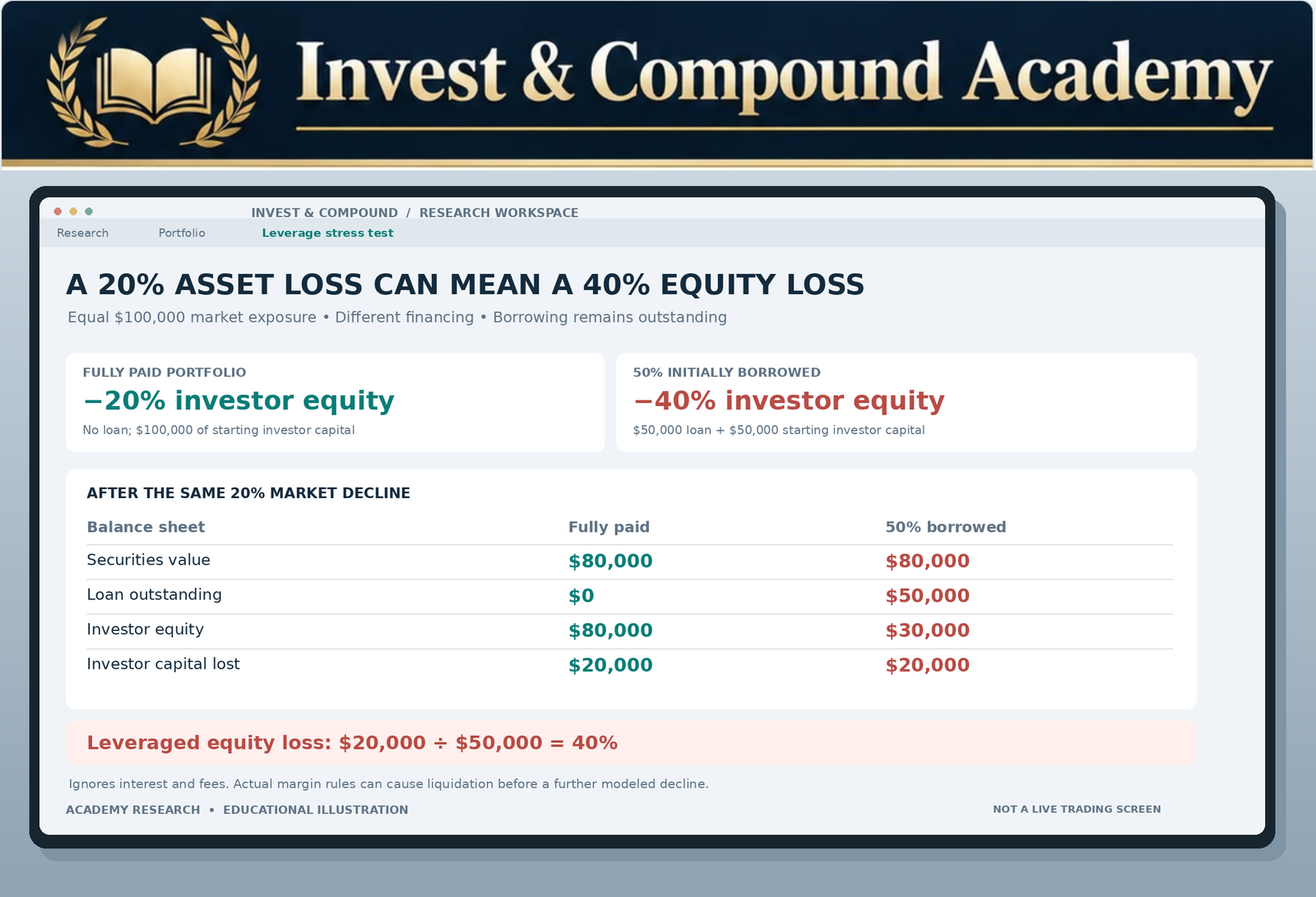
Suppose an investor contributes $50,000 of personal capital and borrows another $50,000. The investor purchases $100,000 of securities. If the market declines 20%, the securities fall to $80,000. The loan remains $50,000, ignoring interest and fees. The investor’s equity is now $30,000. Although the securities declined 20%, the investor’s own capital has declined 40%.
If securities instead reach $60,000—a cumulative 40% decline from the original $100,000—the investor’s remaining equity would be $10,000. The cumulative loss on personal capital would be 80%. Two successive 20% asset declines would instead leave securities worth $64,000.
Margin Calls
Brokerages establish collateral and maintenance requirements. If the equity in a margin account falls below required levels, the investor may need to deposit additional funds or reduce positions. A broker may liquidate securities under the applicable account agreement and margin rules. The investor may not control the precise timing or securities selected for liquidation. This risk makes leveraged investing fundamentally different from holding fully paid securities.
Why Cash Reserves Do Not Eliminate Leverage Risk
An investor may hold cash outside a margin account and assume it provides protection. However, severe market movements can develop rapidly. Additional margin requirements may arise before funds can be transferred or during periods of reduced market liquidity. Borrowing costs can also continue accumulating while asset prices remain depressed. Investors should therefore evaluate worst-case financing obligations, not only expected returns.
A Practical Leverage Review
During a correction, investors using leverage should understand their current borrowing, collateral value, maintenance requirements, concentration, interest expenses, and potential consequences of further declines. Reducing excessive leverage may be financially appropriate even when an investor expects markets eventually to recover. The goal is to preserve control over financial decisions rather than become dependent on favorable short-term price movements.
Should You Sell During a Market Correction?
Selling during a correction is not automatically a mistake. The important question is why the investor is selling. A decision based on changed financial circumstances or deteriorating fundamentals differs from a decision driven only by fear of further losses.
Situations Where Selling May Be Justified
An investor may need to reduce exposure because an upcoming financial obligation requires capital. A position may have become excessively concentrated. A company may face fundamental deterioration that undermines the original investment thesis. Leverage may create unacceptable financial pressure. An investor’s risk capacity may have changed because of employment, household circumstances, or retirement timing. These are legitimate reasons to reconsider portfolio holdings.
Selling Solely Because Prices Have Fallen
A broad-market ETF declining 12% does not establish that its long-term investment case has failed. If the portfolio remains diversified, the investor has adequate liquidity, and the original financial objectives are unchanged, selling may not be necessary. However, maintaining exposure should also be an intentional decision. Investors should understand what they own and the risks they continue to accept.
The Reentry Problem
Selling an investment creates another decision: when to buy again. An investor may successfully avoid part of a decline but remain in cash during the recovery. Stock markets can rebound before economic news becomes broadly positive. Waiting for reassuring headlines may therefore result in purchasing at higher prices. This does not prove that maintaining exposure always produces the best result. It illustrates why market timing requires multiple successful decisions.
Selling and Tax Consequences
Selling investments in taxable accounts can create realized capital gains or losses. Tax consequences depend on jurisdiction, account structure, holding period, and applicable rules. Investors should consider the after-tax effect of transactions. A strategy that appears attractive before taxes may deliver a less favorable result after costs.
Should You Buy During a Market Correction?
Lower market prices can create investment opportunities. However, a decline does not automatically establish that an asset is undervalued. A stock may fall because expected earnings have deteriorated. A sector may decline because its competitive or regulatory environment has changed. An ETF may experience losses because its underlying holdings have become less attractive relative to alternative investments. Purchasing decisions therefore require analysis rather than enthusiasm about lower prices alone.
Evaluate the Investment Thesis
For an individual company, examine profitability, cash generation, debt obligations, competitive advantages, and valuation. For an ETF, consider the index methodology, underlying holdings, sector exposure, concentration, costs, and investment objective. A fund’s previous peak price is not an estimate of its intrinsic value.
Avoid Using Essential Cash
Capital needed for emergency expenses or near-term obligations should not be treated as automatically available for speculative purchases. A correction can continue longer than expected. An investor who deploys all available cash may subsequently face both additional investment losses and a liquidity shortage.
Consider Position Size
Even when an investment appears attractive, excessive position size can create financial risk. The appropriate allocation depends on portfolio diversification, risk capacity, and the consequences of further losses. A sound investment idea can become a poor portfolio decision if its position size is disproportionate.
Recognize the Limits of Buying the Dip
Suppose an ETF falls from $100 to $85. An investor buys shares, expecting a recovery. The ETF subsequently declines to $70. The purchase at $85 has experienced an additional loss of approximately 17.65%. Buying after a decline can improve the entry price relative to the previous peak. It does not guarantee that the purchase was made near the final bottom. This guide keeps buying decisions within the broader review of liquidity, exposure and suitability; a lower price is only one input.
Consider Dollar-Cost Averaging
Dollar-cost averaging involves investing predetermined amounts at regular intervals. It can provide a structured process for investors who contribute from ongoing income. Instead of attempting to forecast the exact market low, the investor follows a contribution schedule.
How Fixed Contributions Affect Share Purchases
Suppose an investor contributes $500 monthly to an ETF. Ignoring fees and assuming fractional shares are available:
| ETF price | Monthly investment | Shares purchased |
|---|---|---|
| $100 | $500 | 5.0000 |
| $90 | $500 | 5.5556 |
| $80 | $500 | 6.2500 |
| $75 | $500 | 6.6667 |
As prices decline, the same contribution purchases more shares. If the underlying investment subsequently recovers, those additional shares participate in future gains. However, lower prices may persist for extended periods. A dollar-cost averaging strategy can continue accumulating losses if the investment performs poorly.
Investing New Income Versus Existing Cash
There is an important distinction between regularly investing money as it becomes available and gradually deploying a previously accumulated lump sum. The first approach reflects the timing of income and savings. The second represents a decision to delay part of an investment that could otherwise have been made immediately. These strategies may have different expected outcomes. Gradual deployment reduces initial market exposure but may involve opportunity costs if asset prices rise. The appropriate method depends on the investor’s financial objectives and risk capacity.
Rebalance Your Portfolio When Appropriate
Rebalancing involves adjusting holdings to restore the portfolio’s intended asset allocation. The SEC identifies several common methods: selling overweight holdings, purchasing underweight investments, or redirecting new contributions. A correction may create circumstances in which portfolio weights move away from established targets.
A 60/40 Portfolio Example
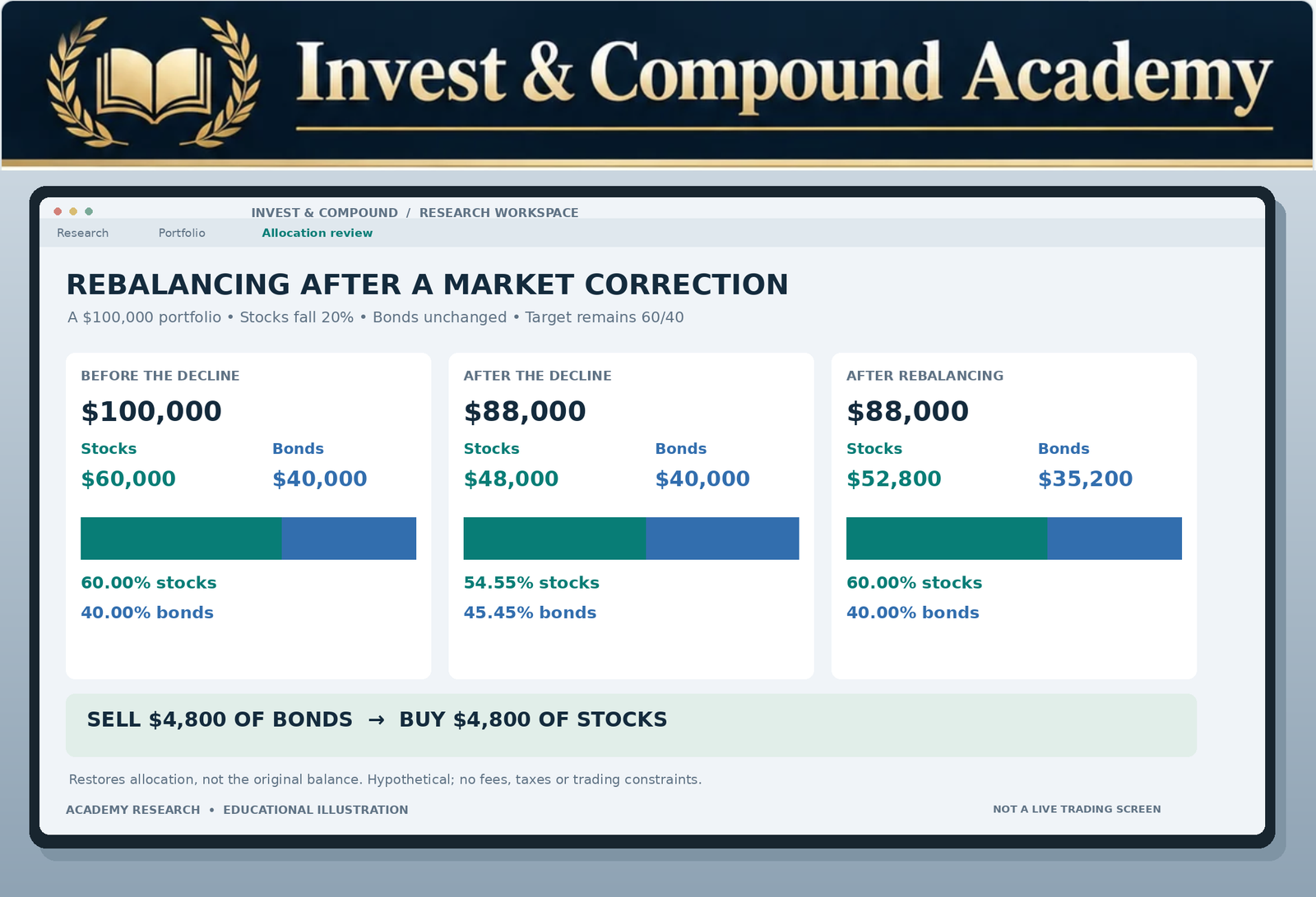
Suppose an investor begins with $100,000. The allocation is 60% equities and 40% bonds. The equity position is worth $60,000. The bond position is worth $40,000. Assume equities decline 20% while bond values remain unchanged. The equity position falls to $48,000. The total portfolio is now worth $88,000. Equities represent approximately 54.55%. To restore a 60% equity allocation, the investor would need $52,800 invested in equities. That requires transferring $4,800 from bonds to equities, ignoring fees and taxes.
Why Rebalancing Can Be Difficult
Rebalancing may require purchasing assets that have recently performed poorly. This can feel uncomfortable when financial headlines remain negative. However, an allocation-based process evaluates the portfolio’s target risk rather than attempting to identify the market bottom.
Rebalancing Does Not Guarantee Higher Returns
If equities continue declining, purchasing more shares during rebalancing may lead to additional losses. Rebalancing can also reduce exposure to assets that subsequently outperform. Its primary purpose is maintaining an appropriate risk allocation. It should not be marketed as a strategy that consistently increases returns.
Calendar-Based Rebalancing
Some investors review allocations every six or twelve months. The advantage is simplicity and a predictable review schedule. However, significant market movements may occur between review dates.
Threshold-Based Rebalancing
Other investors rebalance when an asset class deviates from its target by a predetermined amount. This approach responds to allocation drift rather than calendar dates. However, frequent threshold breaches may increase transaction activity and costs.
Rebalance With New Contributions
Investors making regular contributions may direct more of their new capital toward underweight assets. This can help restore allocation without selling existing holdings. The effectiveness depends on portfolio size and contribution amount. A small monthly contribution may not be sufficient to correct a large allocation imbalance quickly.
For the execution details, our whole-share ETF rebalancing guide explains funded trades, rounding and residual cash. The example here isolates the allocation calculation.
Understand the Costs of Portfolio Changes
Trading decisions can generate costs beyond the movement in market prices. Investors should account for commissions where applicable, bid-ask spreads, currency conversion, fund expenses, and taxes. During volatile markets, spreads may widen. This means the difference between the price at which securities can be bought and sold may increase.
Taxable Accounts
Selling at a gain may create a taxable capital gain. Selling at a loss may produce a capital loss, subject to applicable tax rules. In some jurisdictions, buying an identical or substantially identical security around the time of a loss sale can affect the ability to claim that loss. In Canada, investors should understand the superficial-loss rules and how they can apply across certain accounts and affiliated persons. In the United States, wash-sale rules may apply to relevant securities transactions. The rules are not identical across jurisdictions.
Investors should not assume that a tax strategy described for one country applies in another.
Registered and Tax-Advantaged Accounts
Tax treatment also depends on account type. Canadian TFSA, RRSP, and other registered accounts operate under rules different from U.S. IRAs and 401(k) plans. Transactions may have different consequences depending on the account. Tax considerations should support sound portfolio decisions rather than encourage unnecessary trading.
Avoid Costly Overreaction
An investor who repeatedly sells and repurchases investments may accumulate transaction costs and experience unfavorable execution prices. Frequent activity can make a strategy appear disciplined while actually increasing expenses and uncertainty. Before making changes, evaluate the expected financial benefit against all relevant costs.
Evaluate Investment Quality, Not Just Recent Performance
Market corrections can reveal differences between financially resilient companies and businesses dependent on favorable market conditions. Some companies maintain healthy cash flows and strong balance sheets. Others rely heavily on debt refinancing, external investment, or optimistic revenue projections.
Balance-Sheet Strength
Cash holdings, debt maturities, liquidity facilities, and interest coverage can influence a company’s resilience. A business with manageable debt and stable operating cash flow may have more flexibility during economic uncertainty. However, strong balance sheets do not eliminate valuation risk. A financially sound company can still experience a large share-price decline if its previous valuation was excessive.
Cash Flow Versus Accounting Profit
Reported earnings and cash generation are related but distinct. A company can report positive earnings while experiencing weak operating cash flow. For example, growing accounts receivable may increase reported revenue without immediately increasing cash receipts. During stressful conditions, the timing of cash inflows and outflows becomes especially important. Companies that depend on external financing may face challenges when credit conditions tighten.
Competitive Position
Businesses with durable competitive advantages may be better positioned to manage difficult conditions. However, competition, technology, regulation, and customer preferences can change. A previously successful company may lose its competitive position. Investors should therefore avoid treating past profitability as a guarantee of future resilience.
Valuation
An attractive business is not necessarily an attractive investment at every price. Expected future cash flows, required returns, and valuation multiples all affect prospective returns. During a correction, declining share prices may improve valuations. However, deteriorating expected earnings can offset that apparent improvement. The appropriate decision requires examining both price and fundamentals.
What Income Investors Should Do During a Correction
Investors focused on dividends and portfolio distributions face additional considerations. A correction may cause a dividend-paying stock or income ETF to decline in market value even while distributions continue. The investor should distinguish between cash income and total return.
Distribution Yield Can Rise Because Prices Fall
Suppose a stock pays an annual dividend of $4. At a share price of $100, its indicated dividend yield is 4%. If the share price falls to $80 and the annual dividend remains $4, the indicated yield increases to 5%. The higher quoted yield does not necessarily mean the investment has become safer. The price may have declined because investors expect earnings or future dividends to weaken.
Assess Distribution Sustainability
For individual companies, relevant considerations include free cash flow, payout ratios, debt obligations, and business conditions. For ETFs, the source of distributions depends on the fund’s underlying strategy. Some distributions may include dividends, interest, option premiums, realized capital gains, or return of capital under the applicable reporting framework. Investors should avoid assuming that every dollar distributed represents an economic profit.
Covered-Call ETF Considerations
Covered-call funds may generate option income during volatile markets. However, their underlying holdings can still experience substantial losses. Option premiums may partially offset market declines, but they do not guarantee principal protection. Some strategies also limit participation in strong recoveries. The appropriate evaluation focuses on total return, risk exposure, fund structure, costs, and distribution mechanics.
Read dividend yield vs total return to distinguish cash paid out from the full investment result.
What Retirees Should Consider During a Correction
Investors who rely on portfolio withdrawals face a different challenge from those continuing to accumulate capital. A correction can reduce portfolio values at the same time that spending obligations continue. This creates sequence-of-returns risk.
How Withdrawals Change Recovery Mathematics
Suppose a retiree begins with $500,000. The portfolio experiences a 20% decline. Its value falls to $400,000. The investor then withdraws $25,000 for living expenses. The remaining portfolio is worth $375,000. Returning to the original $500,000 would require a gain of approximately 33.33% on the remaining balance. Without the withdrawal, a 25% gain from $400,000 would have been sufficient.
This is a comparison of account balances. The $25,000 withdrawal funded spending and is not itself an investment loss. Removing that capital also reduces the amount available to participate in any subsequent rebound.
Consider Spending Flexibility
Some household expenses are essential and difficult to reduce. Others are discretionary. Where practical, flexibility in discretionary spending can reduce the pressure to withdraw substantial amounts during unfavorable markets. However, not every retiree has meaningful spending flexibility. A sound retirement plan should recognize the difference between essential and discretionary obligations.
Review Withdrawal Sources
Retirees may hold cash, bonds, equities, and other assets. The source of withdrawals can affect portfolio composition and future returns. The appropriate withdrawal strategy depends on tax treatment, available income, liquidity, and asset allocation. There is no single rule that always produces the best result.
What If the Correction Becomes a Bear Market?
A market correction can reach or exceed the conventional 20% bear-market threshold. Investors should prepare for this possibility without assuming that it will necessarily happen. The transition into bear-market territory does not automatically require a different trading strategy. The more important question is whether the investor’s financial situation and portfolio remain viable under deeper losses.
Assess the Consequences of a Larger Decline
A portfolio that has fallen 10% could fall another 10% or more. Investors should evaluate cumulative drawdown rather than simply adding successive percentage changes. For example, two consecutive 10% declines produce a cumulative loss of 19%, not 20%. A subsequent decline may take the market beyond the conventional bear-market threshold.
Review Financial Obligations
If a prolonged downturn would create a liquidity shortage, the investor may need to address that risk before additional losses occur.
Avoid Assuming Recovery Will Be Immediate
Historical recoveries vary substantially in duration. A portfolio designed around the expectation of a quick rebound may be vulnerable if unfavorable conditions persist.
Focus on Portfolio Survival
Investment strategies should consider the ability to withstand adverse outcomes. For leveraged investors, avoiding forced liquidation can be particularly important. For retirees, maintaining spending flexibility and suitable liquidity may matter more than attempting to exploit short-term price movements. For long-term accumulation investors, a diversified and affordable contribution strategy may remain appropriate.
The market correction vs bear market comparison explains the threshold. Our bear-market guide examines the earnings, credit and liquidity pressures that may accompany deeper declines.
Manage the Psychological Pressure of Market Volatility
Market corrections create uncertainty, and uncertainty influences behavior. Investors may monitor prices repeatedly, follow conflicting forecasts, and experience increasing concern as losses accumulate. Behavioral finance provides useful explanations for several common reactions.
Loss Aversion
Loss aversion describes the tendency for financial losses to feel more significant than equivalent gains. An investor may feel a strong urge to sell an investment simply to avoid observing further declines. However, emotional discomfort is not necessarily evidence that the investment strategy is unsuitable. The decision should be evaluated against financial capacity and underlying fundamentals.
Recency Bias
Recent market movements can become disproportionately influential. During a prolonged bull market, investors may expect gains to continue. During a correction, they may expect further losses indefinitely. Both expectations can lead to poor decisions. A balanced analysis considers multiple possible outcomes.
Confirmation Bias
Investors may selectively focus on information supporting their existing beliefs. Someone expecting a crash may give excessive attention to pessimistic forecasts. Someone convinced that markets will rebound immediately may ignore deteriorating earnings or credit conditions. A better process includes examining evidence that could contradict the original investment thesis.
Excessive Monitoring
Frequent portfolio checks can increase emotional pressure without improving investment decisions. A long-term investor may not need to respond to every daily price movement. Establishing review intervals can help distinguish meaningful portfolio developments from short-term fluctuations.
The Value of a Written Decision Process
A written investment plan can establish target allocations, contribution policies, risk limits, liquidity reserves, and conditions that justify reassessment. The goal is not to eliminate flexibility. It is to create a framework in which decisions are made deliberately rather than impulsively.
A Practical Market-Correction Decision Framework
A correction does not need to trigger immediate trading activity. However, it can justify a structured portfolio review. The following framework focuses on financial conditions that investors can evaluate directly.
Stage One: Financial Stability
Begin with liquidity and obligations. Determine whether household expenses, debt payments, and foreseeable commitments can be met without forced investment sales. If an immediate cash shortage exists, it may take priority over maximizing expected investment returns.
Stage Two: Portfolio Exposure
Review the allocation among equities, bonds, cash, and other assets. Examine underlying holdings and concentration. Determine whether the portfolio remains aligned with financial objectives.
Stage Three: Investment Fundamentals
For individual companies, assess financial condition, profitability, debt, and competitive position. For ETFs, examine holdings, strategy, index methodology, expenses, and risk characteristics. Determine whether the original investment rationale remains valid.
Stage Four: Downside Capacity
Evaluate plausible further declines. Consider what would happen if the portfolio lost another 10%, 20%, or more. A useful stress test examines the financial consequences without asserting that the scenario is likely.
Stage Five: Decision and Documentation
If changes are justified, identify the financial rationale. Record what has changed and how the proposed transaction improves alignment with the investment plan. If no changes are justified, maintaining the existing strategy can also be a deliberate decision. The aim is to distinguish action that addresses a financial problem from activity motivated primarily by discomfort.

Examples of Different Investor Responses
Consider three hypothetical investors experiencing the same 15% broad-market correction.
Investor A: Long-Term Retirement Saver
Investor A is 30 years old and expects to invest for another three decades. The investor has stable employment, adequate emergency savings, a diversified portfolio, and no need for near-term withdrawals. A portfolio review confirms that the allocation remains appropriate. Continuing scheduled contributions may be consistent with the existing strategy. There may be no financial reason to sell solely because market prices have declined.
Investor B: Near-Term Homebuyer
Investor B expects to use $60,000 for a home down payment within nine months. The full amount was invested in equities. A 15% correction reduces the portfolio to $51,000. The investor faces a clear mismatch between the asset’s volatility and the spending deadline. The appropriate decision may involve reducing market exposure or adjusting the financial objective, depending on circumstances. This situation requires a different analysis from Investor A.
Investor C: Leveraged Investor
Investor C holds $200,000 in securities financed partly through margin borrowing. The portfolio experiences a substantial decline. Collateral coverage weakens while financing costs continue accumulating. The investor may face margin requirements and limited ability to hold through further losses. Reducing leverage could be necessary to preserve financial flexibility. Again, the market decline is the same, but the financially appropriate response differs.
These examples demonstrate why generic instructions to always buy or always hold are inadequate. Investment decisions must reflect the investor’s actual financial constraints.
Mistakes Investors Should Avoid During Corrections
Making Decisions Solely From Headlines
Financial headlines emphasize immediate developments. A long-term strategy should not automatically change because market commentary has become pessimistic. Relevant economic and company-specific information deserves analysis, but headlines alone do not establish a trading decision.
Assuming a 10% Decline Guarantees a Rebound
A correction can deepen into a bear market. The numerical threshold does not create a protective price floor.
Treating Every Declining Stock as Undervalued
A lower price may reflect weaker fundamentals. Valuation analysis should consider expected earnings, cash flows, and business risk.
Investing Emergency Funds
Deploying essential reserves into volatile assets can create liquidity problems if further losses occur or unexpected expenses arise.
Using Excessive Leverage
Leverage magnifies losses and can introduce forced liquidation risk. An investment that might eventually recover can still produce catastrophic outcomes for an investor unable to meet margin requirements.
Ignoring Portfolio Overlap
Owning several funds does not guarantee diversification. Different ETFs may share substantial exposure to the same companies and sectors.
Rebalancing Without Considering Costs
Taxes, trading spreads, commissions, and currency conversion can affect results. Portfolio changes should be evaluated on an after-cost basis.
Confusing Distributions With Total Return
An income investment can pay substantial distributions while losing capital value. Investors should examine the complete investment outcome.
Believing Doing Nothing Is Always Wrong
Maintaining an appropriate portfolio during a correction can be a rational decision. The absence of trading activity does not imply the absence of financial discipline.
Assuming Holding Is Always Correct
If financial circumstances change, leverage becomes unsustainable, or investment fundamentals deteriorate, adjusting the portfolio may be necessary. Discipline should not become an excuse for ignoring new evidence.
Frequently Asked Questions
What Is the Best Thing to Do During a Market Correction?
There is no universally best action. A useful starting point is reviewing liquidity, financial obligations, investment horizon, diversification, and portfolio risk before making transactions.
Should I Sell All My Stocks During a Correction?
Selling everything may reduce immediate equity exposure, but it creates reinvestment timing and opportunity-cost risks. The decision should reflect financial circumstances rather than the market label alone.
Should I Buy More Stocks When the Market Falls 10%?
Lower prices can create opportunities, but further losses remain possible. Purchases should be evaluated against valuation, diversification, liquidity, and financial objectives.
Is It Better to Hold Through a Correction?
Holding may be appropriate for investors with suitable portfolios and sufficient liquidity. It is not automatically appropriate for every security or financial situation.
Should I Stop Investing During a Correction?
Some investors may continue regular contributions because their long-term objectives and financial circumstances are unchanged. Others may need to prioritize emergency savings or debt obligations.
Does Dollar-Cost Averaging Prevent Losses?
No. It creates a systematic contribution process but cannot guarantee gains or protect against declining investment values.
Should I Rebalance During a Correction?
Rebalancing may be appropriate when portfolio weights have moved outside predetermined targets. Transaction costs, taxes, and financial circumstances should be considered.
What Should I Do If My Portfolio Falls 20%?
Assess liquidity, leverage, asset allocation, and whether investment fundamentals remain consistent with the original strategy. A 20% decline does not automatically justify buying or selling.
Are Dividend ETFs Safer During Corrections?
Not necessarily. Their performance depends on underlying holdings, valuations, and distribution sustainability. Cash income does not eliminate capital risk.
Can I Use Bonds to Protect My Portfolio?
Some bonds may provide diversification or relative stability under certain conditions. However, bond prices can fall when interest rates rise, and credit risk can create additional losses.
Is Keeping Cash During a Correction a Good Idea?
Cash can provide liquidity and reduce immediate market exposure. However, excessive cash holdings may produce opportunity costs and inflation-related purchasing-power losses.
What If I Need My Investment Money Soon?
Capital needed for near-term obligations may require lower-volatility investments. A significant equity-market decline can create problems when the spending date is inflexible.
Can a Correction Become a Bear Market?
Yes. A decline reaching or exceeding the conventional 20% threshold enters bear-market territory. Not every correction develops into a bear market.
Should I Change My Retirement Strategy After a Correction?
A correction can justify reviewing retirement allocation, withdrawal requirements, and liquidity. Changes should reflect financial needs and risk capacity rather than market headlines alone.
How Do I Know When the Correction Has Ended?
The final market low can only be identified with confidence retrospectively. Short-term rallies may occur before the downturn has ended.
What Is the Biggest Risk During a Correction?
The answer varies. For some investors, excessive leverage is the greatest risk. For others, it is inadequate liquidity, concentration, permanent capital impairment, or forced withdrawals during market weakness.
Making a Deliberate Decision During a Market Correction
Market corrections create uncertainty because investors cannot know in advance how far prices will fall or how long the decline will continue. The conventional 10% threshold identifies a meaningful market drawdown. It does not determine whether the decline is temporary, whether a recession will occur, or when prices will recover. For that reason, the most important decisions during a correction are often financial rather than predictive. Investors should understand their liquidity needs, evaluate portfolio concentration, review leverage, and determine whether their asset allocation remains appropriate.
Those with long investment horizons and stable financial circumstances may have the flexibility to continue established contribution strategies. Others may need to adjust risk because of upcoming expenses, changing financial obligations, or unsuitable portfolio exposures. Neither buying nor selling should be treated as an automatic response to a particular percentage decline. Lower prices do not guarantee attractive value. Likewise, falling markets do not prove that a disciplined long-term investment strategy has failed.
The quality of a decision depends on its relationship to financial objectives, risk capacity, underlying investment fundamentals, and the potential consequences of being wrong. Historical market recoveries provide evidence that broad equity markets have demonstrated resilience across many difficult periods. They do not guarantee that future markets will follow the same timeline or that every individual investment will recover. A strong financial plan must accommodate that uncertainty.
During a market correction, discipline means understanding when action is financially justified and documenting the reasons for that decision.
Continue Learning in the Invest & Compound Academy
Connect this decision framework with the five earlier market-risk pillars and the practical rebalancing workbook.
Market risk, indexes and portfolio strategy
Market Correction Pillar | Indexes and Markets | Portfolio Construction
Sources and Further Reading
Reference review: October 18, 2026. Numerical examples and calculator scenarios are hypothetical. Tax and margin rules depend on jurisdiction, account agreements and individual circumstances; consult the applicable official guidance.
- SEC Investor.gov: Asset Allocation and Diversification
- SEC Investor.gov: Asset Allocation, Diversification and Rebalancing
- SEC: Margin—Borrowing Money to Pay for Stocks
- SEC Investor.gov: Leveraged Investing Strategies and Risks
- Canada Revenue Agency: Capital Gains Guide, including superficial losses
- IRS Publication 550: Investment Income and Expenses
This article provides general education, not personalized financial, investment, legal or tax advice or a recommendation to buy, sell or hold any security.
Investments can lose principal. Diversification and rebalancing do not guarantee profits or prevent losses. Leverage can amplify losses, create liabilities beyond initial equity and lead to forced liquidation. Calculators omit the costs and constraints stated alongside them. Consider your circumstances and consult qualified professionals where appropriate.