Where to Park Cash: Comparing Short-Term Savings Options
Where to park cash depends on more than the highest advertised rate. Compare savings accounts, GICs or CDs, Treasury bills and money market funds by safety, access, maturity, fees, tax treatment and the date you actually need the money.
Where to park cash is primarily a question of purpose. Money needed next week, in eight months, or several years from now should not automatically be held in the same product.
Short-term cash generally has a different job from long-term investments. Its priority is usually to remain available when a bill, emergency or planned purchase arrives.
That means the best quoted rate is not necessarily the best choice.
A slightly higher return can be irrelevant if the money is locked past the payment date, exposed to unnecessary price movement or difficult to transfer when needed.
Where to Park Cash: Start With Safety, Access and Yield
A useful framework for deciding where to park cash is to compare safety, access, yield and the specific purpose of the money.
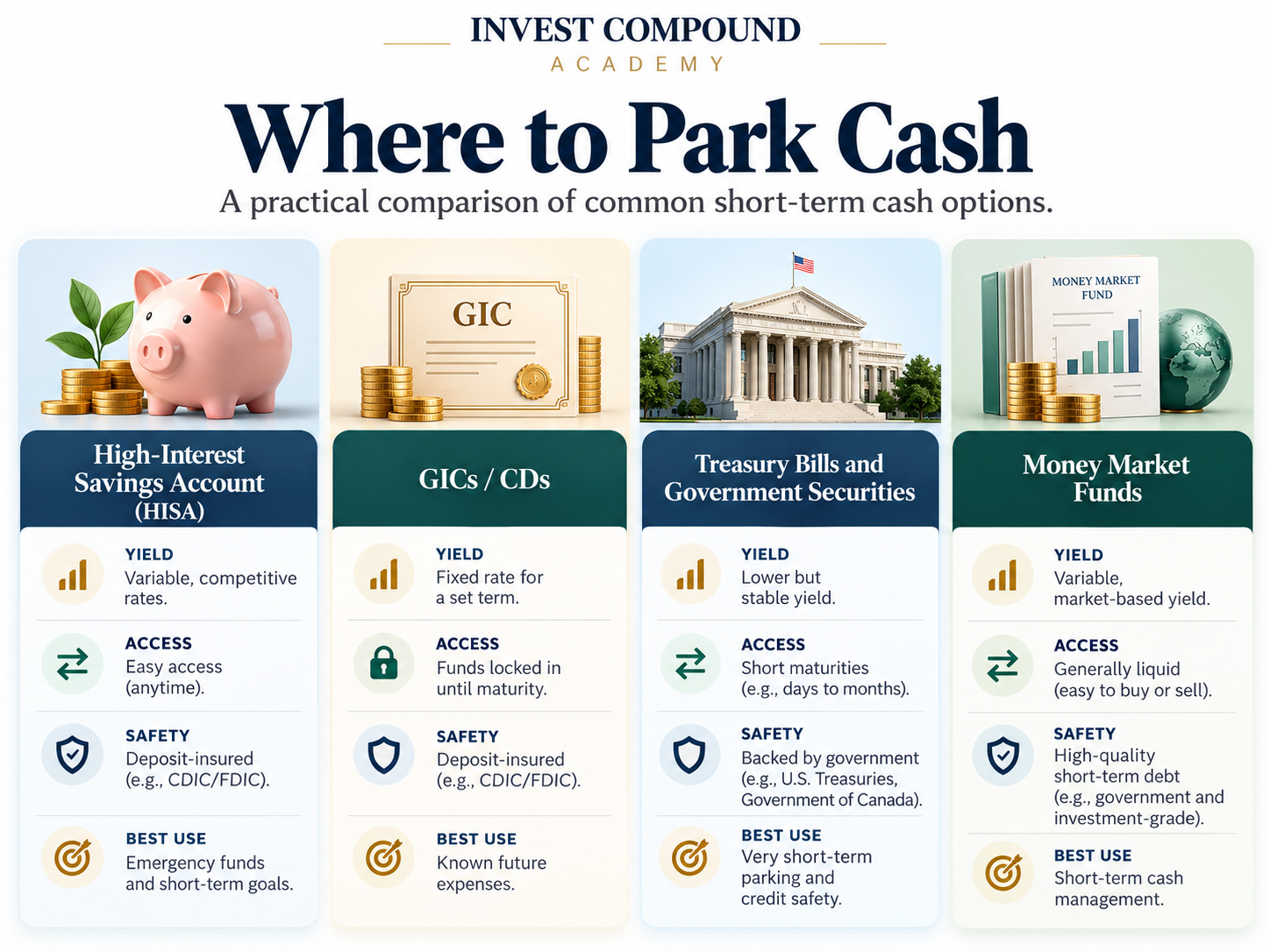
High-Interest Savings Accounts
A high-interest savings account, or HISA, pays a variable rate on money held at a financial institution.
HISAs can be useful when deciding where to park cash that may need to be accessed with little notice.
Their main advantage is flexibility. Their main drawback is that rates can change.
Promotional rates also deserve careful attention because a temporary headline rate may fall materially after the promotional period ends.
What to Check
- the ongoing rate after any promotion,
- transfer and withdrawal restrictions,
- monthly or transaction fees,
- the legal institution holding the deposit, and
- whether the deposit qualifies for applicable insurance.
GICs and CDs
Guaranteed Investment Certificates in Canada and Certificates of Deposit in the United States generally involve placing money with an institution for a stated term in exchange for an agreed rate.
The major trade-off is liquidity.
Some products are cashable or redeemable. Others can remain locked until maturity.
A fixed-term product can work well for a known future expense, but only when the maturity date occurs early enough for the payment to be made.
Treasury Bills and Government Securities
Treasury bills are short-term government obligations.
They are commonly purchased for less than their maturity value, with the difference representing the investor’s return.
Government bills generally have very low credit risk when held in the issuing government’s currency.
Practical considerations can include:
- purchase mechanics,
- settlement timing,
- secondary-market pricing,
- bid-ask spreads, and
- selling before maturity.
Money Market Funds
Money market funds invest in short-term securities according to their portfolio mandate.
They are investments rather than insured bank deposits.
When considering where to park cash inside a brokerage account, confirm whether the broker uses:
- a bank sweep,
- a money market fund,
- uninvested brokerage cash, or
- another cash-management arrangement.
Quick Comparison of Short-Term Cash Options
| Option | Protection | Access | Rate Behavior | Potential Use |
|---|---|---|---|---|
| High-Interest Savings | Eligible deposits may qualify for deposit insurance | Usually high | Variable | Emergency reserve or flexible short-term savings |
| GIC / CD | Eligible deposits may qualify for deposit insurance | Can be restricted | Often fixed | Known future expenses |
| Treasury Bill | Government obligation | Maturity or market sale | Market-based | Known short-term horizon |
| Money Market Fund | Investment product, not a bank deposit | Generally liquid | Variable | Brokerage cash management |
Match the Product to the Payment Date
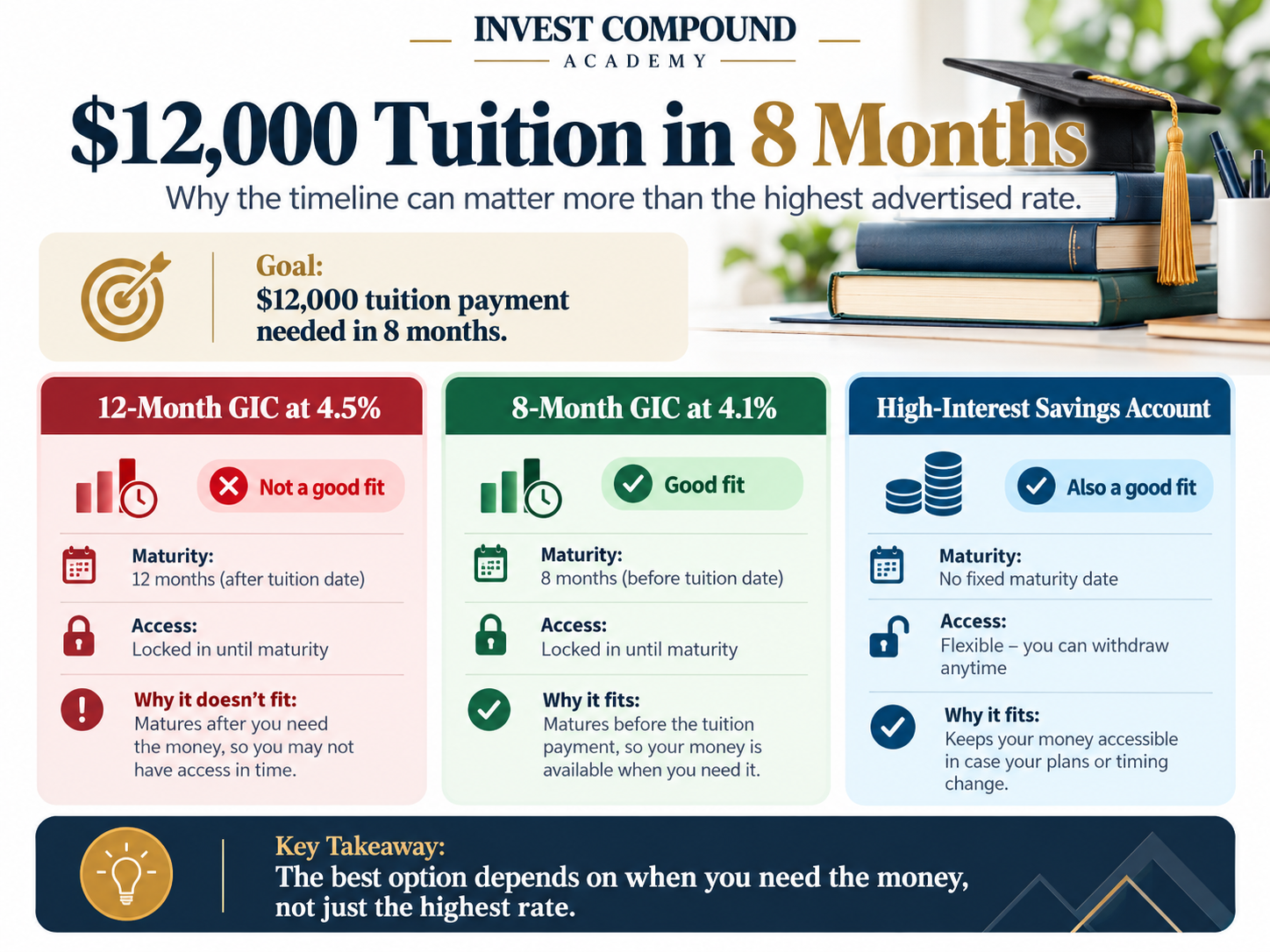
One of the most important rules for deciding where to park cash is to write down the date the money is required before comparing rates.
Tuition required: $12,000
Payment date: 8 months from today
Product A: 12-month non-cashable GIC at 4.5%
Product B: 8-month product at 4.1%
Product A may advertise the higher rate.
But if it cannot be redeemed before month 12, it fails the basic requirement because the tuition payment is due four months earlier.
Emergency Cash Is Different
An emergency fund has no known payment date.
That makes immediate or near-immediate access especially important.
Locking the entire reserve in a product that cannot be redeemed quickly can undermine the reason the reserve exists.
Compare Actual Dollars, Not Just Annualized Rates
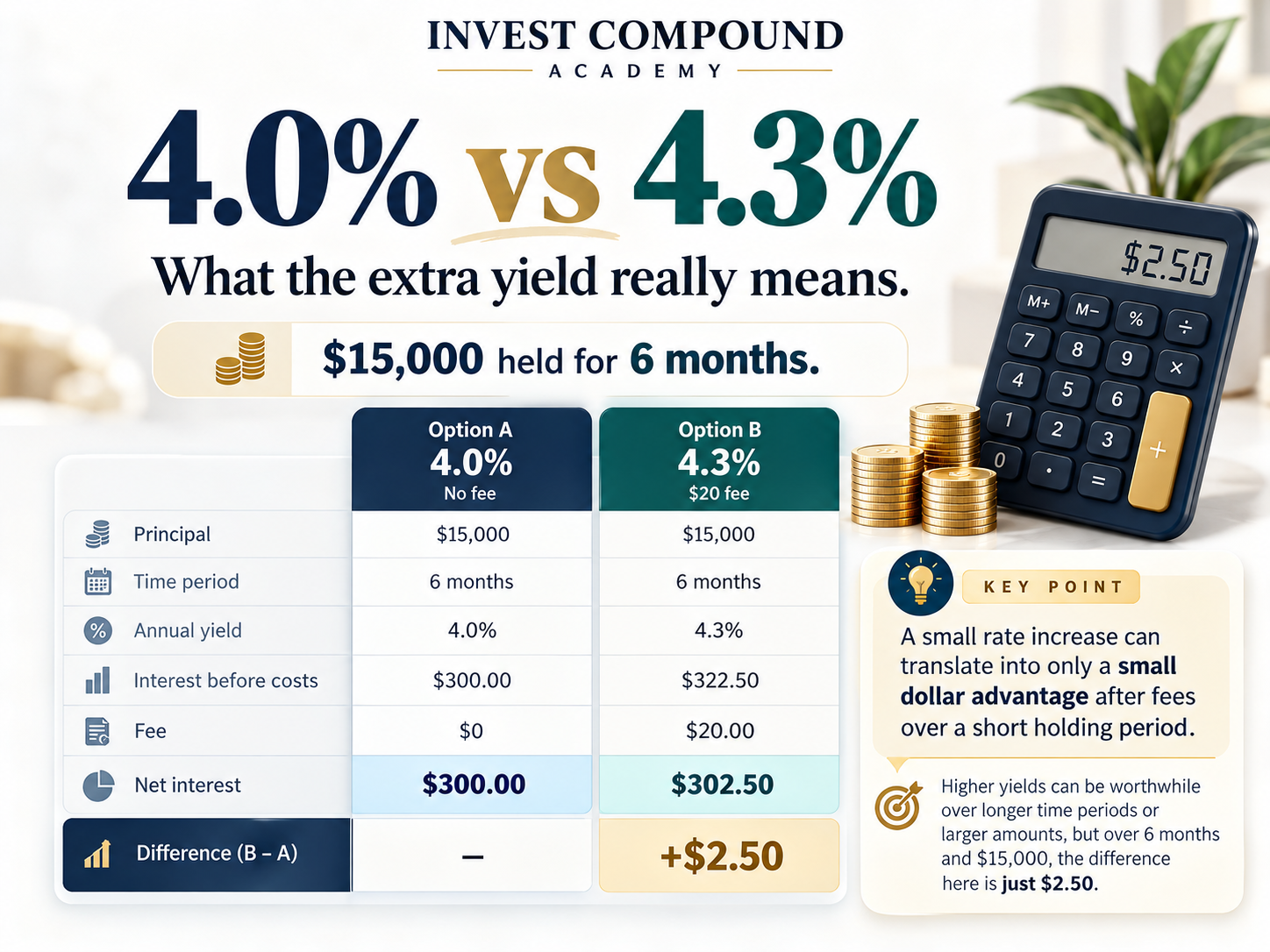
Advertised yields are usually annualized, while your actual holding period may be much shorter.
Cash balance: $15,000
Option A: 4.0%
Option B: 4.3%
Holding period: 6 months
Using a simplified simple-interest illustration:
- 4.0% produces about $300.
- 4.3% produces about $322.50.
The difference is only $22.50 over six months.
If the higher-yielding option carries a $20 fee, the advantage falls to approximately $2.50 before tax.
Check Deposit Insurance Before Moving Large Cash Balances
Another important part of deciding where to park cash is identifying the legal institution that actually holds the deposit.
Canada
Eligible deposits at CDIC member institutions can receive protection within the applicable insured limits and categories.
United States
Eligible deposits at FDIC-insured banks can receive protection within the applicable ownership-category limits.
Verify the Legal Institution
A financial app, brokerage interface or marketing brand is not necessarily the legal institution holding your money.
When protection matters, verify:
- the actual institution,
- whether it belongs to the relevant insurance system,
- the ownership category,
- other deposits you hold at the same institution, and
- whether the specific product qualifies.
Taxes and Inflation Affect the Real Result
A higher pre-tax rate does not necessarily produce a meaningfully higher after-tax result.
Tax treatment can depend on jurisdiction, account type and the form of interest or investment income.
Savings yield: 3.0%
Inflation: 3.5%
Approximate pre-tax real result: slightly negative
That does not mean the cash failed at its job. Short-term reserves are primarily held for stability and access rather than maximum long-term growth.
How Much Cash Should You Hold?
There is no single amount that works for every household.
A commonly discussed emergency-reserve range is several months of essential expenses, but the appropriate amount depends on personal circumstances.
- income stability,
- number of earners,
- fixed expenses,
- insurance coverage,
- dependents,
- planned purchases, and
- other liquid resources.
Common Mistakes When Parking Cash
- Chasing promotional rates without checking when they expire.
- Locking emergency money beyond the period when it may be required.
- Comparing annualized percentages without calculating actual dollars.
- Ignoring fees and settlement delays.
- Assuming every GIC, CD or savings product is automatically insured.
- Treating money market funds as insured deposits.
- Ignoring automatic renewal terms.
- Choosing a slightly higher yield that does not match the required payment date.
Frequently Asked Questions
Where should I park an emergency fund?
Emergency cash generally benefits from high liquidity, understandable protection and minimal principal volatility.
Is a GIC or CD better than a savings account?
Neither is automatically better. A fixed-term product can provide rate certainty, while a savings account generally offers greater flexibility.
Is a Treasury bill better than a savings account?
It depends on maturity, access, taxes, rate and convenience.
Are money market funds insured?
Money market funds are investment products rather than insured bank deposits.
Should I always choose the highest rate?
No. A higher rate can be a poor choice if its maturity date, access terms, fees or protection do not match the purpose of the money.
Key Takeaways
- Where to park cash depends first on when the money will be needed.
- Safety, liquidity and yield should be evaluated together.
- Savings accounts usually offer flexibility but variable rates.
- GICs and CDs can provide rate certainty but may restrict access.
- Treasury bills provide short-term government credit exposure.
- Money market funds are investment products rather than insured deposits.
- Small differences in annualized yield can translate into very small dollar differences over short periods.
- Fees can eliminate much of a small yield advantage.
- The maturity date can matter more than the advertised interest rate.
LEARNING LAB · HYPOTHETICAL
Cash Yield Comparison Calculator
Compare two annualized rates over your actual holding period and see how fees change the final result.
Simplified educational calculation using annual rate × months ÷ 12. Actual results can differ because of compounding, taxes, promotional periods, fees, day-count conventions and product-specific terms.
Cash Management and Portfolio Planning
Bonds and fixed income | Inflation and real returns | Asset allocation | Economic resilience | Portfolio construction
References & Official Data Sources
Educational disclosure: This material is general investment education, not individualized financial, tax, or legal advice. Valuation metrics, growth estimates, and stock prices can change materially. Do your own research and consider a qualified financial professional before making investment decisions.
