Investing in Gold and Commodities: Risks, ETFs and Portfolio Strategy
Understand bullion, mining shares, commodity funds and futures—and how each can affect a diversified investment portfolio.
Investing in gold and commodities is not simply a bet on rising prices. The vehicle you choose determines the costs, risks, potential income and relationship to the underlying market.
What Are Gold and Commodities?
Gold and other commodities are real-world resources, but investing in them rarely means owning a warehouse of raw materials. An investor might buy bullion, shares in a mining business, an exchange-traded product, or a fund holding futures contracts.
Those instruments can produce substantially different returns even when they refer to the same commodity.
Unlike a profitable company or an interest-paying bond, a bar of gold does not generate operating earnings or coupon payments. Its investment result depends on the resale price minus transaction and holding costs.
Commodity futures and producer stocks have additional sources of gains and losses.
Why Investors Consider Gold
For thousands of years, gold has served as a store of value. Today, it is used in jewelry, technology and as a reserve asset held by central banks.
Investors consider gold for diversification, potential protection during periods of financial stress and long-term purchasing-power considerations.
However, gold’s real purchasing power fluctuates. Its starting price and holding period matter, so it is not a dependable hedge for a particular expense on a particular date.
Gold has experienced strong rallies and extended weak periods. Comparisons with stocks depend on dates, currency, dividends and inflation.
Gold’s relationship with inflation and equities varies. It can fall alongside other assets during a rush for liquidity, and strong inflation does not necessarily produce an immediate gold gain.
Investing in Gold and Commodities: Choosing the Investment Vehicle
The first decision is not whether gold prices will rise. It is which exposure you want to own and what you are willing to pay for it.
| Investment route | What you own | Key trade-off |
|---|---|---|
| Physical bullion | Coins or bars | Premiums, custody, insurance and resale spreads |
| Bullion-backed exchange-traded product | Units of a fund or trust | Fund structure, fees, custody and tracking |
| Gold mining stocks | Equity in operating businesses | Operating costs, debt, management and equity risk |
| Commodity futures fund | Exposure through expiring contracts | Roll yield, collateral returns, fees and tracking |
| Broad commodity fund | A basket of commodity exposures | Composition, concentration and methodology |

An investor can own physical gold, shares in a bullion-backed vehicle, a mining business or a derivative strategy. Each route connects to gold through a different mechanism.
Physical metal changes in resale value and incurs storage or transaction costs. A producer also depends on extraction costs, financing, reserves, management and the country in which it operates.
For oil or other commodities, a futures-based fund can behave differently from the spot-price headline.
It holds contracts with specified maturities and follows a roll process. Collateral income, fees, contract changes and the shape of the futures curve affect the result.
Write one sentence explaining what creates a gain or loss in the chosen product. If that sentence is unclear, the product needs more research.
Risks and Costs of Investing in Gold and Commodities
- Volatility: Commodity prices can fluctuate sharply.
- No income: Physical metal generates no earnings or interest.
- Holding costs: Storage, insurance, spreads and fees affect returns.
- Complex products: Futures and leveraged funds may behave differently from spot prices.
- Speculative flows: Investor sentiment can amplify price movements.
- Tracking differences: Fund results may differ from commodity-price benchmarks.
U.S. tax treatment depends on legal structure. Some physical-bullion trusts may be subject to collectibles rules, while other commodity products have different reporting and tax treatment.
Canadian treatment may depend on whether activity is capital investment or a business. Read the product’s tax disclosures before buying.
Also consider liquidity, tracking differences, concentration and opportunity cost. Some products are designed for short-term trading rather than long-term ownership.
Why Futures Funds Can Differ From Spot Prices
Suppose a commodity’s near-month contract is priced at $70 and a later contract at $74. A fund that rolls its exposure sells the nearer contract and buys the later one according to its rules.
If the curve and spot price remain unfavorable, the rolling strategy can experience a drag relative to simply following the spot quote.
Contango describes later contracts priced above nearer ones; backwardation describes the reverse.
Neither label alone predicts the fund’s entire return. Changes in contracts, roll timing, collateral yield, expenses and market movement also matter.
Gold Mining Stocks Versus Bullion
Consider a fictional mine receiving $2,000 for each unit of output with all-in modeled costs of $1,500. Its illustrative margin is $500.
If the sale price rises 10% to $2,200 while costs remain fixed, the margin rises to $700—a 40% increase.
The reverse also matters. A decline to $1,800 reduces the margin to $300, a 40% drop. If energy, wages or other costs rise at the same time, the result can worsen further.
The company can also face debt, project delays, political risk and share dilution. A mining share is a business claim rather than ownership of a stored quantity of metal.
Investing in Gold and Commodities Within a Diversified Portfolio
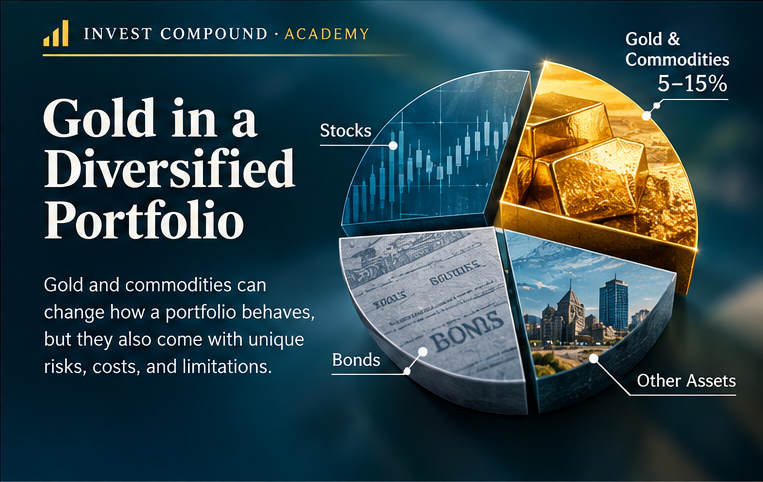
There is no universal gold allocation. If you include it, identify the risk it is meant to address, the maximum weight you can tolerate and how you will rebalance.
A zero allocation can also be reasonable; broad portfolios do not require every available asset class.
If gold represents 5% of a $100,000 portfolio and gains 30%, it contributes $1,500, or 1.5% of the initial portfolio.
If the remaining $95,000 falls 20%, its $19,000 loss overwhelms the gold gain. The portfolio still loses $17,500.
A small diversifier can moderate a decline without delivering protection comparable to insurance.
Distinguish the risks you are trying to address: currency depreciation, equity drawdowns, commodity supply shocks or long-term purchasing power.
Record a target weight and rebalancing policy rather than increasing the allocation every time alarming headlines appear.
Physical Gold Ownership and Break-Even Costs
A physical gold purchase can involve a premium above the reference price, a selling spread, storage charges, insurance and authentication concerns.
The market price must move enough to cover the full purchase and sale costs before the owner realizes a gain.
For a hypothetical purchase costing $1,050 when the reference value is $1,000, and a later sale yielding only 98% of the reference price, a reference value of $1,050 generates just $1,029.
The reference price rose 5%, yet the investor remains below the original purchase cost.
Check how you would sell, how authenticity is established, and whether storage is allocated or unallocated under the provider’s terms.
Silver, Copper, Oil and Broad Commodity Funds
Investing in gold and commodities is not one uniform strategy. Silver, copper, oil and agricultural markets respond to different supply and demand conditions.
- Silver: Has industrial and investment demand, creating different price drivers from gold.
- Copper: Industrial demand can be closely tied to construction, manufacturing and economic activity.
- Oil: Prices respond to production decisions, inventories, geopolitics and global demand.
- Broad commodity funds: Provide exposure to multiple markets but may remain heavily weighted toward energy.
Review the index methodology and how the fund obtains each commodity exposure before assuming the basket is diversified.
Taxes, Currency and Account Considerations
Read the prospectus and tax disclosures for the particular vehicle. A trust holding bullion, a company holding mining shares, and a futures fund can have different legal structures and reporting treatment.
Jurisdiction and account type also matter. A broad claim that all gold investments receive one tax treatment is unreliable.
For a cross-border investor, distinguish the trading currency from the economic exposure and reporting currency.
Buying a fund in Canadian dollars does not automatically remove the effect of an underlying commodity priced in another currency.
Registered-account eligibility and tax reporting vary by product and jurisdiction. Investors should verify the specific vehicle and applicable reporting rules.
Common Investing Mistakes
- Buying immediately after a large rally because of fear.
- Using leveraged or inverse commodity ETFs as long-term holdings without understanding their daily objectives.
- Ignoring storage and premium costs on physical metal.
- Assuming gold always rises when stocks fall.
- Over-allocating at the expense of other portfolio assets.
- Confusing the change in spot price with the actual return from a commodity fund.
Frequently Asked Questions
Does gold always rise during a stock market crash?
No. Gold can sometimes diversify equity risk, but it can also decline during liquidity-driven selloffs.
Is gold a reliable inflation hedge?
Not over every short period. Gold’s purchasing power varies, and entry price and holding period matter.
Are gold ETFs the same as physical bullion?
No. Some products hold bullion, others use derivatives, and others own mining companies. Their legal structures, expenses and risks differ.
Can gold generate dividends?
Physical gold does not pay dividends. A gold mining company may distribute profits, but that income comes from the business.
Can gold investments be held in a TFSA or IRA?
Some qualifying securities may be eligible, subject to the rules of the particular account and jurisdiction. Verify eligibility with the broker and applicable tax guidance.
Key Takeaways
- Start with the investment vehicle, not only the commodity outlook.
- Gold can diversify a portfolio but is not guaranteed crash protection.
- Futures funds can diverge materially from spot prices.
- Mining stocks are operating businesses with company-specific risk.
- Physical gold involves premiums, spreads and holding costs.
- Allocation should reflect portfolio objectives and risk capacity.
- A deliberate zero allocation can be entirely reasonable.
Gold Portfolio Allocation Calculator
Enter a portfolio value, gold weight and hypothetical price changes. The calculation shows how gold and other assets might affect the total portfolio under the chosen scenario.
Gold Portfolio Allocation Calculator
This hypothetical calculator does not forecast future returns. It ignores taxes, trading costs, interim rebalancing and changes in asset correlations.
Physical Gold Break-Even Calculator
This calculator estimates the future spot-price increase required to recover total purchase and holding costs, including the dealer’s assumed selling discount.
Physical Gold Break-Even Calculator
Simplified educational estimate using a fixed selling discount. Actual prices, transaction fees, insurance and custody costs vary.
References & Official Data Sources
For current rules and product details, consult the relevant regulator and each fund’s official prospectus.
Educational disclosure: This material is general investment education, not individualized financial, tax, or legal advice. Valuation metrics, growth estimates, and stock prices can change materially. Do your own research and consider a qualified financial professional before making investment decisions.