401(k) vs IRA and a Clear Order for Your Retirement Savings
Compare a workplace 401(k) with an IRA: employer match, 2026 limits, rollovers and a sensible order for most savers.
Most people save for retirement through some mix of a workplace 401(k) and an IRA. The two work differently, and the order in which you fill them can matter as much as the choice between them.
Looking for the core Roth versus traditional comparison? Read our Roth IRA vs traditional IRA guide. This guide focuses on the 401(k) vs IRA question: how a workplace 401(k) fits alongside an IRA, and in what order to use them. The 401(k) vs IRA choice is rarely either-or, because many savers use both.
Roth IRAs, traditional IRAs and 401(k) plans differ in tax treatment, eligibility, investment choice and access. An employer match can be valuable, but the right account should also fit your cash flow, your debts and your time horizon.time horizon.
401(k) vs IRA the essentials
A 401(k) is an employer-sponsored retirement plan. You choose a percentage of your paycheck to contribute, and the money goes into investment options the plan offers, often target-date funds and index funds.
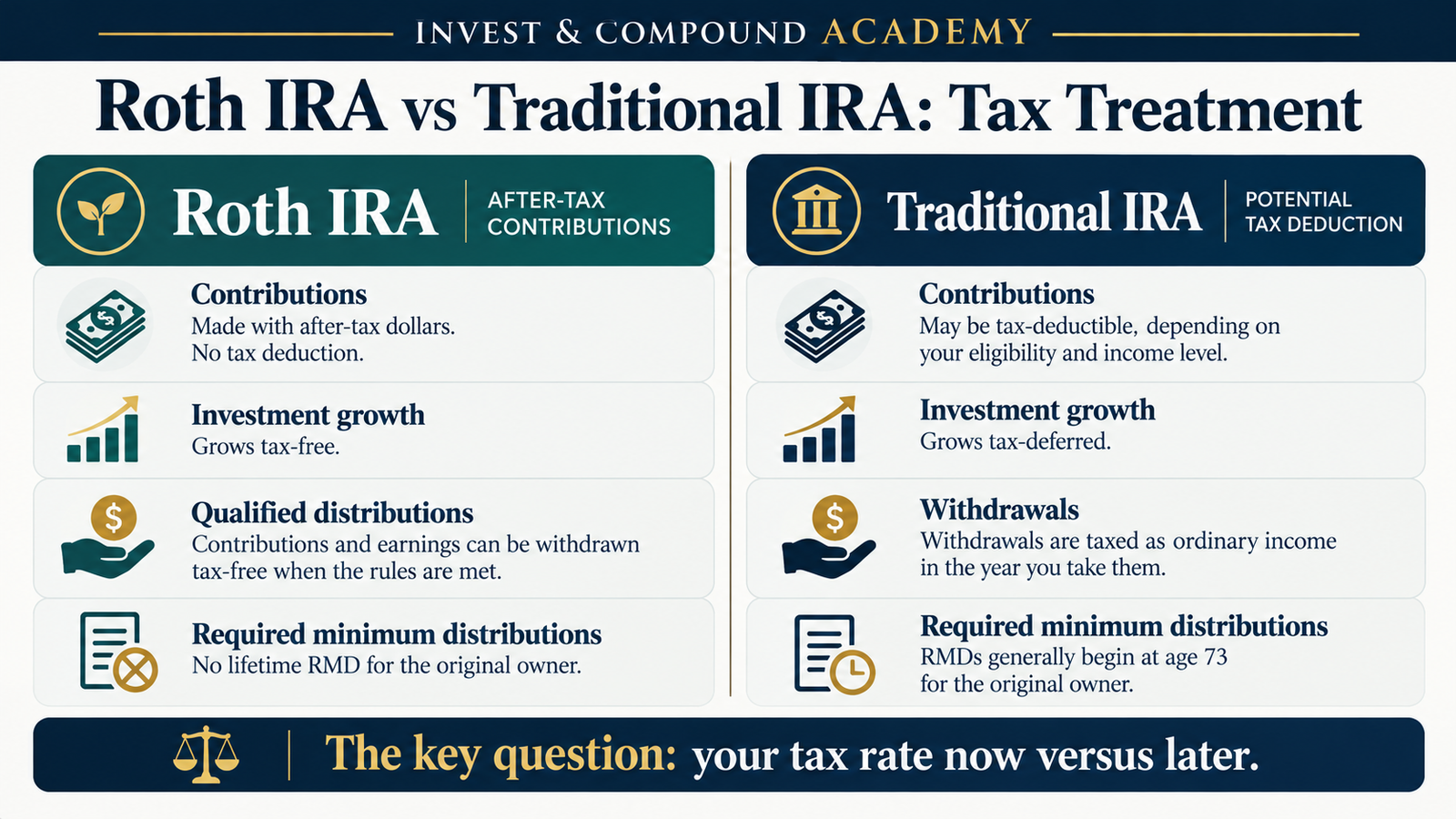
Traditional 401(k): Contributions come out before income tax, lowering your taxable income now.
Growth is tax-deferred. Withdrawals in retirement are taxed as ordinary income.
Roth 401(k): Contributions are made with after-tax dollars. Growth and qualified withdrawals are tax-free.
Employer match: Many employers add money when you contribute, for example matching 50% of your contributions up to 6% of pay. This is extra pay from your employer, so many savers capture the full match before adding other savings.
For 2026, the regular employee deferral limit for most 401(k) plans is US$24,500, shared across pre-tax and Roth deferrals. The general age-50 catch-up is US$8,000; eligible participants aged 60–63 have a higher US$11,250 catch-up. Plan permission, income-related Roth catch-up rules, and other limits can also matter. [1]
Where an IRA fits next to a 401(k)
An IRA is an account you open yourself at a broker, separate from any workplace plan. Traditional IRA contributions may be deductible and are taxed when you withdraw, while Roth IRA contributions are made with after-tax dollars and qualified withdrawals are tax-free. Both share one annual limit of US$7,500 for 2026, plus US$1,100 at age 50 or older. For the full comparison, including income limits and a worked example, read our Roth IRA vs traditional IRA guide.
Side by side
| Feature | Traditional 401(k) | Roth 401(k) | Traditional IRA | Roth IRA |
|---|---|---|---|---|
| Contribution tax treatment | Pre-tax deferrals | After-tax deferrals | May be deductible | After-tax; no deduction |
| Growth | Tax-deferred | Qualified distributions tax-free | Tax-deferred | Qualified distributions tax-free |
| Withdrawals | Generally taxable income | Tax-free if qualified | Generally taxable income | Qualified withdrawals tax-free; contribution ordering rules apply |
| Employer match | Possible under plan terms | Possible under plan terms | No | No |
| Income restrictions | Plan eligibility; no general income cap on elective deferrals | Plan eligibility; no general income cap on elective deferrals | Deduction may phase out | Direct contributions may phase out |
| Owner lifetime RMDs | Generally yes | No under current law | Generally yes | No |
| 2026 regular contribution ceiling | $24,500 shared employee deferral limit | $24,500 shared employee deferral limit | $7,500 shared IRA limit | $7,500 shared IRA limit |
Limits are shared within the relevant plan/IRA category; age, earnings, plan provisions, and other rules can affect eligibility and catch-ups. Source: IRS.
Choosing between Roth and traditional contributions
The choice mostly comes down to your tax rate now compared with your expected rate in retirement. If you expect a lower rate later, traditional contributions tend to fit. If you expect a higher rate, Roth contributions tend to fit. Many savers split the difference and hold both. Our Roth IRA vs traditional IRA guide walks through a worked example.
A simple priority order for the 401(k) vs IRA question
Many planners suggest something like this, adjusted to your situation: Where a match is offered, understand the matching formula and vesting schedule. Employer contributions can materially improve the benefit of participating, but some may be forfeited if you leave before vesting.
Pay off high-interest debt, such as credit cards.
Build an emergency fund.
Max out a Roth IRA (if eligible) or a Traditional IRA.
Return to your 401(k) and contribute more, up to the limit.
Consider a Health Savings Account (HSA) if you have a qualifying high-deductible health plan. It offers a rare triple tax benefit.
Invest in a taxable brokerage account for goals beyond the limits.
The backdoor Roth
High earners who exceed Roth income limits sometimes contribute to a non-deductible Traditional IRA and then convert to Roth. It is legal but has tax complexities (such as the pro-rata rule), so many people seek professional advice first.
A match example with vesting and shared limits
401(k) Employer Match Calculator
Model a simple one-tier match: the employer matches part of employee contributions up to a stated percentage of salary. Check actual plan documents for per-paycheck calculations, vesting and true-ups.
This is a simplified match model, not a plan eligibility or vesting calculator. The article also discusses a different tiered matching formula.

A hypothetical employer matches 50% of employee contributions up to 6% of a US$60,000 salary.
Contributing US$3,600 earns a US$1,800 match under that formula. Contributing US$6,000 does not increase the match if the cap remains 6% of pay. The plan’s vesting schedule determines how much employer-funded money you retain after leaving.
Pre-tax and Roth 401(k) employee deferrals share the applicable employee limit; they are not two separate maximum allowances. Employer contributions have their own treatment within overall plan limits. Some plans now permit eligible employer contributions to be designated Roth under specified conditions. Read the plan document rather than assume a Roth employee deferral always produces a pre-tax employer match.
When Roth withdrawals are tax-free
Roth money is not tax-free in every case. For a Roth IRA, earnings generally come out tax-free only when the account has been open for five years and you are at least 59½, or another qualifying event applies. Your own contributions can be withdrawn at any time without tax. Conversions have their own five-year clock, and a Roth 401(k) follows its own distribution rules, so do not assume the Roth IRA rules carry over.
If you use a backdoor Roth, keep the pro-rata rule in mind. When you hold other pre-tax IRA money, part of a conversion can be taxable even though your new contribution was non-deductible. Keep records of your after-tax basis and look at all of your traditional IRA balances together before you convert.
Compare the contributions you would actually make
Roth vs Traditional: After-Tax Outcome
Compare the same pre-tax resources invested at the same rate, with an assumed current and future tax rate. This simplified illustration assumes deductible Traditional contributions and qualified Roth withdrawals.
Illustrative federal marginal-rate comparison only; ignores limits, deductions not available, state taxes, early withdrawals, benefit effects and fees.
A pre-tax contribution reduces current taxable income under applicable rules, while a Roth contribution generally uses after-tax money. Equal contribution amounts can therefore have different effects on take-home pay. An account comparison should specify whether it holds the contribution amount or the household’s current cash cost constant.
For illustration, a US$5,000 pre-tax contribution at an assumed 24% marginal income-tax rate has a simplified current net cost of US$3,800. A US$5,000 Roth contribution costs US$5,000 after tax. The example ignores other taxes and interactions, but it explains why equal account deposits are not automatically an equal-resource comparison.
Future withdrawal treatment is the other side of the calculation. A Traditional balance can create taxable income when distributed, while a qualified Roth distribution has different treatment. The relevant comparison depends on future rates and rules, which cannot be known with certainty today.
Read your employer’s match formula
Match formulas vary. Some employers match dollar for dollar on the first 3% of pay, others match 50 cents on the dollar up to 6%. A tiered formula might pay 100% on the first 3% of pay and 50% on the next 2%. At an $80,000 salary, contributing 5% ($4,000) under that formula earns $2,400 plus $800, so the employer adds $3,200 and $7,200 goes in altogether.
Check whether the plan matches each paycheck or at year end. If you front-load your contributions and the plan matches per paycheck, you can miss part of the match.
Also check the vesting schedule. The money you contribute is always yours, but employer contributions may vest over time, commonly with a cliff of up to three years or a graded schedule of up to six. Leaving early can mean giving up part of the match.
What to do with an old 401(k)
When you change jobs, you can usually leave the money in the old plan, move it to your new employer’s plan, roll it into an IRA, or cash it out. Cashing out typically triggers income tax and, if you are under 59½, may add a 10% early withdrawal penalty, so it is rarely the best choice.
Ask for a direct rollover, which moves the money between institutions without passing through your hands. Moving pre-tax money into a Roth account is a conversion and creates taxable income, so it is a different step from an ordinary rollover. Before you decide, compare fees, investment choices and the protections that apply in each place.
Look at the investment menu and the fees
A plan’s investment menu can be excellent or mediocre. Look for low-cost index funds or target-date funds, and compare the expense ratio of each option. A target-date fund moves toward bonds as the year in its name gets closer, but the mix and the cost differ from one provider to the next, so the year does not guarantee a suitable level of risk for you.
An IRA usually offers a wider choice of investments, which is one reason some savers roll old plan money into one.
Check your limits and eligibility
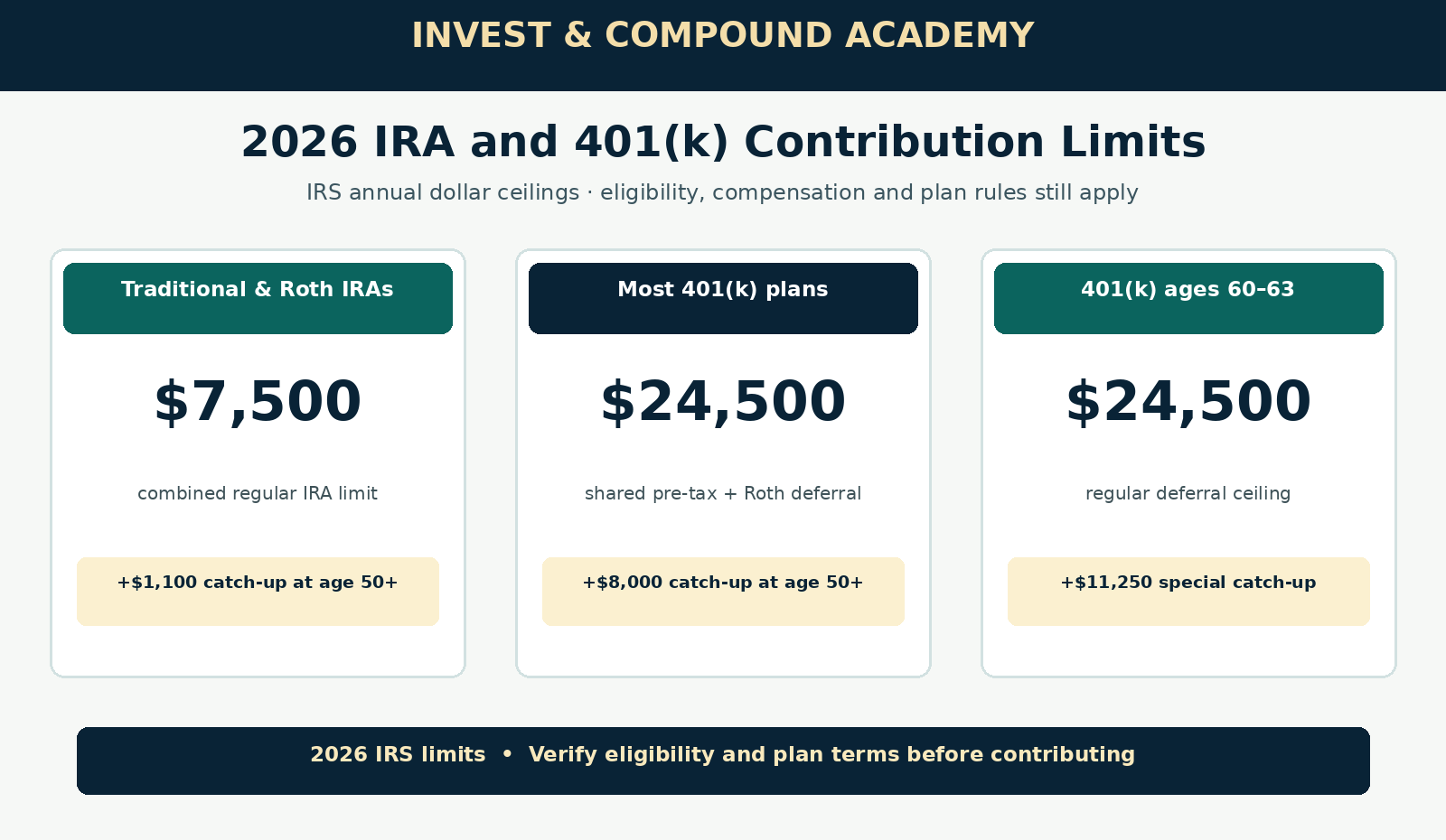
Annual limits are maximums under defined conditions, not universal entitlements. Eligible compensation, age, plan participation, filing status, and income tests can affect what you may contribute or deduct. Traditional and Roth IRA contributions share an applicable combined limit; they are not two independent allowances.
Workplace plan deferral limits and IRA limits also belong to different rule sets. The employer match is not simply another employee deferral. Higher catch-up provisions have specified eligibility conditions.
Use current-year IRS guidance and the plan’s terms for the exact situation.
Keep a record when contributions occur at several institutions or after changing jobs. One provider may not know the amounts contributed elsewhere. A mistaken assumption can produce an excess that requires correction. Checking the combined totals before year-end is more useful than relying on the size of each individual account.
Keep some flexibility
Nobody knows what tax rates will be in 20 years. Holding both pre-tax and Roth money gives you more control over how much taxable income you report in retirement, which is why many savers use a mix. Think of it as a planning habit, not a prediction.
Read the plan documents
The summary plan description spells out the match formula, the vesting schedule, loan rules and withdrawal options. Ask your plan administrator for a copy and read it before you change your contributions or move any money.
Common mistakes
- Missing the employer match.
- Choosing Traditional or Roth purely on habit.
- Cashing out a 401(k) when changing jobs.
- Holding cash inside the account instead of investing it.
- Exceeding contribution limits.
- Ignoring fees in the plan’s menu.
Frequently asked questions
Can I have both a 401(k) and an IRA? Yes. They have separate limits, though the IRA deduction may be reduced if you have a workplace plan and high income.
Which is better, Roth or Traditional? Neither always. It depends on your tax rate now versus later.
When can I withdraw without penalty? Generally after age 59½, with exceptions.
Key takeaways
- 401(k)s offer high limits and employer matches; IRAs offer more investment choice.
- Traditional accounts give a tax break now; Roth accounts give tax-free withdrawals later.
- Capture the employer match first.
- Blending Roth and pre-tax money provides flexibility.
- Limits and rules change; verify each year.
INTERACTIVE LEARNING LAB
Roth vs Traditional: equal pre-tax resources
Compare the same savings decision under two different tax timings.
Roth-style contribution
Taxes are paid before contribution, so the amount invested is lower than the gross pre-tax resources. Qualified withdrawals can be tax-free if IRS requirements are met.
Traditional-style contribution
A deductible contribution may allow more pretax dollars to enter the account, but future distributions are generally taxable as ordinary income.
Decision rule
If the current and future marginal tax rates were identical and the same pre-tax amount were committed, the mathematical difference narrows considerably. Real decisions also depend on limits, eligibility, matching, withdrawal rules, and estate planning.
Educational illustration only. Verify current IRS rules and contribution limits.
Educational disclaimer: This article provides general educational information, not personalized investment, tax, or legal advice. Investing involves risk, including loss of principal. Account limits and tax rules may change.
Educational content, not personalized investment or tax advice. Investments can lose value. The calculator is a simplified cost worksheet and does not recommend a transaction.