Portfolio Rebalancing: Practical Methods and Worked Examples
Learn when to rebalance, how to calculate trades, how new contributions can help, and why taxes and transaction costs matter.
Portfolio rebalancing is the process of adjusting an investment portfolio toward its chosen target allocation. Markets move, stocks and bonds earn different returns, and yesterday’s 60/40 mix can quietly become 65/35 or 70/30. A written rebalancing policy keeps that change deliberate rather than accidental.
Rebalancing is not a forecast, a promise of higher returns, or an instruction to sell every investment that rises. It is a way to maintain a level of risk that still fits your objectives, time horizon, and ability to absorb losses. This guide uses transparent arithmetic and two interactive calculators to show how the process works.

What portfolio rebalancing actually means
Imagine an investor who selects 60% diversified equities and 40% high-quality bonds. That target expresses a risk decision. When stock prices rise faster than bonds, the equity weight increases even if the investor never places another order. The portfolio has changed without any conscious change in strategy.
Portfolio rebalancing brings the weights back toward their intended levels. You might sell an overweight asset to buy an underweight one, direct new contributions toward the underweight asset, or redirect dividends and interest. The right approach depends on the account, taxes, costs, and the size of the deviation.
Importantly, rebalancing an asset class is different from automatically buying more of a struggling individual company. A single stock can suffer permanent business impairment. An allocation rule should not replace investment due diligence.
Portfolio rebalancing: a complete 60/40 example
Start with a $100,000 portfolio: $60,000 in stocks and $40,000 in bonds. Assume stocks return 20% and bonds return 2% over a hypothetical year, with no contributions, withdrawals, or fees.
| Asset | Starting value | After return | Current weight | Target value |
|---|---|---|---|---|
| Stocks | $60,000 | $72,000 | 63.83% | $67,680 |
| Bonds | $40,000 | $40,800 | 36.17% | $45,120 |
| Total | $100,000 | $112,800 | 100% | $112,800 |
To restore the original 60/40 mix exactly, the investor sells $4,320 of stocks and buys $4,320 of bonds, ignoring trading costs and taxes. The $4,320 figure is calculated from the target dollar allocation, not from the percentage-point difference alone.
But a review need not always result in a trade. If the investor uses a five-percentage-point tolerance band, 63.83% stocks is still inside the permitted 55%–65% range. Under that policy, no transaction is required yet. This distinction between reviewing and trading can save unnecessary costs.

Why portfolio drift matters
Portfolio drift matters because the mix of assets helps determine the portfolio’s exposure to market declines, interest-rate movements, inflation, and liquidity needs. A higher stock weight may create greater growth potential, but it can also increase losses during an equity sell-off.
For example, if a portfolio becomes 80% stocks rather than its intended 60%, a hypothetical 25% stock decline with unchanged bond values would reduce the overall portfolio by roughly 20% instead of 15%, before costs and other market effects. These simplified numbers isolate allocation exposure; real bonds can rise or fall too.
Rebalancing cannot guarantee a smaller loss in every market. Stocks and bonds can decline together, and the assets trimmed may continue to outperform. The goal is a portfolio whose risk is chosen rather than inherited from recent price movements.
Portfolio Rebalancing Rules and Considerations
Rule 1: Set a target that fits the goal
Choose the asset allocation based on investment horizon, cash needs, risk tolerance, and the role of each holding. A target is not permanent: a new retirement date, house purchase, or change in income may justify revisiting it.
Rule 2: Decide the review schedule in advance
Annual or semiannual reviews are common starting points. A scheduled review is a prompt to measure drift, not an obligation to trade. Investors with complicated holdings may review more frequently without necessarily trading more frequently.
Rule 3: Define tolerance bands precisely
A five-percentage-point band around 60% stocks means a 55%–65% range. A 5% relative band around 60% means 57%–63%. Those are different policies and can trigger very different trades.
Rule 4: Use cash flows before selling when practical
New contributions, distributions, and planned withdrawals can move the mix toward target. They may reduce realized gains and trading costs, though contributions are not always large enough to correct the drift fully.
Rule 5: Measure costs, taxes, and the result
Estimate bid–ask spreads, commissions, capital gains, and account restrictions before placing orders. Afterwards, confirm the executed trades and recompute weights. A perfect spreadsheet is not proof of a perfect execution.
Calendar vs threshold rebalancing
There are three practical ways to organize portfolio rebalancing. Calendar-based: review on set dates, such as every six or twelve months. Threshold-based: review or act when a weight crosses a prewritten boundary. Hybrid: review on a schedule and trade only when the tolerance band is breached.
Calendar reviews are easy to remember and document. Thresholds respond to meaningful drift but can require monitoring and more transactions in volatile periods. A hybrid policy often strikes a useful balance for an investor who wants a disciplined process without constant trading.
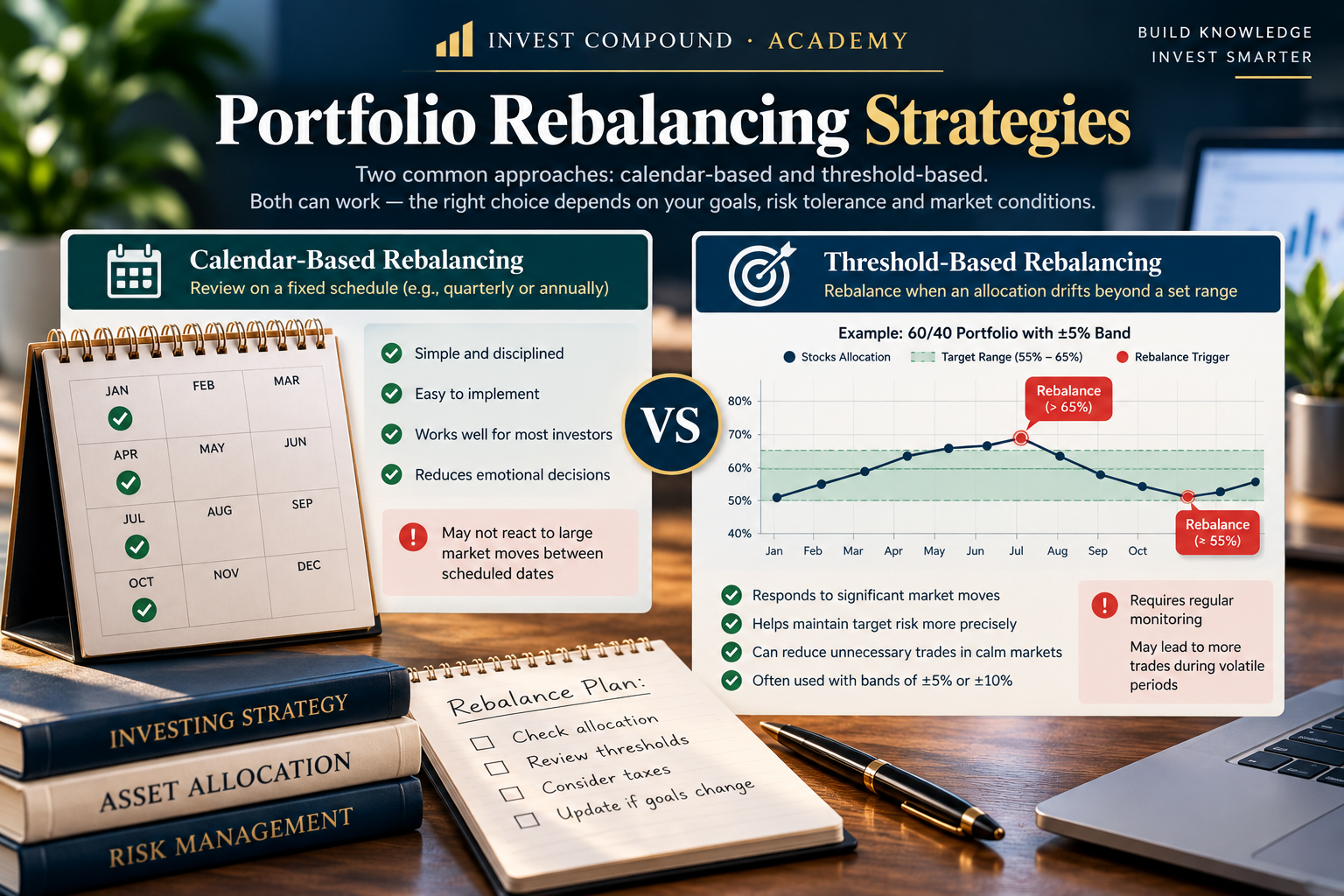
No method reliably maximizes returns. The best process is one that can be implemented consistently, at acceptable cost, with an allocation that remains appropriate.
Percentage-point vs relative bands
Percentage points measure the arithmetic difference between two portfolio weights. Relative bands measure the allowed change as a fraction of the target itself. For a 60% stock target, ±5 percentage points produces a range of 55%–65%, whereas ±5% relative produces 57%–63%.
For a 5% commodity allocation, a ±5-percentage-point band permits anything from 0% to 10%—an enormous relative change. A ±20% relative band would instead produce 4%–6%. Neither rule is universally correct; the important point is to define it unambiguously.
Rebalancing with new contributions
New money is often the least disruptive rebalancing tool. Suppose a $100,000 portfolio holds $65,000 in stocks and $35,000 in bonds, while the desired mix is 60/40. Add $10,000 entirely to bonds and the new total becomes $110,000: stocks are 59.09% and bonds are 40.91%.
The investor has moved close to target without selling any appreciated stock. That does not mean a contribution can always fix drift: if an allocation is severely overweight, the required contribution might be impractically large.
For a two-asset portfolio in which stocks are overweight, the exact contribution needed to bonds alone is current stock value ÷ target stock fraction − current portfolio value, provided the result is positive. For the $65,000/$35,000 example, that is approximately $8,333.33. Adding $10,000 slightly overshoots the exact target but may remain well within the investor’s tolerance band.
Tax-aware rebalancing in the US and Canada
Taxes can be the largest practical difference between an elegant model and a sensible trade. Selling appreciated assets in a taxable account may realize capital gains. Before rebalancing, estimate the gain using appropriate cost-basis records and the tax rules that apply to your residence and account.
In the United States, the treatment of taxable brokerage accounts differs from IRAs and employer-sponsored retirement plans. In Canada, trades inside a TFSA or RRSP generally do not trigger an immediate capital-gains tax in the same way as a non-registered account, although account rules, withdrawal treatment, and foreign withholding taxes still matter. Avoid assuming that moving money between accounts is itself tax-free.
Tax-loss harvesting can sometimes offset gains in a taxable account, but rules such as the US wash-sale rule and Canadian superficial-loss rule may restrict the recognition of losses. Review the specific rules before selling and repurchasing related securities. A tax-aware approach should not let a concentrated position grow without limit solely to avoid realizing a gain.
Use contributions, dividends, and sheltered-account transactions where suitable. If a sale is necessary, consider the size of the risk reduction against the estimated tax cost, and consult a qualified tax adviser when circumstances are complex.
Multiple accounts, ETFs and asset classes
Real portfolios rarely contain only one stock fund and one bond fund. You might own US stocks, Canadian stocks, international stocks, investment-grade bonds, cash, and perhaps a modest allocation to other assets. Each category can have its own target and tolerance rule.
Measure exposure across accounts when the goal is household-level allocation. A US equity ETF in a TFSA and another US equity ETF in an RRSP both contribute to overall equity exposure, even though their tax treatment differs. Be mindful that pretax and after-tax balances are not necessarily economically identical.
All-in-one asset-allocation ETFs and target-date funds often perform internal rebalancing. That can simplify administration, but it does not remove the need to review whether the fund’s allocation still suits the investor. Check holdings overlap before assuming several ETFs provide additional diversification.
For more background, read our Asset Allocation Explained and ETF Portfolio Guide. Verify those internal destinations in WordPress before publishing.
Rebalancing during retirement and withdrawals
Retirees face a different cash-flow problem: money is leaving the portfolio rather than entering it. Planned withdrawals can be taken from an overweight asset, accomplishing part of the rebalance without an extra round of trades. If equities are overweight and spending cash is needed, an equity sale may address both needs.
But selling during a severe decline can lock in losses. A cash reserve or a bond maturity schedule may provide flexibility, depending on spending needs and portfolio structure. These measures do not eliminate sequence-of-returns risk; they help manage when sales must occur.
Always calculate the allocation after the withdrawal. Removing cash changes the total portfolio value and can raise the remaining equity percentage even if stock prices do not move.
Common portfolio rebalancing mistakes
- Trading on emotion: changing the policy after a sharp rally or decline.
- Confusing review with trading: making unnecessary transactions on every calendar date.
- Ignoring the denominator: applying a percentage-point drift to a holding’s value rather than the total portfolio.
- Overlooking taxes: creating avoidable realized gains in a taxable account.
- Rebalancing each account in isolation: missing the household’s combined exposure.
- Buying more of a failing single stock: treating a deteriorating business like a diversified asset class.
- Forgetting the goal: restoring an old target even after retirement or spending needs change.
Practical rebalancing checklist
A disciplined portfolio rebalancing review can be documented on a single page. Record the review date, target weights, actual weights, upper and lower bands, account balances, expected contributions or withdrawals, estimated tax and transaction costs, and the final action.
- Confirm that the investment objective and target allocation still fit.
- Calculate current weights using current market values.
- Compare each weight with its prewritten tolerance range.
- Check whether new cash, dividends, or withdrawals can reduce drift.
- Estimate taxes, fees, spreads, and execution constraints.
- Trade only when the policy and costs justify it.
- Record the actual ending weights and the next review date.
Sometimes the best documented decision is no trade. That can be a fully completed review, not neglect.
Frequently asked questions
How often should I rebalance my portfolio?
Many investors review every six or twelve months, or when an allocation breaches a preset band. There is no universal ideal schedule. Costs, account complexity, and portfolio drift matter more than trading frequently.
Does portfolio rebalancing increase returns?
Not reliably. It may improve or reduce returns depending on the market path. Its primary purpose is to maintain intended risk exposure.
Should I rebalance during a market crash?
Apply your prewritten rules after confirming that the target and near-term cash needs remain appropriate. A falling asset can continue to fall, so rebalancing is not a way to identify a market bottom.
Can I rebalance without selling investments?
Often, yes. Directing new contributions or distributions to underweight assets may be sufficient. Large deviations may still require sales or a longer adjustment period.
Is a 5% rebalancing band the same as five percentage points?
No. For a 60% target, a five-percentage-point band means 55%–65%; a 5% relative band means 57%–63%.
Do all-in-one ETFs need manual rebalancing?
Many rebalance internally to their stated allocation. You still need to assess whether the fund remains suitable and whether your other accounts change the overall mix.
Interactive portfolio rebalancing calculator
Enter current stock and bond values and your desired stock allocation. This portfolio rebalancing calculator estimates the current weights and the dollar trade needed to reach the target. It assumes two asset classes, no external cash flow, and no fees or taxes.
Portfolio Rebalancing Calculator
In the default example, the exact trade is $4,320 from stocks into bonds. Yet a 5-percentage-point band would not require a trade because the stock weight is below 65%. The calculator displays both facts so you can distinguish mathematical precision from a policy trigger.
Contribution-based rebalancing calculator
This contribution-based rebalancing calculator models adding fresh money to a two-asset portfolio. It first directs the contribution to the underweight asset, then calculates whether the contribution alone can reach the target. If it overshoots the exact target, the result shows a split contribution that reaches the target without selling, when feasible.
Contribution-Based Rebalancing Calculator
This simplified calculator assumes contributions are freely divisible and can be allocated to either asset. In real brokerage accounts, whole-share rules, minimum orders, spreads, and available cash may prevent an exact split.
References & Official Data Sources
The US Securities and Exchange Commission’s investor-education materials explain the connection between asset allocation, diversification, and rebalancing, including the use of sales, new purchases, and redirected contributions. FINRA also emphasizes monitoring holdings against goals and time horizons.
Educational disclosure: This material is general investment education, not individualized financial, tax, or legal advice. Valuation metrics, growth estimates, and stock prices can change materially. Do your own research and consider a qualified financial professional before making investment decisions.