Scarcity and Opportunity Cost. How to Make Sense of Economic Trade-Offs
Understand how scarce resources shape choices—and how opportunity cost reveals what is given up when households, businesses, and communities choose one path over another.
An offer can be attractive and still be the wrong use of a scarce resource. A business might earn money from a project yet earn more from another project using the same equipment. A household might afford a purchase yet value the financial flexibility it gives up more highly. A community might receive a donated building yet lack the people and operating funds needed to use it well.
Scarcity and opportunity cost describe the need to choose among competing uses of resources. Opportunity cost makes the comparison explicit by asking what the next-best feasible alternative would provide. Together, these ideas explain why a price tag, a positive cash balance or a worthy objective is not enough to establish that a decision is desirable.
This chapter develops a practical method for analyzing scarcity and opportunity cost through those trade-offs. It connects household budgets, time allocation, production possibilities, comparative advantage and bottlenecks. The detailed lessons examine each concept separately; the pillar shows how they work together in a complete decision.
Our recurring example is Northbank Workshop, a fictional shared facility that repairs furniture and offers practical classes. We also follow Maya, a fictional resident balancing paid work, training and care responsibilities. Every quantity, price and schedule is an original teaching assumption, not information about an actual organization or person. The aim is a clear framework you can adapt to real questions using appropriate evidence.
Learning objectives
After working through this chapter, you should be able to apply scarcity and opportunity cost by defining the resource that limits a decision, distinguishing feasible alternatives from attractive but unavailable ones, and identifying a next-best use without adding incompatible opportunities together. You should understand why cash payments differ from full economic costs and why sunk expenditure should be separated from consequences that a current choice can still change.
You should also be able to interpret simple budget and production constraints, explain why opportunity costs can rise, and recognize when specialization or additional capacity changes the available choices. The final skill is communication: state what is gained, what is forgone, who is affected and which assumptions could alter the conclusion.
1. Scarcity is a relationship, not a judgment about deservingness
Northbank has a room, several tools and willing volunteers. It still cannot run every proposed activity at once. The same room cannot simultaneously host two incompatible uses; a skilled instructor cannot supervise two tasks requiring full attention at the same moment. Scarcity exists because the available resources have competing uses — the first half of the scarcity and opportunity cost pair.
That description does not imply that every shortage of access is natural, permanent or acceptable. Poor organization, unequal purchasing power and institutional barriers can restrict choices unnecessarily. A facility might appear full because scheduling is inefficient, while another has space but lacks trained staff. Diagnosis should identify the actual constraint rather than invoke scarcity as a reason to stop asking questions.
It is also important to distinguish scarcity from poverty. A person with limited resources for basic needs faces deprivation of a different kind from a wealthy person choosing between luxuries. Both face trade-offs, but the shared analytical vocabulary does not make the consequences equivalent. Economic explanation should remain attentive to urgency, distribution and feasible options.
The practical starting point is therefore specific: which resource, over which period, is insufficient for which set of uses? That question can reveal whether more money, better coordination, new equipment or a different institutional arrangement would actually help. A general statement that resources are limited is true but too broad to guide an operational decision by itself.

2. Define the decision before measuring its cost
Northbank receives a proposal to make shelving during the coming weekend. The question could be whether to accept the order, whether to buy additional machinery, whether to hire staff or whether to replace a teaching session. Those are different decisions, even though they concern the same project.
For an accept-or-decline decision using existing equipment, the analysis focuses on consequences that differ between accepting and declining. For a permanent expansion, it must consider purchase costs, financing, future demand and other opportunities. Mixing the two can produce an answer that is numerically detailed but irrelevant to the actual choice.
Write the alternatives in complete form. Accept the order and postpone the class differs from accept the order and hire another instructor. Decline the order and leave the facility unused differs from decline and complete a repair contract. The economic cost depends on what the resource would otherwise do, not on an undefined alternative called doing nothing.
A well-framed decision also names the objective. Northbank may care about financial sustainability, access to learning and preservation of useful furniture. A monetary comparison can clarify part of the choice without capturing every objective. Keeping the purpose visible prevents an easy-to-calculate figure from quietly becoming the only criterion that matters.
3. The alternative must be feasible
Suppose Northbank could theoretically earn $2,000 from a specialist restoration. If no qualified restorer is available during the weekend, that project is not a feasible alternative under the stated conditions. Using its imagined value as the opportunity cost would exaggerate what the shelving order actually displaces — a common error in scarcity and opportunity cost reasoning.
Feasibility includes timing, legal permissions, skills, equipment, access and commitments. Maya may see a higher-paid job advertised, but it is not an immediate substitute for her current work if the schedule is incompatible with unavoidable care responsibilities. The possibility might become feasible after additional support, which would change the decision and introduce its own costs.
Do not confuse feasible with easy or preferred. An alternative can be inconvenient yet available. Conversely, something desirable can remain unavailable despite appearing in an online comparison. Good analysis records the reason an option is excluded so readers can assess whether the constraint is genuine or could be relaxed.
This makes opportunity-cost reasoning practical rather than speculative. The comparison concerns the best alternative the decision maker could actually pursue over the relevant horizon. A future possibility may deserve consideration as an option, but it should not be treated as certain current earnings without acknowledging the steps and uncertainty involved.

4. Opportunity cost uses the next-best alternative
Assume Northbank has one available machine slot. Option A produces a $700 net contribution after project-specific cash costs. Option B produces $550, and option C produces $300. If only one can be chosen and these are the complete relevant monetary consequences, choosing A forgoes B, the best alternative.
The opportunity cost is not $850 from adding B and C. Those projects cannot both occupy the same slot under the assumptions. Adding incompatible alternatives would count more opportunity than the resource actually provides. The gain from A relative to the next-best alternative is $150 in this simplified comparison.
A different answer may arise if B and C can be combined within the available slot. Then the combined package, including any interactions and extra costs, is a candidate alternative. The correct comparison depends on the feasible set. It is not determined by a rule that alternatives must always be considered individually.
Introductory economics describes opportunity cost as the value of the next-best forgone alternative. [1] The important practical work lies in defining that alternative consistently. It should include relevant benefits and costs, avoid double counting and use a comparable period. A neat formula cannot rescue a poorly specified comparison — which is why scarcity and opportunity cost analysis rewards careful definition.
5. Compare net alternatives without counting the same sacrifice twice
Suppose accepting the shelving order brings $1,200 in receipts and $500 in additional materials and paid help. Its project contribution is $700. The best alternative repair project brings $900 and requires $350 in project-specific cash costs, giving $550. Comparing $700 with $550 yields the same $150 difference as comparing all incremental receipts and costs directly — a core discipline in scarcity and opportunity cost calculations.
Do not subtract the alternative’s $900 receipts without recognizing the $350 costs avoided by not doing that project. That would treat gross receipts as net value. Nor should you subtract the $550 alternative contribution and then subtract its already-included material costs again. Economic cost requires complete but nonduplicated accounting.
The treatment of shared resources also needs care. If the facility pays a fixed lease regardless of which project occurs, assigning a share of that lease to each project may serve accounting purposes without changing the accept-or-decline difference. If accepting requires an additional rental period, that new payment becomes relevant.
A useful method is to construct a full outcome statement for each alternative, then compare the difference. This is often safer than assembling one long list of costs under only the favored option. It makes omissions, inconsistent boundaries and repeated entries easier to see.
6. Explicit payments and implicit costs both matter
An explicit cost involves a payment, such as buying timber or hiring a technician. An implicit cost involves an owned resource whose best alternative use is forgone, such as using a room that could be rented or committing the owner’s time to one task instead of another.
Northbank might own its equipment outright. That does not make using it economically free. There can be maintenance, wear and an alternative use. Equally, ownership does not justify inventing a rental value if no rental opportunity exists and no relevant wear or alternative is displaced. The implicit cost must reflect a credible counterfactual.
Maya may use her own funds to buy course materials. The expenditure is explicit, while the time required to attend may have an implicit opportunity cost. Whether that time displaces paid work, care, rest or another activity depends on her circumstances. An hourly wage is not automatically the value of every hour she gives up.
The purpose is to measure sacrifices consistently, not to attach arbitrary monetary values to every meaningful activity. Some consequences are best described in their natural units or through explicit qualitative criteria. A complete scarcity and opportunity cost decision can combine monetary calculations with a transparent account of nonmonetary objectives and constraints.
7. Time is scarce, but its opportunity cost is contextual
Maya has six hours available on Saturday. She can accept a paid assignment yielding $150 after relevant travel expenses or attend a practical course. If the assignment is genuinely available and incompatible with the course, the forgone $150 is relevant to attending. If no paid assignment is available, her usual wage does not create one.
Time can also displace rest, household work or a valued personal activity. These uses have value even when no market payment occurs. A responsible explanation should not imply that unpaid time is worthless or that everyone should monetize every moment. The comparison is about what the person actually gives up.
Scheduling introduces indivisibilities. An activity requiring three uninterrupted hours may not fit into six scattered half-hour gaps. Two options may overlap during one crucial period despite leaving other time unused. Counting total hours without examining their timing can create an opportunity set that is impossible in practice.
This is why a time-allocation exercise needs a schedule as well as a total. Identify fixed commitments, recovery needs, travel and the flexibility of each activity. The best feasible alternative may be a combination of uses rather than one task, and its value may not be captured by a single wage rate — a key nuance in scarcity and opportunity cost reasoning.
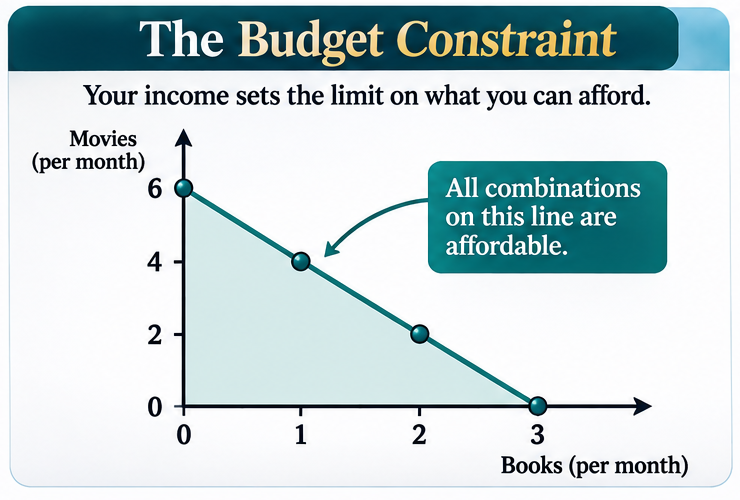
8. A budget constraint separates affordability from preference
Suppose Maya allocates a $240 discretionary monthly budget between transport trips priced at $4 and course sessions priced at $20. If T denotes trips and C denotes sessions, the simplified constraint is 4T plus 20C less than or equal to 240. The boundary uses the entire budget.
At the extremes she could buy 60 trips or 12 sessions, assuming those quantities are available and no other constraints apply. One additional course session requires giving up five trips along the boundary. That is the monetary trade-off at the assumed prices, not a statement that five trips and one session provide equal satisfaction.
The feasible set tells us what she can purchase under the model. Preferences and circumstances determine which feasible combination she chooses. A point inside the budget boundary can be reasonable if she preserves funds for another use, faces uncertainty or does not value additional units. The simplified two-good model must not silently assume away saving when saving matters.
A higher budget expands purchasing possibilities. A price change alters the trade-off. A schedule restriction can make an affordable combination infeasible. The detailed budget-constraint lesson develops these cases; here the purpose is to show how affordability, availability and preference are related but distinct parts of a scarcity and opportunity cost decision.
9. Production constraints concern resources rather than just money
Northbank has 40 skilled labor hours for a planning period. Assume a repair package requires two hours and a teaching session requires four, with no other binding constraint. If R is repairs and S is sessions, the simple resource condition is 2R plus 4S less than or equal to 40.
The facility can produce at most 20 repair packages or ten teaching sessions under these assumptions. Along the boundary, adding one session requires giving up two repair packages. That trade-off comes from production requirements rather than consumer prices. It remains relevant even when no money changes hands internally.
The model is deliberately restrictive. Real repairs differ, teaching may need preparation, and equipment or room capacity can bind separately. A valid resource plan should identify those details when material. A single labor equation is a useful introduction, not proof that every point it permits can be implemented.
Production-possibility analysis represents feasible output combinations and their trade-offs. [2] Its practical value is to make constraints visible and distinguish reallocating resources from expanding productive capacity. Deciding which mix is desirable also requires information about benefits, distribution and the organization’s objectives — the same discipline that scarcity and opportunity cost analysis demands.
10. Opportunity cost can rise as production is reallocated
The constant trade-off above assumes interchangeable labor with fixed requirements. Real resources often have different strengths. Northbank’s best instructors may initially handle teaching while experienced craftspeople continue repairs. Expanding teaching further may require moving people less suited to instruction away from repair work they perform especially well.
Imagine the first additional teaching session displaces one repair package, the next displaces two, and the third displaces three. The marginal opportunity cost rises because reallocating progressively less suitable resources becomes more costly. These are illustrative increments, not a universal measured pattern.
Rising opportunity cost does not mean every resource transformation must have the same curvature. Technology, scale and coordination can create other relationships. The important habit is to investigate whether the next unit has the same sacrifice as the previous unit. An average over a broad interval can hide a much higher marginal cost near capacity.
For decisions, compare the benefit of the particular expansion with the particular output forgone. A program justified for its first few sessions may not justify unlimited expansion at the same average cost. Conversely, an initial setup burden can make later expansion cheaper over some range. The shape should follow the mechanism, not be assumed because a textbook diagram is familiar — a recurring lesson in scarcity and opportunity cost analysis.
11. Idle resources do not eliminate every trade-off
If Northbank has unused room time, an additional activity might fit without displacing another room use. That can reduce one opportunity cost. It does not establish that the activity has no relevant cost: supervision, materials, cleaning, administration or future scheduling flexibility may still be scarce.
An apparently idle resource may also be reserved for a reason. Spare equipment can provide resilience during breakdowns. Empty appointment slots can support urgent needs. The value of flexibility should be examined rather than automatically treated as waste. At the same time, invoking resilience should not become an excuse for avoidable underuse without evidence.
The correct question is which constraint binds at the proposed scale. A small pilot might use spare capacity, while a permanent expansion requires new staff. The first unit’s cost is not necessarily the cost of the hundredth. Scaling analysis should identify when the arrangement crosses a threshold.
This perspective avoids two extremes: assuming every unused asset is free to exploit, and assuming every activity necessarily displaces an equally valuable alternative. Opportunity cost can be low when a resource genuinely has little alternative value. It should be established through the feasible comparison, not imposed as a slogan — the discipline that separates real scarcity and opportunity cost analysis from hand-waving.
12. Bottlenecks explain why more resources sometimes achieve little
Suppose the workshop has plenty of room and basic labor but only one qualified supervisor for a task requiring certification. Donating additional tables may not increase output while supervision remains the binding constraint. The new tables could still be useful later, but they do not solve the immediate problem.
A bottleneck is a constraint that limits the relevant outcome under the current arrangement. Its identity can change after expansion. Adding a supervisor may make tools or room time the next limit. A useful analysis therefore traces the sequence rather than treating one input as permanently decisive.
The value of relaxing a constraint depends on what the extra capacity enables. If one additional supervisory hour permits a project with net benefits exceeding its cost, it may be valuable. If demand is absent or another constraint blocks output, the same hour may add little in the immediate comparison.
Later optimization lessons introduce shadow prices formally. At this stage, understand the intuition: a resource’s decision value depends on the best feasible use it unlocks, within a particular range and set of assumptions. That value is not automatically its market price or a permanent property of the resource itself — a foundation of scarcity and opportunity cost thinking.
13. Comparative advantage concerns relative sacrifice
Two volunteers can differ in both repair and teaching ability. Suppose Alex can complete four repair packages or two teaching sessions in a day, while Bea can complete three repair packages or one session. Alex has an absolute productivity advantage in both activities under these assumptions.
Alex forgoes two repairs for one session. Bea forgoes three repairs for one session. Alex therefore has the lower opportunity cost of teaching, while Bea has the lower repair cost measured in sessions forgone: one-third of a session per repair rather than one-half. This is the basic logic of comparative advantage.
It can be useful for allocating tasks even when one person is faster at everything. The relevant comparison is relative sacrifice, not only absolute speed. The detailed lesson examines feasible output combinations and the conditions under which specialization and exchange can help.
Do not overextend the example. Training, fatigue, preferences, coordination and the value of maintaining skills can affect real task allocation. Complete specialization is not automatically desirable. The calculation identifies a production trade-off under specified assumptions; a complete scarcity and opportunity cost decision includes the other consequences and practical constraints that matter.
14. Scarcity differs from a market shortage
Scarcity concerns competing uses of resources. A shortage, in a simplified market description, occurs when quantity demanded exceeds quantity supplied at the prevailing price. A market can clear at a price while the underlying resources remain scarce because they still have alternative uses.
Northbank can have a waiting list for a free class even when unused tools exist. The relevant shortage may concern supervised places at a zero fee under the current schedule. Raising the fee could reduce the waiting list without creating more trained instructors or resolving unequal access. The mechanism and the objective must be separated.
Conversely, a temporarily empty shelf can reflect delivery timing rather than a fundamental inability to produce the item. A useful diagnosis asks which quantity, price, location and period are being discussed. Labels such as scarcity or shortage should make the problem more precise rather than replace the investigation.
This distinction matters for policy. More funding, a different allocation rule, improved logistics or expanded production address different constraints. A response can reduce visible queues while shifting burdens to prices, travel or eligibility requirements. Evaluate the complete result, including who obtains access and what resources are actually added — the same question that scarcity and opportunity cost analysis asks at every scale.
15. A zero price does not imply zero economic cost
A donated machine can require transport, installation, training, maintenance and space. Even if these payments are modest, using the machine can displace another activity. The absence of a purchase price is only one feature of the decision.
A free event can require a long journey or a queue. Participants may value attendance enough to accept those costs, but the event is not resource-free. The organizer also uses time and materials. A complete account distinguishes the payment arrangement from the resources consumed and opportunities forgone.
This does not mean free access is misguided. Removing a fee can improve inclusion or serve a public objective. It means the financing and allocation mechanism should be explicit. Someone provides the resources, and a zero-price service can still face limited capacity that must be allocated by another rule.
The practical test is to ask what would change if the offer were accepted rather than declined. List new commitments and displaced alternatives. Then compare benefits using the relevant objectives. This method avoids both being dazzled by a free label and dismissing a useful donation simply because it has some operating cost — the complete scarcity and opportunity cost framing.
16. Sunk expenditure should not be charged to the current choice again
Suppose Northbank paid a nonrefundable $300 application fee for a project that now appears less attractive. The fee is already incurred and cannot be recovered under either current alternative. It does not change the difference between continuing and stopping from this point forward.
Future consequences still matter. Continuing might require $500 more and generate $650 in benefits, while stopping could free a machine slot worth $250. Comparing only the future receipts and payments would miss the alternative use; comparing them and then adding the sunk fee again would count an irrelevant past sacrifice against one side.
A payment is not sunk merely because it occurred earlier. A refundable deposit, an asset with resale value or a contract with avoidable future obligations can differ across alternatives. The relevant test is recoverability and how the current decision changes the outcome, not the calendar alone.
The detailed sunk-cost lesson separates this economic rule from the psychological difficulty of abandoning a past commitment. Here, the link to opportunity cost is central: evaluate the best feasible use of resources still under your control. The past matters through information, obligations and remaining options, not through a requirement to repeat an earlier choice — a core rule in scarcity and opportunity cost reasoning.
17. Uncertainty changes the comparison without removing the principle
Northbank may not know whether a repair contract will arrive. Treating it as a certain alternative overstates its value, while ignoring it entirely may understate the value of keeping capacity available. The comparison should represent uncertainty explicitly.
A scenario can show what happens if the contract arrives and if it does not. Expected-value calculations require justified probabilities and a consistent treatment of benefits and costs. A midpoint between optimistic and pessimistic scenarios is not automatically an expectation. Different risk tolerances or financing constraints can also affect which option is suitable.
Preserving flexibility can have value when committing now prevents responding to later information. That does not imply delay is always best; waiting can lose current benefits or allow an opportunity to expire. The decision is between complete strategies, including timing and the information available at each stage.
At an introductory level, state which alternatives are certain, conditional or speculative. Avoid hiding uncertainty inside a precise monetary opportunity cost. A transparent range with clear assumptions can be more useful than one unsupported number that implies knowledge the decision maker does not have — a practical habit in scarcity and opportunity cost analysis.
18. Short-run and long-run opportunity costs can differ
For one weekend, Northbank’s floor space may be fixed. Over several years, it could renovate, rent another building or redesign activities. A resource constraint that binds tomorrow may be relaxed through investment, although the expansion itself has costs and risks.
Maya’s immediate work options may be limited by qualifications. Training could expand those options later. Comparing a course with current earnings alone might miss its future effects, while assuming a guaranteed salary increase would overstate them. The appropriate horizon depends on the decision and the evidence.
Keep the comparison internally consistent. Do not count several years of one option’s benefits while including only one month’s costs for the alternative. Match time periods, consider relevant residual values and identify future commitments. More advanced present-value methods help compare timing, but the basic requirement is conceptual consistency.
This is another reason not to treat opportunity cost as a permanent label attached to an activity. It depends on available alternatives, technology, institutions and time. A decision can be sensible under today’s constraints and become less attractive after circumstances change. Revision in response to better options is part of good scarcity and opportunity cost reasoning.
19. Distribution and rights remain relevant
A project can have a larger net monetary contribution while making access worse for the community Northbank exists to serve. The financial comparison is useful for sustainability, but it does not determine the organization’s complete objective. Identify who benefits and who loses.
Some constraints also reflect legal duties or ethical commitments rather than resources available for unrestricted trade. A required accessibility standard should not be treated as optional merely because avoiding it would increase receipts. A real evaluation must use current applicable rules and an explicit normative framework.
Opportunity cost still informs the discussion. Meeting a legitimate obligation can use resources that could serve other purposes, and choosing an efficient compliant design can preserve more resources for other goals. Recognizing a cost does not imply that the obligation should be abandoned.
This balanced approach connects the chapter with Efficiency vs Equity. Economics can clarify sacrifices and expose avoidable waste while leaving value judgments visible. A professional explanation should not disguise a distributional preference as an unavoidable consequence of arithmetic, nor ignore resource limits because an objective is morally important — the balanced view of scarcity and opportunity cost analysis.
20. Expansion can change the feasible set
Better tools, training, infrastructure and coordination can allow Northbank to accomplish more with the same initial resources or obtain additional useful resources. Growth can relax a trade-off rather than merely select a different point on an unchanged boundary.
The expansion is not free. A new machine requires funds, space, learning and maintenance. A scheduling improvement requires information and administration. Evaluate the investment against its own next-best alternative and include implementation risk. A genuine productivity improvement can be valuable even when its costs are substantial, provided benefits justify them under the chosen criteria.
Distinguish movement toward an existing frontier from a shift of the frontier. Reducing avoidable downtime can use current capacity better. Introducing a new method can change maximum output. The empirical distinction may be difficult, but stating the mechanism makes the claim testable.
This perspective prevents scarcity from becoming fatalism. Constraints can change through purposeful action. The role of opportunity-cost analysis is to help choose among those actions and avoid assuming that every expansion creates more value than the resources it uses. Better possibilities are an achievement to evaluate, not a reason to stop comparing alternatives — the forward-looking side of scarcity and opportunity cost.
21. Build a decision statement that another reader can check
Begin with the decision maker, objective and period. List feasible strategies, including a credible baseline. Describe which resources each uses and what each produces. Separate payments, owned-resource opportunities, sunk items and uncertain outcomes. Use comparable units and avoid counting the same sacrifice twice.
Then identify the next-best alternative under the stated criteria. If benefits are multidimensional, show the dimensions rather than forcing an unexplained monetary score. If the recommendation depends on a value judgment, state it. If the alternative depends on uncertain availability, disclose that condition.
Present the result as a comparison. For the simplified machine-slot case, A contributes $700 and B $550 after their own project costs, so A improves the monetary outcome by $150. The statement is narrow but clear. It does not claim that A is automatically best for every community objective or that the inputs are empirical facts.
Finally, explain which evidence could change the decision. A new contract, higher material cost, unavailable staff or a different schedule can alter the feasible set. Good analysis is reproducible and revisable. Its strength comes from a transparent method, not from pretending that circumstances will never change — the reproducible standard that scarcity and opportunity cost analysis aims for.
22. Worked case: a weekend workshop decision
Northbank has 12 available supervisory hours. A repair contract requires all 12 and generates $960 in receipts with $300 in additional materials and transport costs. Its simplified contribution is $660. A teaching program also requires 12 hours and generates $800 in fees with $220 in project costs, giving $580.
If these are the only feasible options and the objective is the stated monetary contribution, repairs lead by $80. The opportunity cost of choosing repairs is the $580 teaching contribution, not the $800 gross fees. Existing expenses unchanged by either choice do not alter this difference, although they matter for the facility’s overall sustainability.
Now suppose teaching also serves a documented access objective valued by the organization, while repairs support customers who have alternatives. The $80 difference quantifies part of the trade-off. It does not assign a complete value to teaching. Decision makers can choose teaching while acknowledging the monetary sacrifice and explaining the additional objective.
Alternatively, an extra supervisor might allow both activities. Compare the cost and operational feasibility of that expanded strategy. If hiring costs $250 and no other constraints change, the combined project contribution before that hire is $1,240 and after it $990, exceeding either single option. The new comparison changes the feasible set; it does not contradict the original calculation for a single supervisor — a live example of scarcity and opportunity cost reasoning in practice.
23. Worked case: Maya’s course choice
Maya can attend a course costing $180 and requiring six hours. During those same hours, a genuine available assignment would yield $120 after its own relevant expenses. Attending therefore has a simplified economic sacrifice of $300 before other consequences: the fee plus the net earnings forgone.
If the course uses hours that would otherwise be unpaid rest, the $120 work alternative is not the relevant comparison. Rest still has value, but the analysis must represent the actual alternative. Using a wage merely because Maya has earned it at other times creates an option that may not exist during the course schedule.
Suppose she already paid a nonrefundable $40 registration charge, included within the $180 total fee. From the current point, the remaining payment is $140. If the $40 cannot be recovered under either choice, the current decision compares $140 plus relevant remaining sacrifices with future benefits. The total historical cost and the forward-looking choice answer different questions.
The course’s benefits may include skills, enjoyment and future opportunities. Some can be described or estimated; others remain uncertain. A responsible conclusion states the trade-off and assumptions rather than promising a financial return. The method helps Maya understand the choice without dictating that paid work must always outrank learning or personal time — the role of scarcity and opportunity cost analysis in a personal decision.
24. Practice questions with explanations
Why is the largest rejected gross receipt not necessarily the opportunity cost? Because the alternative may require costs avoided when it is not selected. Compare net consequences under consistent boundaries. A $1,000 alternative with $800 of additional costs differs from a $600 alternative with only $100 of costs.
Why can an owned room have an opportunity cost? Because using it may displace a feasible rental, class or other valuable activity. Ownership removes a purchase payment, not competing uses. If no valuable use is actually displaced, the opportunity cost can be low; do not invent one without a credible alternative.
Why does more money not always solve the immediate problem? Because a different resource, such as qualified supervision, may bind. Funds can sometimes obtain that resource, but availability and timing matter. Identify the mechanism connecting additional funding to useful capacity rather than assuming the connection is instantaneous.
Why can the preferred option change after a new opportunity appears? Because opportunity cost depends on the feasible set. The same project can be attractive when its alternative is idle capacity and unattractive when it displaces a valuable contract. Reassessing the decision is a response to changed conditions, not proof the original analysis was irrational — the recursive nature of scarcity and opportunity cost reasoning.
25. Check whether a comparison survives a change in assumptions
The repair project leads teaching by $80 in the weekend example — a margin close enough to make scarcity and opportunity cost sensitivity worth checking. If its material estimate is uncertain by more than that difference, the apparent ranking may be fragile. A sensitivity analysis can identify the cost increase, revenue reduction or alternative benefit that would reverse the narrow monetary result.
For example, an additional $100 of repair-specific transport cost reduces its contribution from $660 to $560, below teaching’s $580. That does not prove the original estimate was wrong. It shows which information is decision-relevant. Confirming transport cost may be worth more than refining an unrelated shared expense that cancels from the comparison.
Use plausible ranges supported by evidence when applying this method. Do not assign probabilities merely because a tool offers several scenarios. Report whether a recommendation is robust or sensitive, and identify the assumption responsible. Scarcity and opportunity cost analysis becomes more useful when it directs attention toward the uncertainties that can actually change the choice.
Continue Learning in the Invest & Compound Academy
Explore the supporting topics in this chapter to examine each scarcity and opportunity cost concept in greater detail.
All topics in this chapter
References & Official Data Sources
- [1] OpenStax, Principles of Economics 3e, section 2.1, “How Individuals Make Choices Based on Their Budget Constraint,” for introductory definitions of opportunity cost and the budget constraint.
- [2] OpenStax, Principles of Economics 3e, section 2.2, “The Production Possibilities Frontier and Social Choices,” for production trade-offs and the introductory comparative-advantage framework.
- Further curriculum reference: CORE Econ, The Economy — economic decision-making, opportunity cost, and production trade-offs.
- For a glossary of the terms used across this chapter, see the Invest & Compound Glossary.
Northbank Workshop, Maya, the production parameters and every numerical project comparison are original hypothetical instructional constructions. They are not reproduced empirical cases or forecasts. Sources checked October 22, 2026.
This chapter teaches general economic reasoning. It does not provide individualized financial, employment, legal or tax advice. Real decisions require relevant evidence, complete feasible alternatives and attention to applicable obligations, uncertainty and nonmonetary objectives.