What Is Economics? Understanding Choices, Resources and Society
Explore how people, businesses and governments make choices, allocate limited resources and shape the economy.
At its core, what is economics is a question about choices: how people and societies use limited resources, coordinate activity and decide how goods, services and opportunities are produced and shared. To understand what is economics in practice, it helps to examine individual decisions as well as the systems connecting households, businesses, markets, governments and institutions.

That definition reaches beyond money. A parent deciding how to divide time between paid work and care is making a choice involving economic constraints. A hospital deciding how to allocate staff faces an economic problem. A community choosing how to protect a river must consider resources, incentives, rights and consequences. Money can help coordinate these decisions, but it does not capture everything people value.
This topic explains the subject itself: what economics asks, what an economy contains, how economic explanations work and what studying economics can help you understand. Detailed techniques belong in the connected topics. Here, the aim is to build a clear foundation without assuming prior knowledge or suggesting that one discipline can answer every question about human life.
Learning objectives
After studying this topic, you should be able to define economics in your own words, identify several different economic questions, distinguish the economy from financial markets, and explain the roles of resources, production, distribution and institutions. You should also be able to recognize that an observed outcome can reflect constraints as well as preferences.
No previous economics course is required. The examples use simple arithmetic and fictional situations. They illustrate reasoning rather than report actual economic conditions. When you encounter a new concept, ask what practical question it helps answer. That habit will make later topics on markets, inflation, employment and public policy easier to follow.
1. What Is Economics? Why Choices Matter
Imagine a neighborhood community center with one available room during the evening. A language class, a youth program and a small-business workshop all want to use it at the same time. Each activity may be worthwhile. The challenge is that the same room cannot accommodate all three simultaneously under the existing arrangement.
An economic question concerns how to use that room, whether additional capacity is worth creating, and how the choice affects different groups. The center might rotate activities, change schedules, charge a fee or seek another location. Each option changes access, costs and opportunities. Deciding among them requires more than declaring that every activity has benefits.
This simple example captures a central issue: desirable activities can compete for resources. Understanding what is economics means examining how those competing needs are managed and how different arrangements affect the people involved. Economics helps describe that competition and evaluate possible arrangements. It does not mean every decision must be made through a market or expressed in money. A community can choose voting, administrative rules or shared scheduling, while economic analysis investigates the consequences of each approach.
2. Scarcity is broader than poverty
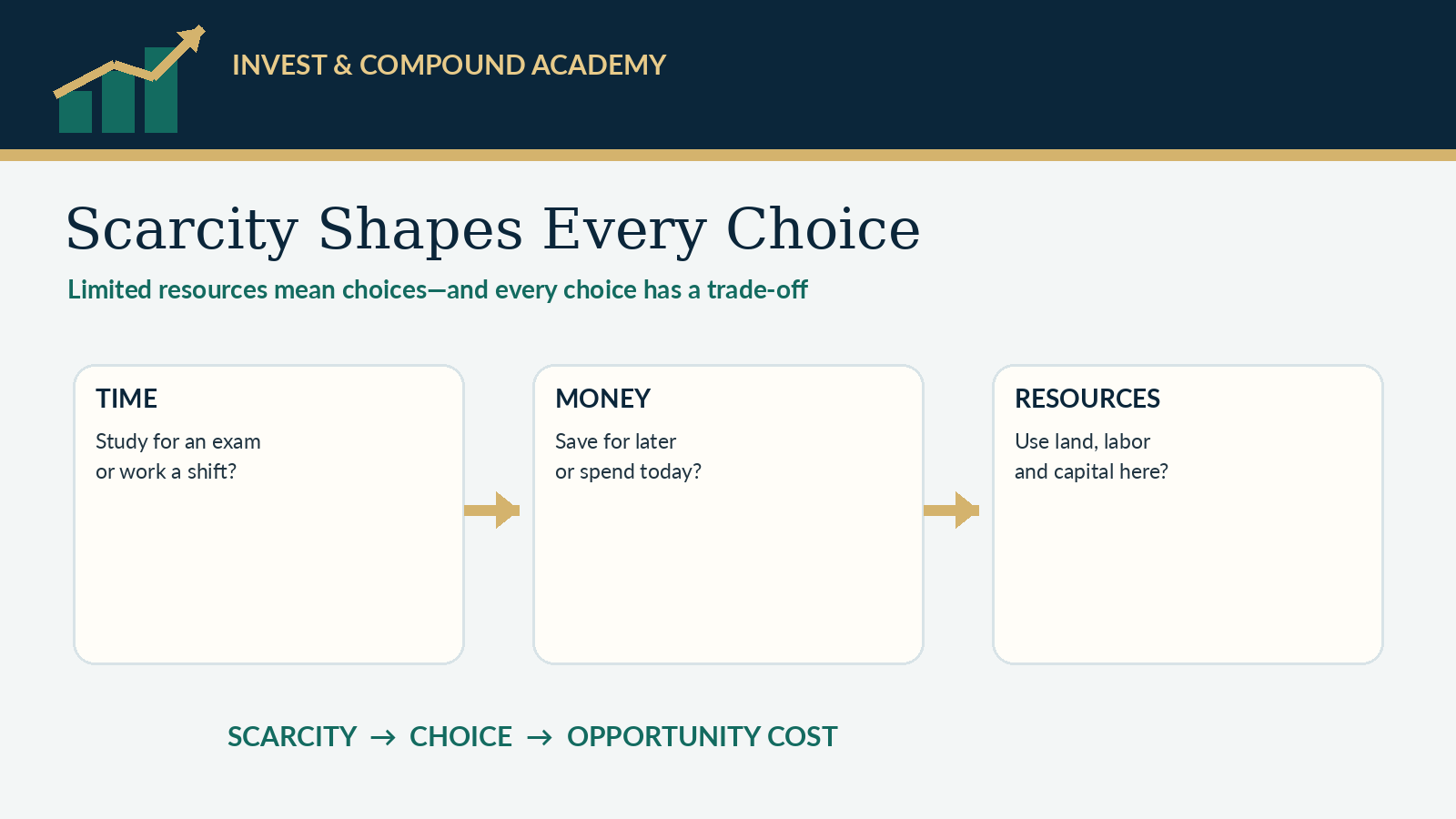
Scarcity means resources are limited relative to their possible uses. A wealthy individual still has limited time and attention. A high-income country still faces choices about land, skilled workers, energy and environmental capacity. More resources can ease important constraints without eliminating every trade-off. This is one reason introductory economics treats scarcity as a general problem. [1]
Poverty concerns inadequate resources or opportunities relative to a specified standard of living. It is not interchangeable with scarcity. A household unable to afford nutritious food faces a much more urgent deprivation than a wealthy household choosing between holidays. Both involve constraints, but describing them with the same analytical vocabulary does not make their circumstances morally or practically equivalent.
The distinction matters because policies address different problems. Understanding what is economics also means recognizing that scarcity and poverty are different concepts requiring different responses. Food assistance may reduce deprivation. Better agricultural technology may expand production. Improved transport may connect existing supplies with underserved communities. An economist should identify the actual constraint rather than assume that a general statement about limited resources explains the specific cause of hardship.
3. What resources enter economic activity?
Resources include human effort and skills, natural inputs, productive equipment, buildings and organizational knowledge. A bakery uses workers, flour, ovens, electricity, premises and routines that coordinate tasks. A software business uses programmers, computing equipment, electricity and knowledge. A care service depends heavily on trained people, time and relationships.
Economists often group productive inputs into labor, capital and natural resources, with technology and institutions influencing how effectively those inputs are used. Physical capital means produced assets used in production, such as machinery. It should not be confused automatically with money. Financial resources can help purchase equipment, but the money and the equipment are different objects of analysis.
Economics examines how these resources are combined, developed and allocated. This is an important part of understanding what is economics: productive capacity depends not only on the resources available, but also on the knowledge, skills and institutions that influence how effectively they are used. Human capital refers to productive knowledge and skills embodied in people. The term can help explain training and productivity, but a person’s value is not exhausted by their economic contribution.
4. Production creates goods and services
Production combines inputs to provide goods and services. A good is often a tangible item, such as bread or a bicycle. A service includes activities such as teaching, transport, repairs or medical care. Many products combine both: buying equipment may include installation, software updates or maintenance.
Production is not limited to factories. A household preparing meals produces something useful, even when no money changes hands. Volunteers maintaining a community garden create value. Standard market transactions capture only part of productive activity. Later national-accounting topics explain which activities particular statistical measures include and why those boundaries matter.
A useful production question asks what can be generated from available inputs and how that changes with technology, skills or organization. If a bakery reduces spoiled ingredients through better planning, it can provide more usable output with the same resources. If workers are pushed beyond safe limits, a short-run output increase may conceal costs through exhaustion, errors or future turnover.
5. Distribution asks who receives what
An economy must organize not only production but also access to its results. Wages, profits, interest, rents, taxes, public services, transfers and household arrangements influence how income and consumption opportunities are distributed. Distribution can change even when total output remains constant.
Suppose a business becomes more productive and generates additional revenue after relevant expenses. Owners might receive higher profits, workers might negotiate higher pay, customers might benefit from lower prices, or funds might support expansion. What happens depends on competition, contracts, bargaining and business decisions. Productivity gains do not mechanically flow to one group in a fixed proportion.
Understanding what is economics also involves asking how the results of production are distributed. Economic analysis can investigate these mechanisms and estimate who gains or loses from a change. Judging whether a distribution is fair also requires explicit ethical and social criteria. A responsible explanation distinguishes its empirical findings from its value judgments. Identifying that distinction does not reduce the importance of fairness; it makes the discussion more transparent.
6. Exchange connects specialized activities
Most people consume many things they do not produce themselves. A nurse does not need to grow every ingredient in dinner, manufacture a phone and maintain the water system personally. Specialization allows people and organizations to concentrate on selected activities, while exchange connects their output.
The benefits depend on coordination and access. A specialized worker needs reliable ways to obtain other necessities. A business depends on suppliers, transport and payment systems. A disruption in one link can affect many others. Interdependence can increase productive possibilities while also creating vulnerabilities that require resilience, alternative suppliers or public infrastructure.
Exchange can occur through markets, but organizations also coordinate activity through employment relationships, long-term contracts and internal rules. Inside a hospital or factory, not every task is allocated through a new auction. Economics studies why different arrangements emerge and how their incentives, information needs and costs compare.
7. A market is an arrangement for interaction
A market connects buyers and sellers of a particular good, service or input. It can exist in a physical place, through an online platform or through negotiated contracts. The relevant market is defined by the economic question, including which alternatives buyers and sellers can realistically use.
A local bakery competes partly with other bread sellers, but the strength of competition depends on convenience, quality and customer preferences. A business selling specialized industrial equipment may face a geographically wider market. Simply counting businesses is not always enough to judge competitive pressure, because their products and customers may differ.
Markets depend on rules and supporting systems. Contracts, product standards, payment infrastructure and enforcement influence whether transactions are reliable. Understanding what is economics requires looking beyond prices to examine how markets actually operate and where their limitations arise. A price can help communicate relative scarcity and coordinate choices, but it does not automatically reflect every social cost or benefit.
8. The economy is larger than the stock market
The economy includes the production and distribution of goods and services, work, consumption, investment, public activity and related institutions. This broader definition is central to understanding what is economics because the subject covers far more than financial markets or the buying and selling of investments. The stock market concerns trading ownership claims in listed businesses. These domains interact, but neither is a complete measure of the other.
A rising stock index may reflect improved expected profits, lower discount rates or changing investor sentiment. It does not directly tell you whether every household is better off or whether employment increased. Many businesses are not publicly listed, and substantial economic activity occurs in households, public services and nonprofit organizations.
Conversely, economic growth does not guarantee that every listed investment will rise. Prices depend on expectations and what investors pay relative to future outcomes. Understanding the difference helps readers avoid treating financial headlines as comprehensive economic reports. The appropriate measure must match the question: household purchasing power, output, employment and asset prices are related but distinct.
9. Households occupy several economic roles
A household can be a consumer, a provider of labor, a saver, a borrower and an owner of assets. It may also provide unpaid care and produce goods or services for its own use. Describing households only as shoppers misses many important decisions and contributions.
Consider a parent choosing between additional paid hours and caring for a child. The choice depends on wages, taxes, childcare availability, work schedules and family needs. Observing fewer paid hours does not establish a lack of ambition or productive activity. It may reflect expensive childcare or responsibilities that available services do not accommodate.
Economic analysis can make those constraints visible. It can examine whether more flexible work, transport or care services would expand feasible choices. It should not assume that one observed arrangement reveals a universal preference. People respond to the opportunities available, and those opportunities are shaped by institutions as well as individual characteristics.
10. Businesses organize production under uncertainty
A business brings resources together to provide goods or services and must usually cover its obligations through revenue, financing or other support. Its decisions concern products, prices, employees, investment, suppliers and risk. Objectives may include profit, survival, growth, professional standards or a social mission.
Suppose a repair shop considers hiring another technician. More workers could increase capacity, but the owner must assess demand, training, workspace and the reliability of future revenue. The wage is not the only relevant cost, and expected sales are not guaranteed. A decision can be reasonable based on available information and still turn out badly.
Economics studies these decisions without assuming all businesses are identical. A small owner-managed firm, a cooperative and a large corporation may face different governance arrangements and financing options. Competition and contracts influence behavior, while management choices determine how those pressures translate into operations. Later chapters develop the formal tools for analyzing costs, pricing and market structure.
11. Governments shape and participate in economic activity
Governments establish and enforce rules, collect taxes, purchase goods and services, provide infrastructure and administer public programs. Their responsibilities vary across countries and levels of government. Economic analysis examines both what policies aim to achieve and how institutions affect implementation.
A road repair program uses labor, machinery and materials. Its financing affects public budgets and potentially other decisions. Its benefits might include shorter journeys, fewer vehicle repairs or safer travel. Evaluating it requires comparing those benefits with costs and alternative uses of resources, rather than assuming all public spending is either beneficial or wasteful.
Governments also face information problems, administrative limits and political incentives. Recognizing a market problem does not establish that any proposed intervention will solve it effectively. Recognizing implementation risks does not establish that inaction is best. The useful question is which feasible arrangement produces better outcomes under the relevant conditions and criteria.
12. Institutions explain the rules surrounding choices
Institutions shape expectations and interactions. Formal laws, enforcement practices, professional standards and social norms affect whether people can trust agreements and invest in future activity. The written rule and the way it is implemented may differ substantially.
Imagine two identical businesses buying equipment on credit. One operates where contracts are clear and disputes are resolved predictably. The other faces uncertain enforcement and opaque fees. Their decisions can differ even if the machinery and initial interest rate are the same. Institutional reliability affects the effective cost and risk of doing business.
This perspective helps explain why copying a policy from another country may not reproduce its results. Administrative capacity, existing rules, market structure and public trust can differ. Economics becomes more informative when it examines those mechanisms rather than treating institutional labels as explanations. Asking how a rule changes practical behavior is more useful than assuming its title determines its effect.
13. Microeconomics and macroeconomics ask related questions
Understanding what is economics also requires recognizing its two connected perspectives. Microeconomics studies particular decision makers and markets. Macroeconomics studies aggregate outcomes, including overall employment, inflation and growth. A question about a firm’s hiring response to a wage change is microeconomic; a question about nationwide unemployment is macroeconomic. The analytical distinction is introduced in the IMF’s overview of the two fields. [2]
The perspectives connect because aggregate outcomes emerge from interactions among many decision makers, while aggregate conditions influence individual choices. A household’s spending depends partly on employment prospects and borrowing costs. A firm’s revenue depends partly on demand elsewhere. These connections mean that a conclusion about one isolated decision may not hold when everyone changes behavior simultaneously.
The next topic explores this distinction in detail. For now, recognize that neither perspective is inherently more realistic or important. The right perspective depends on the question. A complete explanation often needs both, with clear attention to how individual responses and economy-wide adjustments affect each other over time.
14. Economic models organize explanations
A model is a simplified framework used to examine selected relationships. It may take the form of a verbal explanation, a diagram, an equation or a computer simulation. Simplification is unavoidable because a description containing every detail would be impossible to use. The important question is which details can be omitted responsibly. [3]
A two-product household budget model can clarify the effect of a price change. It cannot explain every emotional or social aspect of consumption. A basic market model can show how supply and demand interact under specified conditions. It may need substantial modification when sellers have market power or buyers lack important information.
Model assumptions should be visible. Readers should know whether the model holds income fixed, ignores uncertainty or assumes firms can adjust immediately. A useful conclusion states the conditions under which it follows. Learning economics therefore involves learning both models and the judgment required to choose among them, rather than searching for one framework that answers every question.
15. Economic evidence tests explanations
Data can describe patterns, challenge models and help estimate effects. Relevant evidence includes surveys, administrative records, experiments, historical records and business information. Each source has coverage limits, measurement choices and potential errors. A large dataset is not automatically suitable for every question.
Suppose a town reports higher employment after opening a business support center. The timing is interesting, but employment might also have risen because a large employer expanded. A credible evaluation needs a comparison that helps separate these possibilities. It must also define employment carefully: residents with jobs, jobs located locally and hours worked are different outcomes.
Economics uses statistical and research methods to address such problems, but no technique removes the need for good reasoning. Researchers must explain their assumptions and assess alternative interpretations. At the beginner level, asking what was measured, how the comparison was constructed and what else changed is an excellent starting point.
16. Facts and values play different roles
A statement about how a tax affects purchases is an empirical claim, even if it is difficult to estimate. A statement that a tax is fair involves a judgment about desirable treatment or outcomes. A policy recommendation commonly combines both: an expectation about consequences and a view about how those consequences should be valued.
For example, an analyst might estimate that a transport subsidy improves access to work for a particular group. Recommending the subsidy also requires considering its cost, financing, alternatives and the priority assigned to that access. Two people can agree on the estimated effect and disagree about the appropriate policy because they weigh outcomes differently.
This does not mean evidence is irrelevant to values or that every empirical claim is equally credible. It means the components should be separated. Clear writing identifies which findings could change with new data and which judgments depend on ethical or political priorities. OpenStax discusses the distinction between positive and normative statements alongside objections to simplified economic reasoning. [4]
17. A worked example: expanding a community class
A community center considers adding a weekly evening course. Assume room preparation costs $40 per session, the instructor costs $120, and materials cost $5 per participant. With a fee of $15, each participant contributes $10 toward the $160 in session costs before materials. Under these simplified assumptions, 16 participants cover those costs.
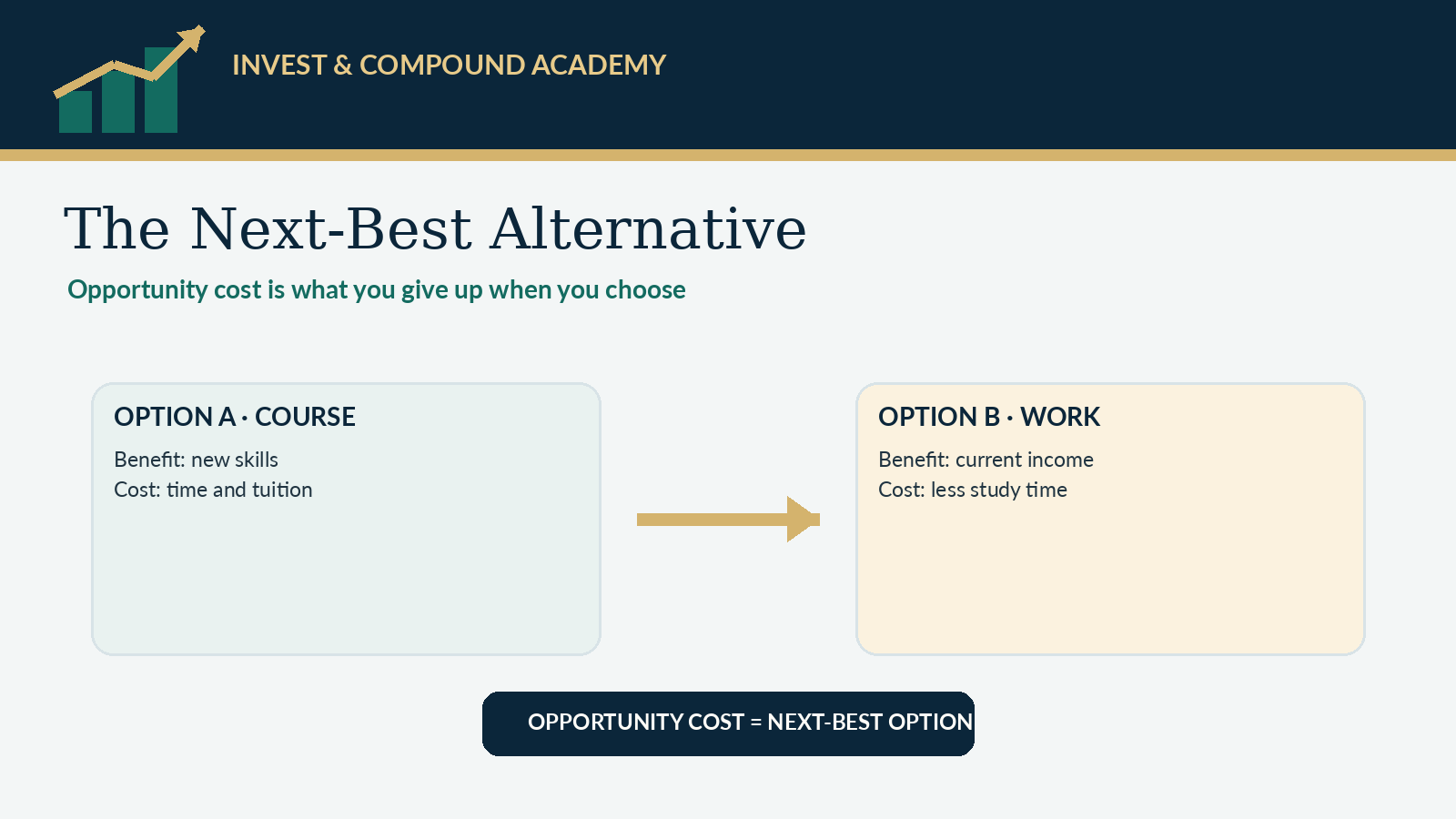
At 20 participants, fee revenue is $300, materials cost $100 and other session costs total $160, leaving $40. That number answers a narrow operating-budget question. It does not measure the complete social benefit. Participants may acquire useful skills, while the room might otherwise serve another valuable activity. Volunteers may contribute unpriced time.
If the course is free to participants, its real resource requirements do not disappear. Someone else must finance the expenditure or provide resources. If a sponsor pays, the distribution of payments changes. Economic analysis separates the financing arrangement from the resources used and the benefits generated. That separation makes the proposal easier to evaluate honestly.
18. Improve the example by examining assumptions
The calculation assumes materials cost the same per participant and the instructor can teach everyone effectively. If more than 20 participants require a second instructor, costs jump. If enrollment falls unpredictably, expected revenue becomes uncertain. If the course displaces another program, the alternative use of the room matters.
A practical evaluation would test several enrollment levels, identify capacity limits and consider ways to learn before committing. Advance registration could reduce uncertainty, although deposits might discourage some people from attending. Subsidized places might improve access but require funding. The best arrangement depends on the program’s objectives as well as its budget.
This is what economic thinking contributes: a structured comparison of feasible choices. The result is not necessarily a single recommendation. The analysis may reveal which information is missing, which assumptions drive the decision and which trade-offs require an explicit public judgment. Improving the quality of the question can be as valuable as producing a numerical answer.
19. What economics can help you understand
Ultimately, what is economics useful for? It helps readers interpret price changes, employment decisions, public budgets, market power and differences in living standards. It offers tools for evaluating whether an explanation is internally consistent, whether a comparison is appropriate and whether important behavioral responses have been omitted.
It can also help people recognize misleading simplifications. A higher salary may not mean greater purchasing power. A lower price may come with reduced quality. A policy that benefits the average resident may leave a vulnerable group worse off. A successful business may owe part of its performance to favorable conditions rather than management alone.
These insights are useful for citizens, workers, managers and investors. They do not require treating every relationship as a transaction. Instead, they encourage careful attention to consequences and alternatives. The goal is to understand how decisions fit together, including the valuable activities and responsibilities that market prices fail to capture adequately.
20. What economics cannot promise
Economics cannot eliminate uncertainty or provide exact forecasts for every outcome. People adapt, institutions change and unexpected events occur. An explanation can be useful even when it predicts a range of possibilities rather than a precise number. The strength of a claim should match the evidence and the purpose of the model.
It also cannot settle every ethical question through efficiency calculations. Deciding how to value rights, dignity, distribution or obligations to future generations requires broader reasoning. Economic analysis can clarify consequences and costs, but those calculations do not replace democratic deliberation or moral judgment.
Finally, studying economics does not guarantee investment success or make an individual immune to bias. The discipline itself contains disagreements and evolving evidence. A strong learner develops the habit of revising conclusions when assumptions fail or better information appears. Intellectual discipline is more valuable than confidence unsupported by a credible method.
21. Practice questions with explained answers
A community garden produces vegetables that volunteers share without selling them. Is this economic activity? Yes. Resources, labor and coordination produce something useful. The absence of a market payment does not eliminate the activity’s economic dimensions. Whether a particular statistical measure includes it is a separate measurement question.
A company raises its prices. Does that prove demand increased? No. Prices could change because of higher costs, a different product mix, reduced competition or a business decision under uncertainty. Establishing the cause requires evidence about relevant conditions and alternatives, rather than treating the observed price as a complete explanation.
A city can fund either a library extension or a road improvement. Does economics require choosing the project with the most revenue? No. Public benefits can include access, safety and time savings that are not collected as revenue. Evaluation should compare relevant benefits, costs and distribution while making value judgments explicit.
A worker accepts a low-paid position. Does that prove it was the worker’s preferred job among all possible jobs? No. The choice reflects the feasible options available, including qualifications, location, schedules and responsibilities. Observed behavior helps identify choices under constraints; it does not show that those constraints were desirable or unavoidable.
22. A practical method for your next economic question
Choose a question from daily life, such as whether a bus pass, training course or delivery service is worthwhile. Identify the decision maker and the objective. List feasible alternatives, then describe the resources each requires. Distinguish money payments from time and other costs. State the time period and any important uncertainties.
Next, ask who else is affected. Could their behavior change the result? Identify which claims are supported by evidence and which are assumptions. If you calculate a threshold, explain what it means and which omitted factors could change it. Avoid treating a spreadsheet output as more certain than its inputs.
Finish by stating what you learned and what remains unresolved. Returning to the question of what is economics, the practical answer is a disciplined way to examine choices, constraints and consequences. It helps explain how people, businesses and governments make decisions, how resources are allocated and why those decisions affect others. Perhaps one option is clearly preferable. Perhaps better information is needed. Perhaps the choice depends on how you value time, access or risk. Each is a useful outcome when the reasoning is transparent. This method prepares you for the more formal models introduced throughout the library.
Continue Learning with Invest & Compound Academy
Related Articles on This Topic
Explore the complete Economic Thinking chapter, return to its pillar guide, and move between all topics in this sequence.
References & Further Reading
- OpenStax — Principles of Economics
- International Monetary Fund — Micro and Macro
- OpenStax — Economic Theories and Models
- CORE Econ — The Economy 2.0
Explore the Earlier Market-Risk and Economic Pillars
Connect purchasing power with the twelve earlier pillars on business cycles, market declines, historical evidence and portfolio decisions.
Educational disclosure: This topic provides general economics education, not personalized financial, legal or tax advice. Its simplified examples illustrate reasoning and do not forecast actual outcomes. Applied decisions require relevant evidence and attention to individual circumstances and local institutions.