INVEST COMPOUND · ACADEMY
What Does the Federal Reserve Do and How Does It Work?
What does the Federal Reserve do? The Fed influences interest rates, credit conditions, inflation, employment, financial stability, and the broader economy—but it does not directly control every mortgage rate, stock price, or financial outcome.
What does the Federal Reserve do? At its core, the Federal Reserve is the central bank of the United States. It conducts monetary policy, promotes financial-system stability, supervises parts of the banking system, provides key payment services, and can provide liquidity during periods of financial stress.
Its decisions influence borrowing costs, deposit rates, bond yields, exchange rates, household spending, corporate investment, and asset valuations. But influence is not the same as direct control.
Understanding how the Federal Reserve works helps investors separate what the Fed actually decides from what markets, banks, businesses, and households do afterward.
What Does the Federal Reserve Do?
A central bank is not an ordinary commercial bank. You cannot open a checking or savings account at the Federal Reserve.
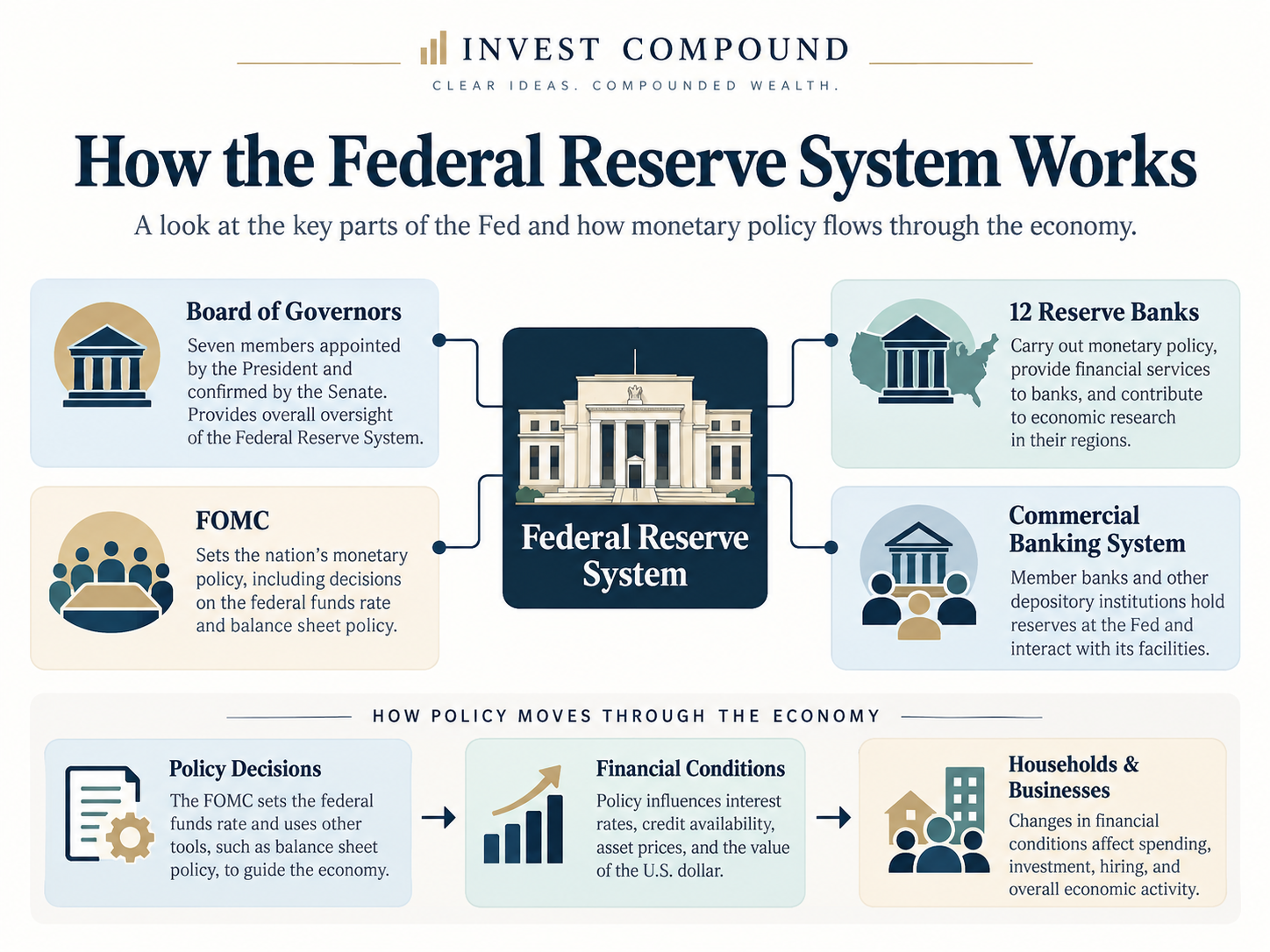
The Federal Reserve System was created in 1913 and combines a national governing structure with regional Reserve Banks.
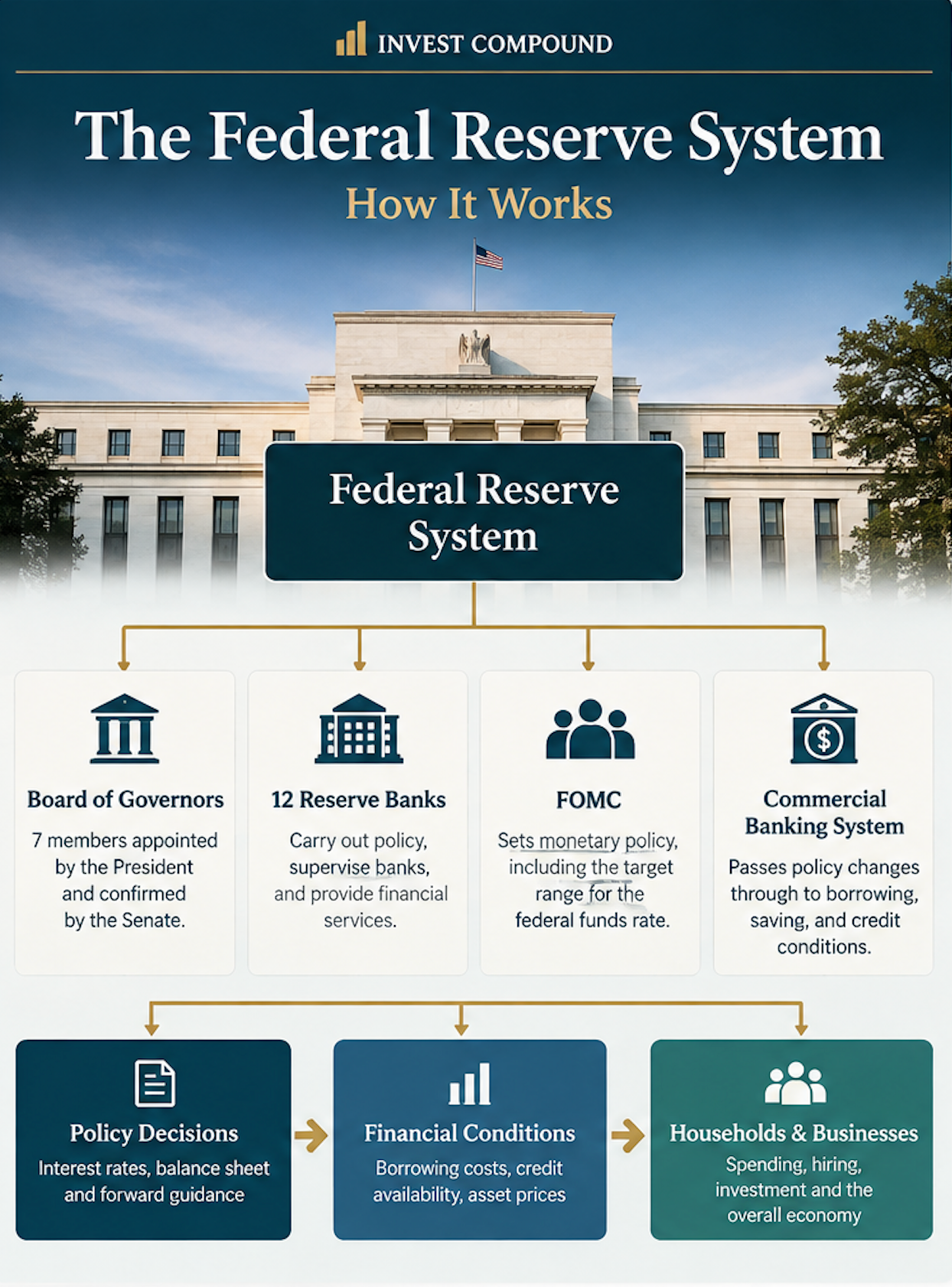
Its major components include:
- The Board of Governors: a federal agency based in Washington, D.C.
- 12 Federal Reserve Banks: regional institutions serving different parts of the United States.
- The Federal Open Market Committee: the FOMC, which determines the stance of U.S. monetary policy.
- Depository institutions and financial infrastructure: banks and other institutions interact with the Fed through reserves, payment systems, lending facilities, and other mechanisms.
The Federal Reserve’s Dual Mandate
Congress has given the Federal Reserve monetary-policy goals that are commonly summarized as a dual mandate:
- maximum employment, and
- stable prices.
The Fed’s longer-run inflation objective is expressed as 2% inflation. Monetary policy therefore involves balancing risks to both inflation and employment rather than responding mechanically to one economic statistic.
For example, if inflation remains too high while labour markets are strong, policymakers may judge tighter financial conditions to be appropriate.
If economic activity weakens substantially and inflation pressure moderates, policymakers may judge lower rates to be appropriate.
These decisions involve uncertainty because economic data describe a complex system with delays, revisions, and competing signals.
How the Federal Funds Rate Works
The Federal Reserve’s best-known monetary-policy tool is the target range for the federal funds rate.
The federal funds rate is an overnight interest rate in the banking system. The FOMC establishes a target range, and the Federal Reserve uses implementation tools to keep market rates consistent with that policy stance.
Changes in this short-term rate can influence:
- bank prime rates,
- variable-rate loans,
- lines of credit,
- deposit rates,
- money-market yields,
- bond-market expectations,
- currency values, and
- corporate financing conditions.
The Fed does not directly set every mortgage rate. Longer-term mortgage rates depend heavily on bond-market yields, expectations about future policy and inflation, credit risk, lender margins, and the structure of the specific loan.
This is why a 0.25 percentage-point change in the federal funds target does not guarantee an identical change in every mortgage or business loan.
Other Federal Reserve Monetary-Policy Tools
The policy rate receives the most attention, but understanding what the Federal Reserve does also requires knowing several other tools.
How the FOMC Makes Federal Reserve Decisions
Monetary-policy decisions are made by the Federal Open Market Committee.
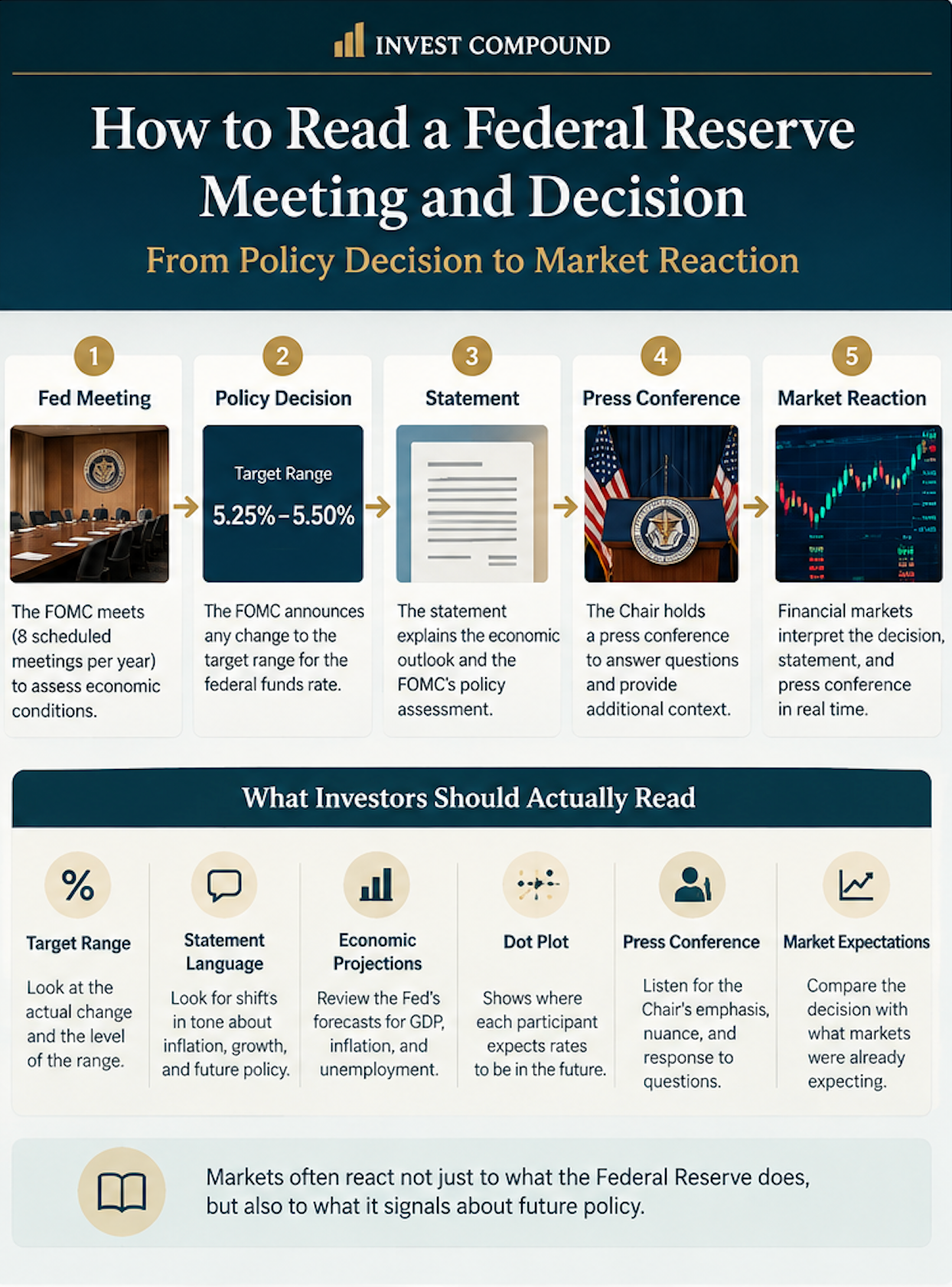
The FOMC normally holds eight scheduled meetings per year. Members review economic activity, employment, inflation, financial conditions, and risks to the outlook.
After a scheduled meeting, investors may receive several different pieces of information:
- the monetary-policy statement,
- an implementation note,
- a press conference,
- meeting minutes released later, and
- at selected meetings, a Summary of Economic Projections.
The famous dot plot forms part of those projection materials. It reflects individual participants’ assessments of appropriate future policy under their economic outlooks.
It is not a contractual promise and should not be interpreted as a guaranteed schedule of future interest rates.
Why Do Markets React to Federal Reserve Decisions?
Financial markets continuously price expectations about future interest rates, economic growth, inflation, and risk.
That means the market reaction to a Fed announcement often depends less on the headline decision than on the difference between expectations and reality.
A widely expected rate cut may produce little positive reaction if the accompanying statement suggests fewer future cuts than investors had anticipated.
Conversely, an unchanged rate can trigger a substantial market move if policymakers communicate a meaningfully different outlook.
Different assets also respond through different channels.
| Market | Possible Policy Connection |
|---|---|
| Stocks | Changes in discount rates, financing costs, expected earnings, and economic growth can affect valuations. |
| Bonds | Yields can respond quickly to policy expectations, inflation expectations, and changes in expected economic conditions. |
| U.S. Dollar | Relative interest rates and expectations can influence currency demand, although exchange rates reflect many additional forces. |
| Housing | Financing costs matter, but fixed mortgage rates are generally more closely connected to longer-term market yields than to the overnight policy rate alone. |
For a deeper explanation of the stock-market channel, read How Interest Rates Affect Stocks and Valuations .
How Federal Reserve Policy Moves Through the Economy
Monetary policy works through a transmission process rather than an immediate switch.
One useful simplified sequence is:
Policy decision → financial conditions → borrowing and saving → household and business decisions → economic activity → inflation and employment.
The effects do not arrive everywhere at the same time.
Imagine two companies with similar operations.
Company A has floating-rate debt.
Company B locked in fixed-rate financing for several more years.
After policy rates rise, Company A may experience higher interest expense relatively quickly.
Company B might initially feel the tightening through weaker customer demand rather than through its own debt payments.
The same Federal Reserve decision therefore reaches the two businesses through different channels and at different speeds.
This is one reason economists describe monetary policy as operating with lags.
A decision made today may continue affecting spending, hiring, financing, and prices long after the announcement itself disappears from the headlines.
Federal Reserve vs Bank of Canada
The Federal Reserve and the Bank of Canada are both central banks, but they operate within different institutional frameworks and economies.
The Federal Reserve conducts monetary policy for the United States.
The Bank of Canada conducts monetary policy for Canada and operates under an inflation-control framework agreed with the Government of Canada.
Canada currently targets total CPI inflation at the 2% midpoint of a 1% to 3% range.
The two central banks do not need to move policy rates at the same time or by the same amount.
Differences in inflation, employment, economic growth, housing markets, financial conditions, and currency movements can justify different policy paths.
Divergence between U.S. and Canadian rates can influence the U.S.-Canadian dollar exchange rate and cross-border financial conditions, but it does not provide a simple prediction of which country’s stock market will perform better.
Monetary Policy Is Not Fiscal Policy
One of the most important distinctions in understanding what the Federal Reserve does is separating monetary policy from fiscal policy.
Monetary policy concerns tools such as interest rates, liquidity conditions, central-bank asset holdings, and monetary-policy communications.
Fiscal policy concerns government taxation, spending, transfers, and public borrowing.
These policies interact, but they are not the same process and are not controlled by the same institutions.
It is also important to recognize the limits of monetary policy.
A central bank cannot directly manufacture oil, build houses, produce food, repair supply chains, or create semiconductor factories.
If inflation begins with a supply disruption, higher interest rates may restrain demand and inflation expectations, but they do not physically replace the missing supply.
This is why monetary-policy decisions can involve difficult trade-offs rather than a cost-free mechanism for controlling every source of inflation.
What Federal Reserve Decisions Mean for Households and Investors
A Fed announcement is most useful when translated into the contracts, cash flows, and risks you actually have.
Variable-Rate Borrowers
Borrowers with variable-rate debt may experience changes relatively quickly when market rates move.
Fixed-Rate Borrowers
A fixed-rate borrower may feel little immediate contractual effect but face a different rate when refinancing or renewing debt later.
Savers
Higher short-term rates can improve available yields on savings accounts, money-market instruments, and short-term fixed-income investments, although institutions decide how much of a policy change they pass through.
Bond Investors
Bond prices and yields respond to interest-rate expectations. Duration is particularly important when estimating sensitivity to changing yields.
See How Bonds Work for the broader mechanics.
Stock Investors
Stock valuations can respond to changing discount rates, earnings expectations, financing costs, and economic conditions.
But a Fed announcement should not automatically become a buy-or-sell signal.
Long-Term Investors
Asset allocation and diversification can reduce the need to correctly forecast every central-bank meeting.
See Asset Allocation Explained With Portfolio Examples .
Common Federal Reserve Misunderstandings
-
“The Fed directly sets mortgage rates.”
It does not. Mortgage pricing is influenced by broader financial markets, expectations, credit conditions, and lender pricing. -
“A rate cut means stocks must rise.”
No. The reason for the cut and what markets already expected both matter. -
“The dot plot is a promise.”
It is not. It summarizes individual policy assessments conditioned on economic outlooks. -
“The Fed controls inflation instantly.”
Monetary policy works through financial and economic channels with delays. -
“QE means the Fed hands newly created money directly to
households.”
Central-bank asset purchases and government fiscal transfers are different transactions. -
“A Fed meeting tells investors what the stock market will do
next.”
Markets reflect earnings, valuations, expectations, geopolitical risks, economic data, positioning, and many other variables.
Frequently Asked Questions About the Federal Reserve
What does the Federal Reserve do?
The Federal Reserve conducts U.S. monetary policy, promotes financial stability, supervises and regulates parts of the banking system, supports payment-system functions, and can provide liquidity under specified circumstances.
Who decides Federal Reserve interest-rate policy?
The Federal Open Market Committee determines the stance of monetary policy, including the target range for the federal funds rate.
How often does the FOMC meet?
The FOMC normally has eight regularly scheduled meetings each year. Additional meetings can occur when circumstances require them.
Is the Federal Reserve a private bank?
The Federal Reserve System has a distinctive public-private structure. The Board of Governors is a federal government agency, while the 12 regional Reserve Banks have a separate statutory structure. Reserve Bank stock held by member banks is not ordinary publicly traded corporate stock.
Can the Federal Reserve control the stock market?
No. Federal Reserve policy can strongly influence financial conditions, but stock prices reflect many forces beyond monetary policy.
What is the neutral interest rate?
The neutral rate is a theoretical interest rate consistent with an economy operating near balance without monetary policy deliberately stimulating or restraining activity. It cannot be directly observed and estimates are uncertain.
Does the Fed control inflation?
The Fed has powerful tools that influence demand, financial conditions, and inflation expectations, but inflation can also reflect supply shocks, fiscal developments, energy prices, productivity, global conditions, and other forces.
Should investors trade around FOMC meetings?
An FOMC meeting can create short-term volatility, but the market response depends on expectations and many other variables. For long-term investors, portfolio construction and risk management are generally more durable analytical tools than trying to predict one meeting’s reaction.
Key Takeaways
- The Federal Reserve is the central bank of the United States.
- Its monetary-policy goals focus on maximum employment and stable prices.
- The FOMC establishes the target range for the federal funds rate.
- The Fed also uses balance-sheet tools, administered rates, open market operations, communication, and liquidity facilities.
- Federal Reserve decisions influence loans, savings, bonds, stocks, currencies, and broader economic activity without directly controlling each of them.
- Markets react to the difference between a policy decision and prior expectations—not simply to whether rates went up or down.
- Monetary policy operates with delays and reaches different households and companies through different channels.
- Monetary policy and fiscal policy are separate systems with different tools and decision-makers.
- Understanding what the Federal Reserve does is more useful than treating every Fed meeting as a short-term trading signal.
LEARNING LAB · HYPOTHETICAL
Interest-Rate Sensitivity Calculator
Estimate how a change in annual interest rate could affect the yearly interest cost on a hypothetical balance.
Educational illustration only. This simplified calculation assumes the full balance is exposed to the entered annual rate for one year. It does not model amortization, compounding, lender spreads, payment schedules, taxes, fees, or contractual terms.
Continue Learning in the Invest & Compound Academy
Explore related guides to monetary policy, inflation, market mechanics, and investing.
Monetary policy and financial markets
Rates and stocks | Inflation and real returns | Bond fundamentals | Bond prices and rates | Portfolio allocation
Sources and Further Reading
- Federal Reserve – About the Federal Reserve System
- Federal Reserve – Federal Open Market Committee
- Federal Reserve – Monetary Policy
- Federal Reserve – FOMC Meeting Calendars
- Bank of Canada – Monetary Policy
