INVEST COMPOUND · ACADEMY
Inflation and Investing With Real Return Examples
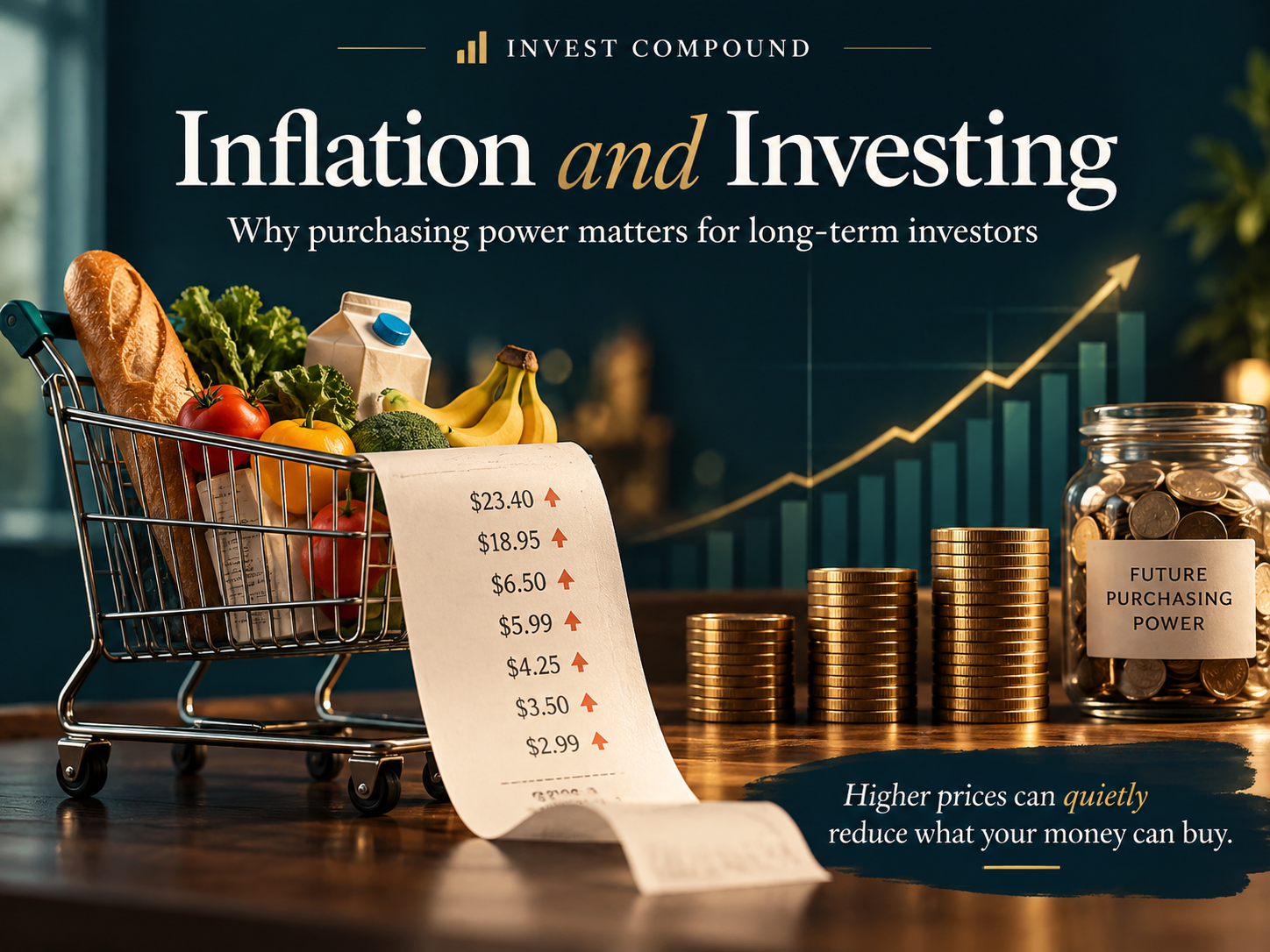
Inflation and investing meet in one practical question: will the money you accumulate preserve enough purchasing power to pay for the things you actually need in the future?
Inflation and investing are connected through purchasing power. A portfolio can grow in dollar terms and still fail to improve your financial position if prices rise faster than the value of your investments.
For that reason, successful long-term planning should not ask only, “How much money will I have?” It should also ask, “What will that money actually buy?”
Understanding inflation and investing means distinguishing nominal returns from real returns, recognizing that different assets respond differently to inflation, and building financial assumptions around the expenses your portfolio eventually needs to support.
Inflation and Investing: The Essentials
Inflation describes a sustained increase in the general price level of goods and services.
Consumer price indexes measure changes in the cost of representative baskets rather than the exact expenses of any one household. Different inflation indexes can also use different baskets, weights, and methodologies.
The practical consequence for investors is straightforward: money loses purchasing power when prices increase.
If prices rise by 3% in one year, something that costs $100 today would, in a simplified example, cost approximately $103 one year later.
Compounded across decades, even modest inflation can substantially change the amount required to fund a future goal.
Nominal Return vs Real Return
This distinction is at the heart of inflation and investing.
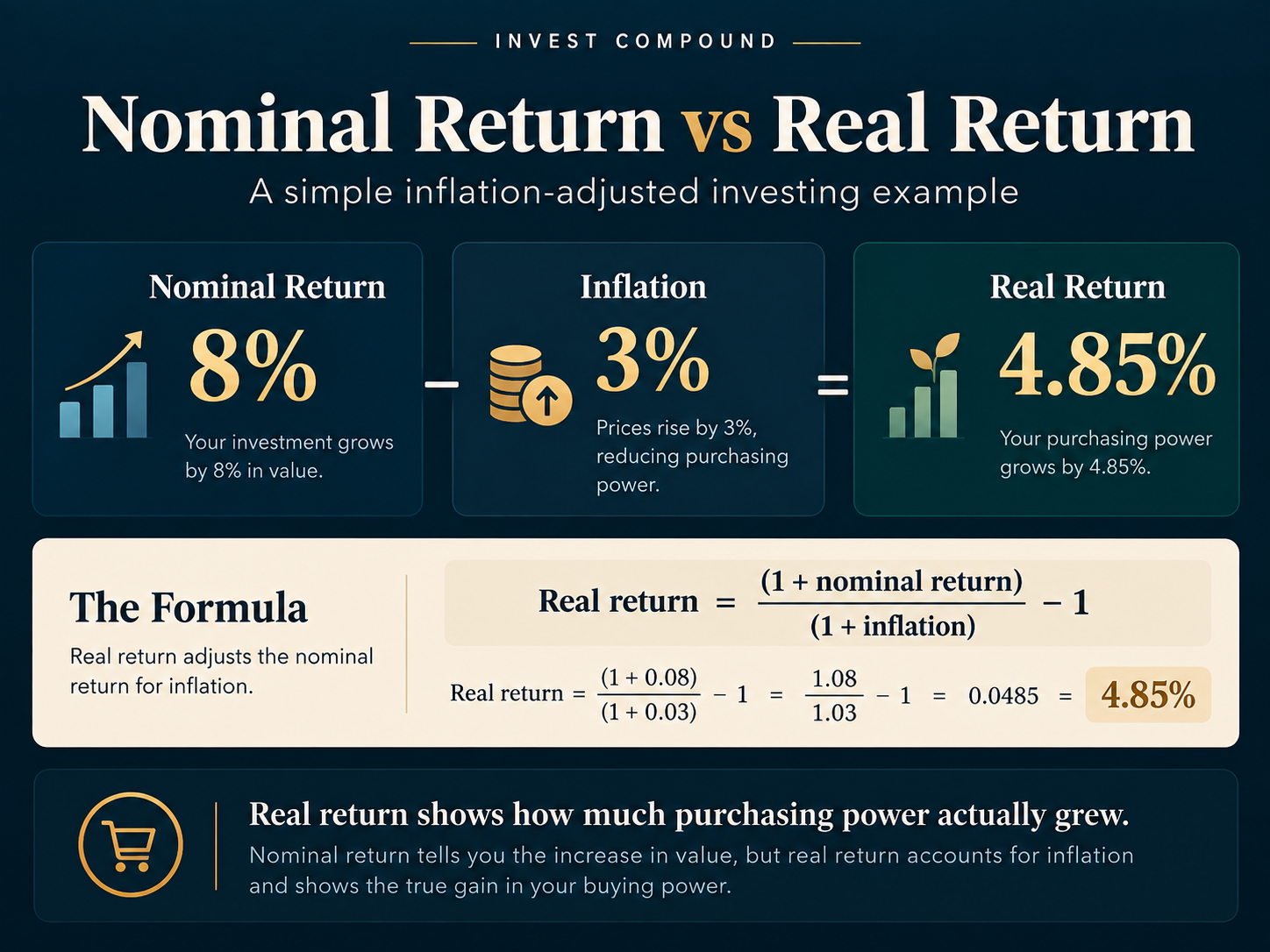
Nominal return is the return you observe before adjusting for inflation.
Real return measures the change in purchasing power after accounting for inflation.
Real Return = [(1 + Nominal Return) ÷ (1 + Inflation Rate)] − 1
Simply subtracting inflation from the nominal return provides a useful approximation when the percentages are relatively modest, but the formula above is mathematically more precise.
For example, a nominal investment return of 8% with inflation of 3% does not produce an exact real return of 5%.
Using the formula:
1.08 ÷ 1.03 − 1 ≈ 4.85%
Your account increased by 8% in dollar terms, but your purchasing power increased by approximately 4.85%.
A Purchasing-Power Example
Consider $20,000 held in an account earning 1% per year for ten years.
Ignoring taxes and fees, the nominal balance would grow to approximately $22,100.
That appears to be progress.
But if inflation averaged 3% annually during the same decade, something costing $20,000 today would cost roughly $26,900 after ten years.
The saver would therefore have more dollars but less purchasing power relative to the original $20,000.
This example demonstrates why an investment return should not be judged only by whether the account balance increased.
This is also why inflation and investing should be evaluated together when measuring long-term financial progress.
How Inflation Affects Different Investments
Inflation does not affect every asset class in the same way, and no investment provides perfect protection in every inflationary environment.
The relationship between inflation and investing also differs across cash, bonds, equities, real estate, commodities, and inflation-linked securities.
| Asset | Potential Inflation Impact | Important Considerations |
|---|---|---|
| Cash | Purchasing power can decline when after-tax interest is below inflation. | Cash still plays an important role for emergencies and near-term obligations. |
| Bonds | Fixed payments can lose purchasing power as prices rise. | Longer-duration bonds can also experience meaningful price declines when market yields rise. |
| Stocks | Businesses can sometimes increase prices and grow nominal earnings. | Higher costs and interest rates can still compress margins and valuations. |
| Real Estate | Rents and property values can sometimes increase with broader price levels. | Higher mortgage rates, financing costs, maintenance, and local conditions also matter. |
| Commodities | Some commodities can rise sharply during inflationary periods. | Returns can also be volatile and unpredictable over shorter periods. |
| Inflation-Linked Bonds | Contractual values are linked to a specified inflation index. | Market prices can still move, and the reference index may not match your personal spending. |
Which Investments Can Help During Inflation?
There is no single investment that reliably wins whenever inflation is high.
Different inflation episodes are associated with different economic conditions, interest-rate environments, starting valuations, and market expectations.
Broad Equity Exposure
Over long periods, ownership of productive businesses can provide an important source of real growth because companies can expand, reinvest, develop new products, and sometimes increase prices.
But stocks can perform poorly during periods of unexpectedly high inflation, particularly when inflation leads to sharply higher interest rates or weaker profit margins.
Inflation-Linked Bonds
Inflation-linked securities are designed to provide contractual adjustments based on a specified inflation index.
In the United States, Treasury Inflation-Protected Securities, or TIPS, link principal adjustments to inflation measures specified by the U.S. Treasury.
That does not mean their market price cannot decline. Changes in real yields, maturity, and purchase price still affect investor results.
Real Assets
Real estate, infrastructure, commodities, and commodity-sensitive businesses may provide partial exposure to prices that increase during some inflationary periods.
They also carry risks unrelated to inflation and should not be treated as guaranteed hedges.
Companies With Pricing Power
Businesses capable of raising prices without losing large numbers of customers may be better positioned to absorb rising input costs.
Pricing power, however, depends on competition, customer alternatives, regulation, contracts, and the economic environment.
Disinflation Is Not the Same as Deflation
This distinction causes considerable confusion.
Disinflation means inflation is slowing.
Deflation means the general price level is declining.
Imagine a service costs $100 and then rises 8% to $108.
The following year, inflation for that service slows to 2%.
Its price becomes: $110.16
Inflation slowed dramatically, but the price did not return to $100. It increased again—just at a slower rate.
This matters for investment and retirement planning because a lower inflation rate does not automatically reverse the purchasing-power loss created by earlier price increases.
Your Personal Inflation Rate Can Differ From CPI
Headline inflation indexes describe broad populations. Your household has its own spending pattern.
A renter, homeowner, retiree, parent with child-care costs, student, or commuter can experience very different changes in annual expenses.
Imagine annual spending of $40,000:
- $16,000 housing
- $8,000 food
- $6,000 transportation
- $10,000 other expenses
Suppose housing rises 5%, food 4%, transportation 2%, and other expenses 2%.
The increases are approximately:
$800 + $320 + $120 + $200 = $1,440
Relative to the original $40,000 budget, that household experienced an illustrative spending increase of about 3.6%.
The objective is not to create your own official inflation statistic. It is to make sure long-term financial assumptions reflect the expenses your investments will actually need to support.
Calculate Real Return After Tax
Taxes can further reduce purchasing-power growth.
Suppose a taxable savings account earns 4%, an assumed marginal tax rate on interest is 30%, and inflation is 3%.
Under a simplified annual-tax assumption:
After-tax nominal return: 4% × (1 − 0.30) = 2.8%
Exact real return:
1.028 ÷ 1.03 − 1 ≈ −0.19%
The account earned interest in dollar terms, yet its inflation-adjusted purchasing power fell slightly.
Inflation and Retirement Planning
For long-term goals, inflation and investing become especially important because even modest annual price increases compound over decades.
Inflation becomes particularly important when a financial goal extends across decades.
A retiree requiring $50,000 of annual spending today would need a larger nominal amount in the future simply to maintain similar purchasing power.
At a hypothetical constant 2% inflation rate, $50,000 of spending grows to roughly $67,300 after fifteen years.
At 3%, the required amount would be higher still.
Retirement planning therefore benefits from expressing goals both in future nominal dollars and today’s purchasing power.
Asset allocation also matters. See Asset Allocation Explained With Portfolio Examples .
Inflation Can Raise Revenue and Still Reduce Profit
It is tempting to assume that businesses can simply raise prices whenever their costs rise.
In reality, customers can reduce purchases, switch competitors, delay spending, or reject higher prices.
Imagine a company with:
Revenue: $100 million
Costs: $90 million
Profit: $10 million
Now assume revenue rises 5%, while costs rise 8%.
Revenue becomes: $105 million
Costs become: $97.2 million
Profit falls to: $7.8 million
Revenue increased, but profit declined.
This is why inflation analysis should consider margins, financing costs, customer behaviour, and cash flow—not just sales growth.
Inflation can also lead to higher interest rates, which can affect stock valuations. See How Interest Rates Affect Stocks and Valuations .
Read the Actual Promise of Inflation-Linked Investments
An investment described as “inflation protected” should still be examined carefully.
Ask:
- Which inflation index is used?
- How is the adjustment calculated?
- When does the adjustment occur?
- What happens if the security is sold before maturity?
- Can its market price decline?
- What fees apply if the exposure is held through a fund?
- How is the investment taxed?
The reference index may also differ substantially from your own household spending.
For broader bond fundamentals, see How Bonds Work .
Practical Ways Investors Can Respond to Inflation
The objective is not to predict next month’s inflation report. It is to build a financial plan that can tolerate a range of inflation outcomes.
- Own productive assets for long-term goals. Diversified equities can provide long-term growth potential, although short-term performance can be volatile.
- Keep appropriate liquidity. Emergency savings can be necessary even when their real return is unattractive.
- Match assets to the time horizon. Near-term obligations should not depend on selling volatile assets at a favourable price.
- Compare after-tax returns. A headline yield is not the same as usable purchasing-power growth.
- Keep fees under control. Fees subtract from returns before those returns can offset inflation.
- Increase contributions over time. A fixed contribution can become less meaningful as income and prices rise.
- Use multiple inflation assumptions. Long-term projections should not pretend one future inflation rate is certain.
A sound approach to inflation and investing focuses on purchasing power, diversification, taxes, fees, and time horizon rather than trying to predict every inflation report.
Common Inflation and Investing Mistakes
- Judging investment success using nominal returns alone.
- Assuming cash is risk-free without considering purchasing-power risk.
- Putting long-term money entirely into cash because market prices are volatile.
- Buying commodities or gold aggressively after they have already risen sharply.
- Assuming every stock automatically protects against inflation.
- Ignoring taxes when comparing yields.
- Confusing falling inflation with falling prices.
- Using the headline CPI rate as if it exactly matched personal expenses.
- Ignoring inflation when estimating retirement or education costs.
Frequently Asked Questions About Inflation and Investing
How does inflation affect investments?
Inflation reduces the purchasing power of future dollars. Different investments respond differently because inflation can affect interest rates, business costs, consumer demand, bond payments, asset values, and required investment returns.
What is the difference between nominal and real return?
Nominal return measures investment growth before adjusting for inflation. Real return adjusts that result for inflation and therefore gives a better indication of how purchasing power changed.
Is cash safe from inflation?
Cash is generally stable in nominal terms, but its purchasing power can decline when inflation exceeds the after-tax interest earned. Cash can still be appropriate for emergency savings and near-term spending.
Are stocks a good inflation hedge?
Stocks have historically provided long-term growth potential, but they are not a reliable short-term hedge against every inflation episode. Inflation can raise costs, interest rates, and discount rates, which can hurt both earnings and valuations.
Is gold a reliable inflation hedge?
Gold has performed well during some inflationary periods and poorly during others. Its short- and medium-term results can be highly variable, so it should not be viewed as guaranteed inflation protection.
Do TIPS always outperform ordinary bonds when inflation is high?
No. Relative performance also depends on inflation expectations already embedded in market prices, changes in real yields, maturity, and the price paid for each security.
Does lower inflation mean prices are falling?
No. Lower positive inflation means prices are increasing more slowly. A broad decline in the general price level is deflation.
Key Takeaways
- Inflation reduces purchasing power even when the number of dollars in an account remains unchanged.
- Real return is more informative than nominal return when evaluating long-term purchasing-power growth.
- Cash, bonds, stocks, real estate, and commodities respond differently to inflation.
- No single asset provides perfect protection against every inflation environment.
- Your household’s inflation experience can differ from a broad consumer price index.
- Taxes and investment fees can further reduce real returns.
- Disinflation means prices are rising more slowly; it does not mean previous price increases have reversed.
- Long-term planning should compare future investment values with the future cost of the goals those investments are intended to fund.
The key to understanding inflation and investing is to focus on real purchasing power rather than nominal account balances alone.
LEARNING LAB · HYPOTHETICAL
Real Return and Purchasing Power Calculator
Enter a nominal return, inflation rate, and starting amount to compare nominal growth with inflation-adjusted purchasing power.
Educational illustration only. The calculation assumes constant annual rates and excludes taxes, fees, contributions, withdrawals, and other real-world factors. Inflation and investment returns vary over time.
Continue Learning in the Invest & Compound Academy
Explore the relationship between inflation, purchasing power, portfolio decisions and long-term investing.
Inflation, rates and purchasing power
Interest rates and stocks | Compound interest | Asset allocation | How bonds work | Bond prices and rates | ETF portfolio construction
Sources and Further Reading
- Federal Reserve – Inflation and the 2% Goal
- Bank of Canada – Inflation
- TreasuryDirect – Treasury Inflation-Protected Securities
